



Harnessing the wind to power the UK









China keen to learn from British example
Angus McNeice reports from the part-Chinese-owned Dudgeon wind farm off the east coast of England on a technology that is being mastered in the UK but coveted by China
It’s 10:30 am on a weekday morning in March, and the United Kingdom is generating 40.2 gigawatts of electricity to serve the needs of 65 million people.
That’s enough energy to power 4 billion LED bulbs, or run a microwave on medium for every person in the country.
Twenty years ago, around half of that electricity would have been produced by burning coal. But a revolution is occurring in the way Britain generates power - and China is paying close attention.
Through the combination of two old technologies - the windmill and the generator - engineers have made it possible to harness the energy of the wind, both on land and at sea, where it’s strongest.
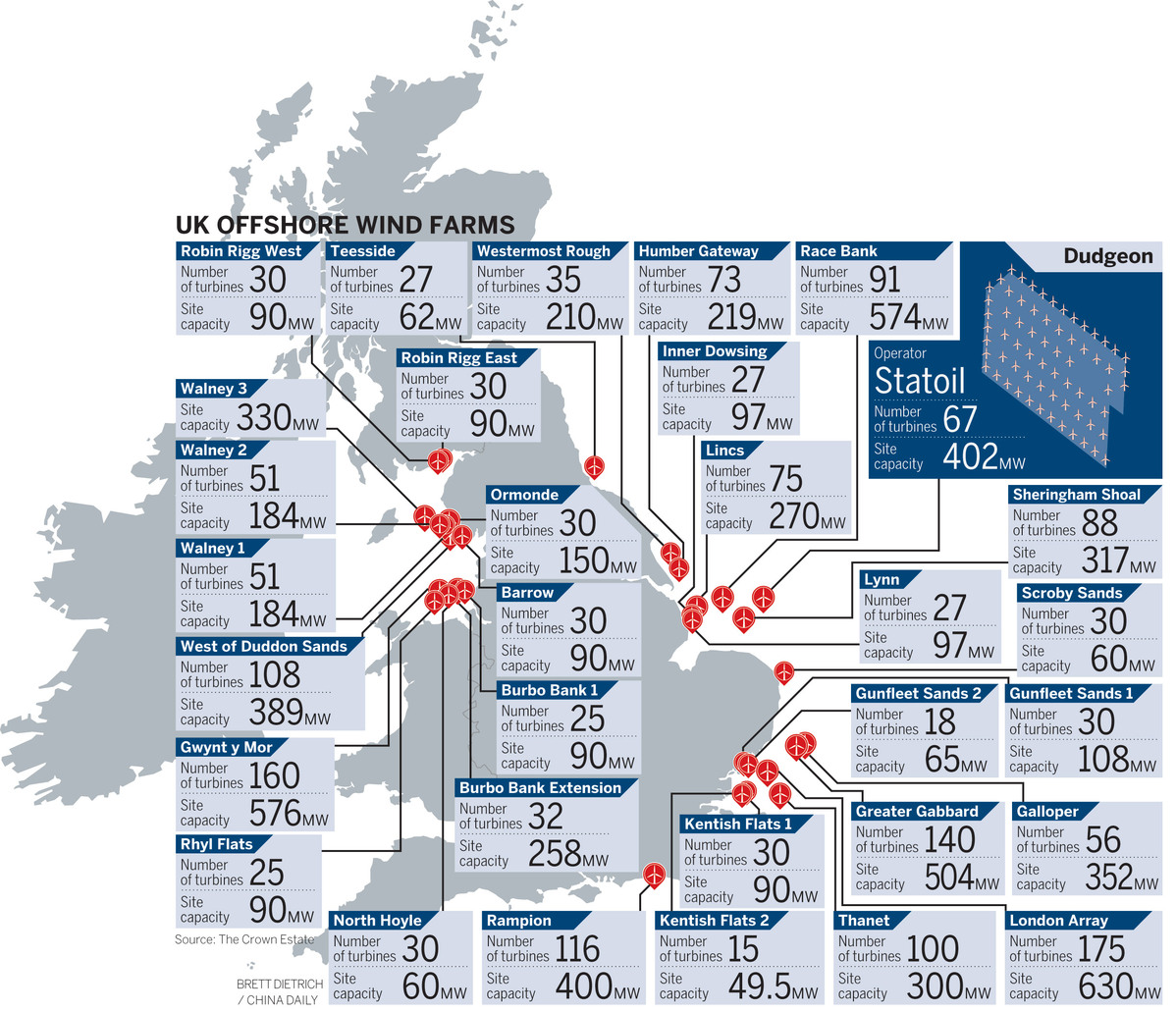
The UK is a world leader in offshore wind, with a total of 5.3 gigawatts of installed offshore wind capacity, which is more than one third of the global total of 14.4 gigawatts.
On that March morning, wind farms supplied 14.5 percent of Britain’s energy need - triple the amount supplied by coal.
A portion of that was produced by 67 turbines that slice through the sea air at the newly-built Dudgeon wind farm, 35 kilometers off the coast of Norfolk, England.
China cashes in on Dudgeon
One of the most recent offshore wind farms to go into operation in the UK, Dudgeon is owned by three companies: Hong Kong-headquartered China Resources, Norwegian oil and gas company Statoil, and Masdar, an energy company from the United Arab Emirates.
State-owned China Resources bought 30 percent of the wind farm for 555 million pounds ($782.8 million) in December last year.
Undergoing its own renewable energy revolution, China plans to install 5 gigawatts of offshore wind capacity by 2020. Chinese wind companies are looking to learn from the Northern European operators that have made a success of the technology.
After three years of construction, the 402-megawatt Dudgeon wind farm now provides enough energy to power 410,000 homes.
A project of this size would have been impossible in the 1980s, when the first offshore wind turbines were constructed. Now the technology is efficient enough to bring the cost of wind energy in line with many conventional means of generation.
“Development is happening at such a fast pace that even the turbines we have are already out of date compared to the ones that are starting new projects,” said Harriet Green, a senior mechanical engineer at Statoil.
“That’s why I chose to work in wind,” she said. “The industry is developing so quickly at the moment. Unlike oil and gas that have been around for so long and are set in their ways - wind is a pioneering area.”
Green is qualified in a range of renewable energy systems after completing a Master's degree at the University of Surrey in 2012.
Perhaps paradoxically, the company's 45 years of experience in gas and oil exploration gives Statoil a huge head start when it comes to building renewable energy infrastructure.
How to run a wind farm
An offshore wind farm is a massive operation involving enormous machinery and specialized vessels.
At Dudgeon’s operations base in Great Yarmouth, dozens of mechanical and electrical engineers work alongside weather experts and control room staff.
At sea, maintenance staff work alongside cooks and medics on board the Esvagt Njord, an 84-meter vessel specially built to service the turbines. The crew is on the water day and night, docking briefly every two weeks for shift rotation and to restock.
“When they come to shore and switch off, they really switch off, they are hard to contact,” said Emil Orderud, Dudgeon operations manager. “When they come back, we need them to switch on again, so we do a lot of reinduction work.”
Accidents involving death and serious injury occur on offshore wind farms around the world each year, so safety training is a primary concern for Orderud.
“Sometimes we play on emotions, reminding them of their loved ones at home,” he said.
Orderud will use props, bringing in objects like cable breakers that have fallen at construction sites, to remind workers of potential hazards. He also screens a health and safety video that Statoil produced in the 1980s, starring Monty Python actor John Cleese.
As well as the core team, Statoil hires a range of subcontractors - from bomb disposal experts to archaeologists.
There is a resident ornithologist conducting a three-year study of the Sandwich tern, a sea bird that breeds in the area. Statoil’s marine license requires them to monitor the birds’ movement in and around the farm.
When Statoil first established the site, they hired exploration teams to scour the seabed for World War II bombs offloaded by pilots flying across the North Sea, as well as warplanes that had crashed into the water. At Dudgeon, three bombs were detonated by a demolition unit, and several planes were marked and registered as war graves.
Statoil also hired a team of archaeologists to study a Saxon grave unearthed while constructing the power line that runs from the turbines to an onshore service station, 85 kilometers inland at Necton where the farm is connected to the National Grid.
The power line runs through 57 different properties, each requiring their own contract negotiated by Hannah Mary Goodlad, Dudgeon’s stakeholder and environmental manager.
“With the grave we had to come forward with the findings, which will be published next year,” said Goodlad. “It’s full of several tens of bodies and relics. And a lot of the objects that were found will belong to the land owners, so there are lots of negotiations.”
The Dudgeon operation is complex but the objective is simple - keep the turbines moving. Every second the blades don’t spin, money is lost and turbines are potentially damaged.
As the rotors are so heavy, a stationary turbine will cause “stand still marks” and dents in the turbine’s bearings. Maintenance teams will work on each turbine three or four times a year to conduct routine service work and repair faults.
Driving down operation and maintenance costs is at the center of the arms race between turbine manufacturers.
“In the future, the absolute ideal is maintenance free-turbines,” said Green. “I don’t think we are ever likely to get there, though with robotics and digitalization it could be that we don’t need, as human beings, to go out there anymore.”
Statoil is looking into the use of both aerial and underwater drones to conduct blade and foundation inspections.
And 1,000 kilometers north of Dudgeon, off the coast of Peterhead in Scotland, Statoil’s most significant contribution to wind farm innovation is already up and running.
The future floats
Hywind is the world’s first floating wind farm, consisting of five foundationless turbines, controlled from the operations base in Great Yarmouth.
The United Kingdom benefits from a shallow continental shelf, so a large vessel known as a jack-up can be used to construct foundations on the seabed that support turbines. In deeper water - anything more than 70 meters - foundations can’t be laid.
Turbines that are anchored by floating structures instead of foundations open up previously inaccessible waters to offshore wind farms.
“Hywind technology allows us to chase deeper waters and higher winds, and we are really excited about that,” Goodlad said. “The global potential of that technology is huge.”
China currently has 1.6 gigawatts of installed offshore capacity, with plans to install a further 5 gigawatts by 2020.
Finding ideal locations for farms in terms of wind speed and water depths is a challenge.
Favorable spots off the coast of Hebei, Zhejiang, Fujian and Guangdong provinces, are already being exploited.
But floating farms may soon come to Chinese waters. The Chinese government has supplied a grant to researchers from Dalian University in China and the University of Exeter in England to explore the use of the technology.
“The China Sea is potentially the largest offshore energy market in the world with up to 500 gigawatts of capacity, a third of which is only exploitable with floating installations,” said Bing Chen, a researcher from Dalian University who co-leads the project.
Link ups with British institutions will be key if China is to become a force in offshore wind, says Yingzhuo Du, vice-president of one of China’s largest wind energy companies, Tus-Energy.
“After a dozen years of rapid growth, China today manufactures and installs half of all onshore wind turbines in the world,” said Du.
“We are now at the start of such a journey in offshore wind, and there is no better place to learn than from the extensive experience and expertise of UK innovators.”




















