



China sends twin BeiDou-3 navigation satellites into space









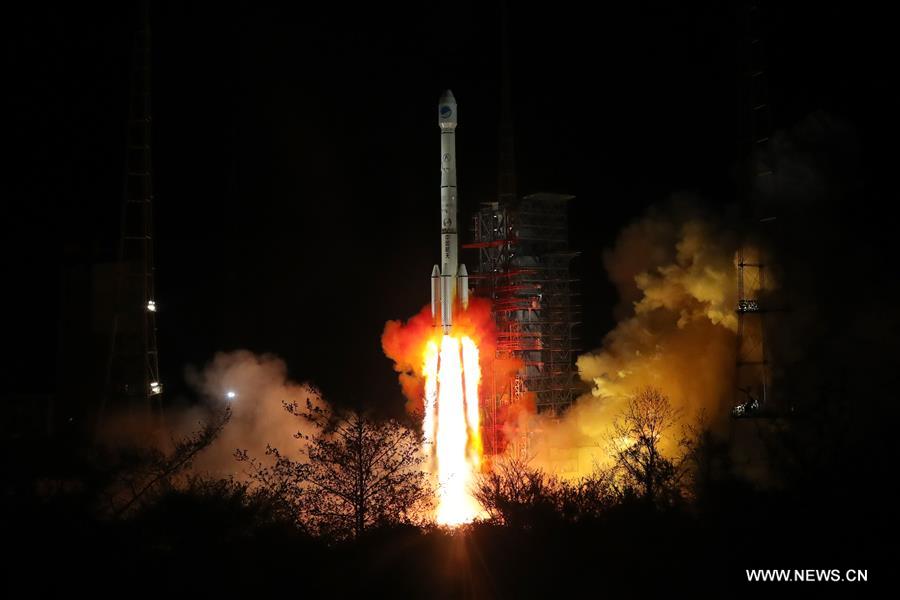
XICHANG — China on Friday sent twin satellites into space with a single carrier rocket, adding two more members for its domestic BeiDou Navigation Satellite System (BDS).
The Long March-3B carrier rocket lifted off from Xichang Satellite Launch Center in southwest China's Sichuan Province at 1:56 a.m. The launch was the 269th mission for the Long March rocket family.
The twin satellites are coded as the 30th and 31st satellites in the BDS.
They entered orbit more than three hours after the launch and will work together with six previously launched BeiDou-3 satellites once they pass a series of tests.
The satellites and the rocket for Friday's launch were developed by the Innovation Academy for Microsatellites at the Chinese Academy of Sciences and China Academy of Launch Vehicle Technology, respectively.
Named after the Chinese term for the Big Dipper, the BeiDou system started providing independent services over China in 2000 and will serve countries along the Belt and Road by the end of 2018.
By around 2020, when the BDS goes global, it will have more than 30 satellites.


- Interwoven communities in China foster cultural unity and development, says national political adviser
- AI revolutionizes education: from uniformity to personalized learning, says national political adviser
- Fisheries research base in Chongqing conserves rare fish species
- Cross-Strait youth exchanges pave the way for a brighter future, says national political adviser
- 'That's what we're for': NPC deputy on solving people's real concerns
- Spring scenery in Kunming, Yunnan





