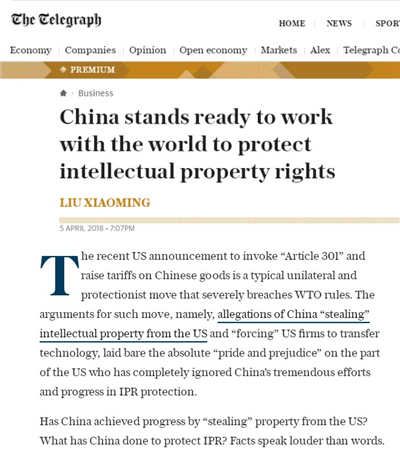
The Daily Telegraph Publishes a Signed Article by Abassador Liu Xiaoming Entitled Through Open Cooperation, We Can Protect Intellectual Property Rights










On 6 April 2018, the Daily Telegraph and its website published a signed article by Ambassador Liu Xiaoming entitled Through Open Cooperation, We Can Protect Intellectual Property Rights. The full text is as follows:
The recent US announcement to invoke "Article 301" and raise tariffs on Chinese goods is a typical unilateral and protectionist move that severely breaches WTO rules. The arguments for such move, namely, allegations of China "stealing" intellectual property from the US and "forcing" US firms to transfer technology, laid bare the absolute "pride and prejudice" on the part of the US, which has completely ignored China's tremendous efforts and progress in IPR protection.
Has China achieved progress by "stealing" property from the US? What has China done to protect IPR? Facts speak louder than words.
As a 5,000-year-old civilisation that has famously contributed, among numerous ideas and innovations, the "four great inventions", a phrase coined by British sinologist Joseph Edkins to refer to paper-making, the compass, gunpowder and movable-type printing, China has continued to make major breakthroughs in innovation in modern times. Since the founding of the New China, especially since reform and opening up, China has contributed most notably artemisinin (anti-malaria medicine), synthetic insulin and hybrid rice, and is leading the world in the new round of scientific revolution featuring artificial intelligence, electric vehicles and 5G communication technology.
According to a recent report issued by the World Intellectual Property Organization (WIPO), China was the second largest source of international patent applications filed in 2017 under WIPO's Patent Cooperation Treaty and was expected to overtake the US, which was the largest, within three years. The same report listed two Chinese technology companies, Huawei and ZTE, as the top filers of international patent applications in 2017. Within China, the State Intellectual Property Office received nearly 1.4 million applications for invention patents in 2017, outnumbering the US, Japan, the ROK and Europe combined. These facts and figures speak loud and clear: China is becoming a world leader in scientific and technological innovation.
Such a level of innovative outcomes could not have been possible without stringent and robust efforts in IP protection. Following a complete and systematic legal revisions around the time of its accession to the WTO in 2001, China has established a full-fledged system of domestic IPR laws and regulations that conforms to both international practice and China's national conditions.
Further improvements in judicial safeguards are made in recent years, with the establishment of the intellectual property courts in Beijing, Shanghai and Guangzhou, and the specialised IP tribunals in 15 cities. Public awareness of IPR has been notably increased, evidenced by over 210,000 first instance court cases and over 40,000 administrative cases last year involving IP disputes and patent enforcement respectively. In 2017, China paid $28.6 billion in intellectual property royalties to overseas rights owners, up from $1.9 billion dollars in 2001 when China joined the WTO.
At the annual sessions of the National People's Congress and the Chinese People's Political Consultative Conference, the decision was made to restructure the State Intellectual Property Office in order to improve the IP management system. Furthermore, the process of amending the Patent Law will be accelerated, which will step up legal measures against IPR infringement by introducing punitive damages. This will be conducive a pro-innovation and business-friendly environment in China where foreign and domestic companies receive equal IP protection.
Of course, no country is perfect and China is no exception. It has its problems, such as the immature system, insufficient protection and inefficient punishment measures. But these "growing pains" will be addressed gradually as China continues to develop.
Globalisation and economic interdependence are irreversible, which means "closing the door" and conversion to protectionism is not a winning path. In IP protection, countries should also be open to cooperation, and this is exactly what China is. After being a member of WIPO for nearly 30 years, China welcomed the opening of a WIPO office in Beijing in 2014. China actively promoted IP protection under the framework of the Belt and Road Initiative and within the BRICS. Several days ago, China and its BRICS partners, namely, Brazil, Russia, India and South Africa, signed the Joint Statement on Strengthening Intellectual Property Cooperation to boost progress of IP development and protection in emerging economies. China also holds regular dialogues on IP protection with the UK, EU and US, and signed the Patent Prosecution Highway agreement with over 20 countries and regions.
These are a few highlights of China's active efforts to build a more balanced, universally beneficial and inclusive global intellectual property system.
The US allegation of "forced technology transfer" is an excuse that clearly has in mind suppressing scientific innovation in China and protecting US domestic industries. This is the complete opposite to the Chinese traditional wisdom that "to establish oneself, one should help others establish themselves; to achieve success, one should help others succeed".
Moreover, this allegation is totally wrong. The fact is, there is not a single provision in Chinese laws that says foreign companies must transfer technology to their Chinese partners.
Moreover, China has taken firm actions against IPR infringements and never tolerated "force" technology transfers. The deals between Chinese and American companies are commercial actions and independent decisions of the companies involved after consultations on an equal basis. They are completely in line with business and market principles, and they have created huge job opportunities for the US.
America is good at innovation but America does not hold the exclusive "patent" on innovation. The past 40 years of reform and opening up in China have seen the country highly integrated with the world and supplying the global market with goods that are not only "made in China" but also "created in China" and "innovated in China". China's economy is in a transition from high-speed to high-quality growth, with an emphasis on innovation, which has been an enabling force behind China's remarkable progress in IP protection.
While pursuing an innovation-driven development strategy, which naturally leads to better IP protection, China is open to cooperation with like-minded partners including the UK and EU. There is a high-degree of complementarity and broad prospect for cooperation between China and the UK, and between China and the EU on creative industry, and current cooperation on IP protection has produced notable results in terms of legislation, policies, data exchanges, IT tools and personnel training.
China stands ready to work with the world to uphold open cooperation and protect IPR, with a view to delivering the benefits of scientific and technological innovation to everyone.