



Trump's high-tech game will hurt US too









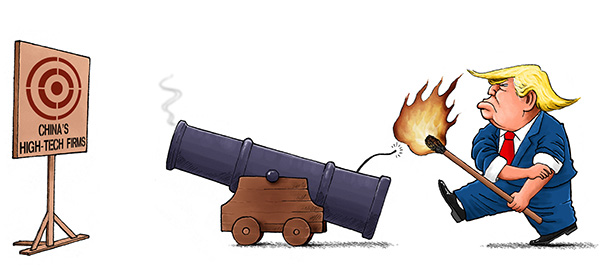
On Monday, the US Department of Commerce imposed a seven-year ban on ZTE Corp's purchase of crucial US technologies, components and parts, and commodities, including chips, for its alleged violation of the terms of a sanctions settlement.
The move further intensified the already fierce trade frictions between the world's two largest economies. Given that the US ban will last until March 13, 2025, the full extent of the Made in China 2025 plan, many believe the United States' real intention is to throttle the development of China's high-tech sector.
There is no doubt the export ban on ZTE, the leading Chinese telecommunications equipment maker, is closely related to US President Donald Trump's trade protectionist moves. But this could also be a negotiating tactic for Trump, who many believe wants the Chinese government to make more concessions in order to strike a "balance" in bilateral trade relations.
The US' overall trade deficit for manufactured goods was about $690 billion in 2016-$170 billion of which was in the automobile sector, mostly with Japan and the European Union. The second-largest US trade deficit was in telecom equipment, about $110 billion, followed by clothing, of which China is a big exporter. So by targeting China with his protectionist moves, Trump will not be able to reduce much of the US' trade deficit.
But considering that the ongoing Sino-US trade spat could ease only in June at the earliest, the US could target other high-tech Chinese companies, such as Huawei, in the following weeks.
Global trade, especially in automobiles and electronics, is essentially intra-industry trade dominated by multinational companies, with enterprises from China, the US and other countries forming a production chain. This means the imposition of sanctions on the companies from a specific country will not help the US strike a "trade balance".
For example, US companies' investments in Singapore are mainly concentrated in electronics and other high-tech industries. And since Singapore's investment in China is similar in nature, it is difficult to say whether it is Singapore or the US where such high-tech investments in China come from.
The US move against ZTE is reminiscent of the "Toshiba incident" in the mid-1980s.
At that time, the US imposed a three-year export ban on Toshiba, forbidding the entry of its products into the US market on the charge that the Japanese company had exported machine tool controllers to the Soviet Union.
Essentially, the ban was necessitated by US concern that it had fallen behind Japan in the semiconductor, optical fiber and intelligent machinery technology sectors.
By putting pressure on the Japanese government through the "Toshiba incident", the US acquired some of Toshiba's technologies for military purposes and used them to jointly develop new fighter jets.
The US' success in the "Toshiba incident" was during the Cold War era when the US and Japan were not only key allies but also members of the Coordinating Committee for Multilateral Export Controls to control (or ban) export of strategic materials and technology to communist countries, especially the Soviet Union.
Compared with Japan of the 1980s, China's gap with the US today is larger in telecom technology, but it enjoys greater independence and equality in its ties with the US than what Japan did in the mid-1980s.
The US has banned technology export to ZTE on the pretext that the Chinese company exported US technologies to Iran. But the US should know that China, unlike Japan, is not its ally, and the current world is not what it was during the Cold War era.
Compared with Japan of the 1980s, whose concessions to the US were mainly based on the fact that about 35 percent of its exports flowed to the US market, China today is not that dependent on the US.
In addition, since in the new era all countries are part, small or big, of a much longer chain of the global division of labor, the US sanctions against Chinese companies will affect the US companies as well.
The author is a researcher at the National Institute of International Strategy, Chinese Academy of Social Sciences. The article was first published in Beijing News.





