



Talks can silence the drums of trade war









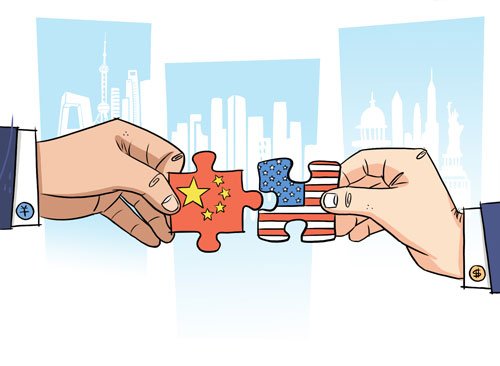
Last month, the United States administration fired the opening salvo in what could lead to a full-blown trade war. While trade frictions have long been an issue in China-US relations, few expected such an escalation, not least because economists widely view trade wars as damaging to all parties. So how did we get to this point, and can we turn back before it's too late?
First and foremost, US President Donald Trump does not seem to understand how trade works. He thinks the US' $500 billion trade deficit with China ($337.2 billion in 2017 according to China's calculation) amounts to a loss, the result of "incompetent" US administrations allowing their Chinese counterparts to take advantage of them. In fact, according to Trump, the US already lost a "trade war" with China years ago.
But trade balances are far more complex than what Trump makes them out to be. For starters, much of what China exports includes components manufactured elsewhere, meaning China's trade surplus actually includes the trade surpluses of many other countries.
China's external account is basically balanced
Moreover, China runs large deficits against Japan and Southeast Asian economies, even as it runs a large surplus against the US. China's overall trade surplus as a share of GDP has fallen steadily over the last decade-from nearly 10 percent in 2007 to just above 1 percent in 2017-meaning the country's external account is basically balanced.
And then there is the US' current-account deficit, which is not necessarily a bad thing, as it implies the acquisition of large amounts of foreign capital. This has benefited the US over the years, by strengthening its financial system and currency. While the US external deficit could stand to be reduced, as it partly reflects its own lack of savings, trade policy alone would not be sufficient to achieve that goal.
None of this is to say the US does not have any legitimate grievances about China's trade practices. But those must be viewed as issues of China's compliance with the World Trade Organization rules.
As former WTO director-general Pascal Lamy once acknowledged, while China has done "really well" in implementing its long list of WTO commitments, "no country is above criticism". In particular, Lamy noted, certain services sectors may not be sufficiently open and protection of intellectual property rights should be strengthened.
These are fair criticisms. Indeed, the Chinese government itself hoped to open up the financial-services sectors more quickly, but financial fragility demanded a gradualist approach.
As for the US, its Trade Representative has closely monitored China's WTO compliance since the country joined it in 2001. The USTR's 2016 report on the topic acknowledged the complexity of the picture presented by China's WTO membership at the time, but took an overall positive tone, highlighting the expansion of mutually beneficial trade and investment.
USTR's focus is on wrong aspects
Yet the USTR report for 2017-Trump's first year in office-mentioned no positive results. Instead, asserting that the US had "erred in supporting China's entry into the WTO on terms that have proven to be ineffective in securing China's embrace of an open, market-oriented trade regime", the USTR focused on complaints about Chinese industrial policy, which is largely beyond the WTO's scope.
In particular, the Trump administration has taken issue with the Made in China 2025 plan, introduced by the State Council, China's Cabinet, in 2015 with the aim of boosting 10 strategic industries, including advanced information technology, automated machine tools and robotics, aviation and spaceflight equipment, and electric vehicles. The USTR report warns that the strategy's "final goal" is to "capture much larger worldwide market shares" in the targeted industries.
In reality, the Made in China 2025 plan-which, incidentally, is inspired partly by the US government's own massive investment in research and development-seeks to raise China's manufacturing ability only to the average level of the world's major manufacturing powers by 2035(not 2025), a rather modest goal. But even if China wants to set more ambitious goals, by what right can the US-which has much larger market shares in the targeted industries-block it from attempting to do so?
According to the USTR report, the problem is that the policy tools the Chinese government is using to achieve the goals of Made in China 2025 "are largely unprecedented, as other WTO members do not use them". Besides, they "include a wide array of state intervention and support designed to promote the development of Chinese industry in large part by restricting, taking advantage of, discriminating against, or otherwise creating disadvantages for foreign enterprises and their technologies, products, and services".
Yet the report fails to identify those interventions, which is not surprising, given that the State Council has not yet specified the policy tools it will use. And even if the US' grievances over IPR issues are understandable, they could be addressed through the WTO. The fact that the Trump administration has taken the approach it has suggests it does not merely want to ensure that China complies with existing rules; it also wants to prevent China from catching up to the US technologically. This is obviously not acceptable to China.
Fueling the risk of Thucydides' trap
This reading is reinforced by the National Security Strategy report that the Trump administration issued in December, which asserted that the US would "respond to the growing political, economic, and military competitions we face around the world". China was cited as the main challenger to "American power, influence, and interests", an adversary that is "attempting to erode American security and prosperity". This perspective fuels the risk of the so-called Thucydides' trap, in which an established power's fear of a rising power leads to conflict.
We may yet avoid a trade war. President Xi Jinping seems eager to ease tensions, exemplified by his recent pledge to lower tariffs on imported US cars "significantly" and further open up China's financial-services sector.
One hopes the trade talks between China and the US scheduled for Thursday and Friday will silence the war drums through negotiation and mutual concessions. US and Chinese leaders could then turn their attention to the broader problem of avoiding the Thucydides' trap, thereby preventing a clash with consequences that would dwarf those of a trade war.
The author is former president of the China Society of World Economics, director of the Institute of World Economics and Politics at the Chinese Academy of Social Sciences, and served on the Monetary Policy Committee of the People's Bank of China from 2004 to 2006.
Project Syndicate





