



Witnessing dramatic changes in Beijing over the past 38 years









I arrived in China in late 1980 to prepare for my new job: to open a representative office for a Belgian company. My friends strongly recommended I not go because it was an unwelcoming place. I ignored them and it was a decision that changed my life.
China at that time was another planet. In my seminars today I show how China has changed from a medieval society in the late 19th century and a hermit country in the late 1970s to a most dynamic and developed country.
Most young Chinese have no idea what China was like when I arrived, they hardly can believe the dramatic changes.
In the early 80s Beijing offered foreigners nothing much except a “fish bowl life”: everybody could see what we did and we had little idea what went on outside the bowl.
There were no international hotels and one could not book a hotel room at a hotel. Reservations were directed through a local bureau that would put you wherever they thought it was “appropriate”. I was lucky to get a room in the best location: the Beijing Hotel. Agreed, the west wing was rather old and not as modern as the east wing, but I had a fabulous view of the rooftops of the Forbidden City and when the air was nice, the mountains in the west. The rooms had no fridge; later on I smuggled a small one in. These hotels were off-limits to local people and they would be stopped at the door to check their permit to enter.
The city had no apartments, no office buildings, no modern shops, no bars, no fancy restaurants, no entertainment. After 8 pm the city was dead. Our life was mostly restricted to the hotel. My room also became the office and every morning my Chinese secretary would arrive – in my bedroom. After much effort I got a second room, one year later, gaining some privacy.
The few foreigners hung out together and we mostly met in the lobby of the Beijing Hotel that had a small bar. We called it the “Beijing Zoo” and it was never clear whether the animals were the ones sitting and watching or the passing crowd. Anybody visiting Beijing would actually pass that bar. Our entertainment was to sit there and drink lots of beer.
The other “entertainment” was the TGIF (Thanks God It’s Friday) organized every Friday evening in one of four embassies, one being the American embassy. At that time nobody cared about security checks, you could attend if you had a foreign passport.
Getting around was a problem. To get a taxi at the embassies or anywhere else you had to call a number and pray one would come. The only place to sometimes get a taxi were the hotels, such as Beijing Hotel.
Contact with locals was not allowed. Forget sharing a bottle of water with a girl. Often security people would interrogate the girl afterwards; visits to the room were a “criminal offense” and so was any further “contact”.
Beijing was a flat city; except for the Beijing Hotel East wing there were no high-rises. A Beijing vice mayor told me the city would never allow elevated roads, being contrary to the spirit of the city.
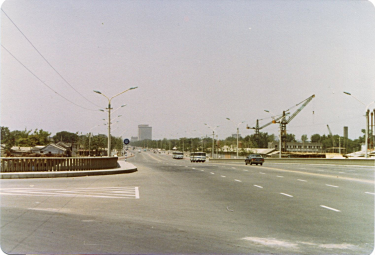
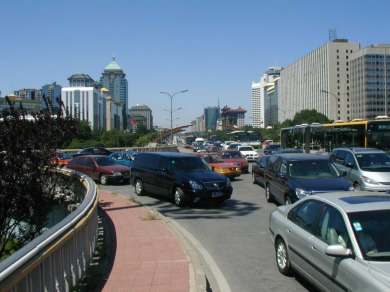
There was little to buy. The only interesting shop was the Friendship Store, where foreigners could buy a bicycle, rancid bread and rancid butter, cigarettes, alcohol, and more. We had to use “FEC” (Foreign Exchange Certificates); we were not supposed to use normal renminbi. Of course there was a thriving black exchange market. We often helped Chinese friends to buy something, like a bicycle. Indeed many of those items could not be bought without a “coupon” in a normal shop.
If the architecture of the city changed dramatically, for me the most impressive changes were with the people.
In the early 80s clothing was ugly and drab. Two colors only – some kind of green and some kind of blue. For the ladies, no fancy clothing, no make up, no jewelry. That was bourgeois and not allowed.
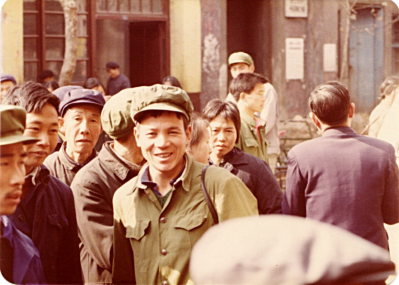
A revolution in dress happened in the early 80s. A Wangfujing shop sold red anoraks. Few people dared to buy one because of the vivid color, afraid the police would make problems. Nothing happened. The next year people flooded the shops to buy the colorful jackets.
A lot changed when the first international hotel opened in 1982, the Jianguo Hotel. That was a revolution: there was a REAL BAR (Charlie’s), a coffee shop, a French restaurant. Later we had the Sheraton Great Wall Hotel and the Lido Hotel - they all changed our lives.
To call my head office in Belgium I needed to book the call hours in advance. At that time, there was no Internet, no IDD, nothing. I made spectacular progress installing a telex machine in my hotel “office”. The machine was bulky, noisy and one had to prepare a perforated tape to send the message. I actually invented SMS with that machine to talk with Charleroi, a city in Belgium.
So now, young people, you don’t know how lucky and spoiled you are.
You have your WeChat, surf the internet while riding the subway, you enjoy the bars, the discos, the immense variety of restaurants; boys and girls can mingle, hold hands (and more). Foreigners have local girlfriends. You can buy ANYTHING in Beijing.
When I arrived here I was told Beijing would never have supermarkets “because that was contrary to Chinese culture”. Chinese business people traveling to Belgium were not allowed to visit a supermarket. Of course they loved it when we secretly did go anyway. Now Chinese are the biggest spenders in luxury shops in Paris, London, anywhere.
Now show me one country that has changed as much as China in barely 40 years!
Gilbert Van Kerckhove is from Belgium and is a permanent resident with a Green Card in Beijing.






