



Latest AI chips a startup success story









China is nurturing domestic tech companies to reduce reliance on foreign products
Artificial intelligence technologies are bursting out of laboratories and into reality at a faster rate than many expected.
Consumers can now take selfies with smartphones that automatically beautify their pictures-removing dark circles under the eyes and adding patches of rouge. After a hard day at work, people can talk to internet-connected TVs, which will switch on automatically and begin beaming their owners' favorite shows. When stepping into smart vehicles, people can ask cars to lower the temperature and recommend the nearest coffee shop, just by speaking.
All these applications are made possible by miniature processors that operate within the devices themselves or via cloud services. As the brains powering these smart electronic products, AI chips help smartphones, TVs and automobiles understand what humans say, recognize pictures, and more importantly, give appropriate feedback.
As part of its broad push to gain a lead in the AI era, China is nurturing globally competitive chip companies that can reduce the nation's reliance on foreign technologies.
Describing chips as being like the human heart, President Xi Jinping said in late April that "no matter how big a person is, he or she can never be strong without a sound and strong heart". He urged businesses to make major breakthroughs in chip technology and reach new heights in the global semiconductor industry.
A string of Chinese startups and tech heavyweights are scrambling to respond to President Xi's call.
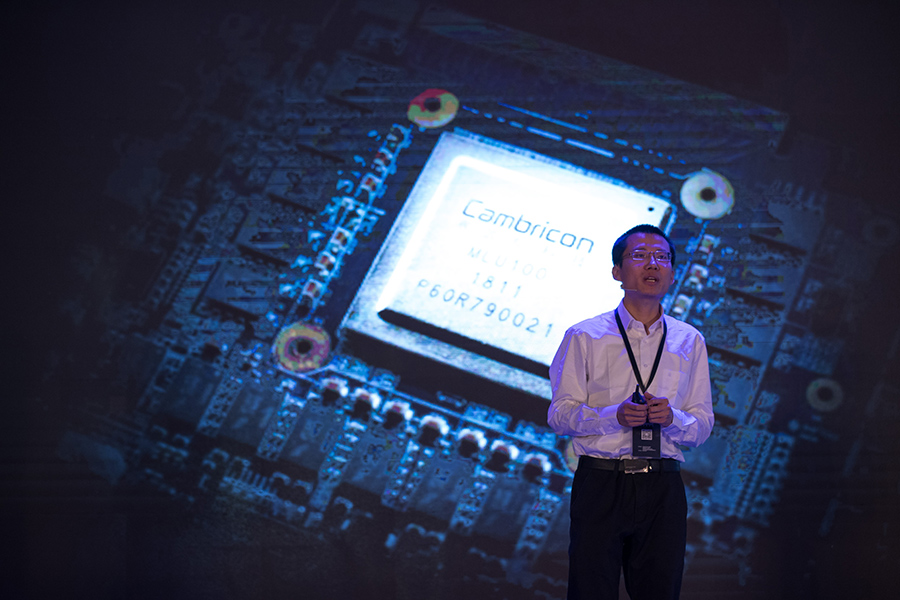
At a much-anticipated event held in Shanghai in early May, Cambricon Technologies Corp Ltd, a startup that specializes in AI processors, unveiled China's first cloud AI chip-the MLU 100. The chip outperforms traditional general purpose processors and can better support AI-powered applications.
"The MLU 100 consumes less power, is compatible with various AI algorithms, and can better drive applications like visual, speech and natural language processing," said Chen Tianshi, CEO of Cambricon, which is affiliated with the Chinese Academy of Sciences and backed by Alibaba Group Holding Ltd.
Cambricon-which raised $100 million from investors last year-is part of a boom of Chinese companies and startups working on AI chips, hoping to take on United States semiconductor giants such as Nvidia Corp, Intel Corp and Qualcomm Inc.
The trend comes as China's semiconductor industry sees a unique opportunity to establish itself amid the current wave of enthusiasm for hardware optimized for AI, after the country lagged behind foreign rivals in traditional general processors for years, company executives and industry experts said.
Chinese companies are now benefiting from favorable government policies, a growing demand for tailor-made AI chips and the country's huge digital population, which lay a sound foundation for large-scale AI applications.
"Chips and software are closely bounded. That is particularly true in AI, as chips powering an application must be specifically designed. China's booming software market and large user base will allow homegrown companies to update chip design quickly based on user experience," said Roger Sheng, research director at consultancy Gartner Inc.
"More importantly, AI has just jumped out of laboratories and into commercial applications. China and the US are almost at the same starting line," Sheng added.
In December 2017, the government set the goal of mass-producing chips that run artificial neural networks by 2020, a vital form of software propelling global tech giants' AI ambitions. The policy is a key part of China's ambition to become the world's leader in AI by 2030.
The global AI chip market is forecast to hit $10.8 billion by 2023, with the industry growing at a compound average annual growth rate of 54 percent, according to data from market research company ReportLinker.
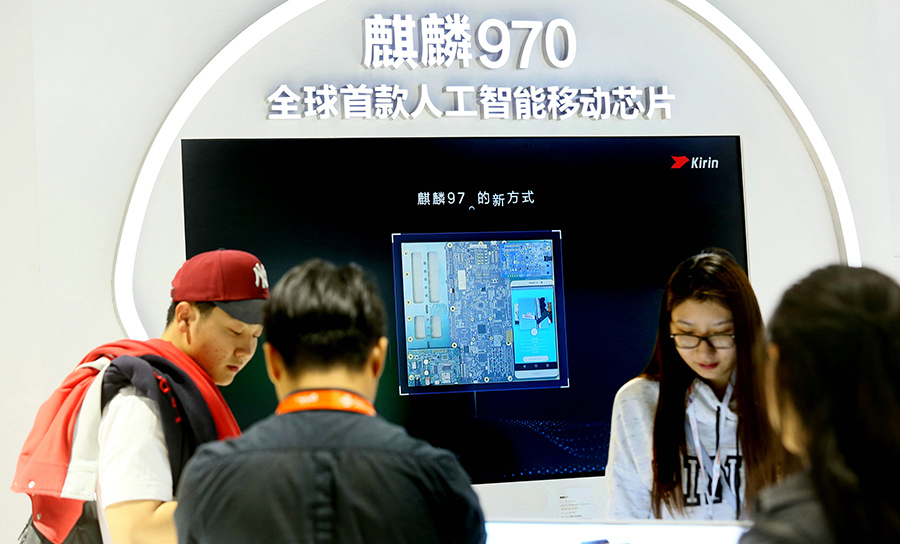
Sensing huge opportunities, at least 14 AI chipmakers have emerged in China within the past two years, data from Tencent Research Institute show. They are joining the efforts made by Chinese tech heavyweights including Huawei Technologies Co Ltd to make chips that can add AI to any gadget.
"In the past 10 years, we have never seen so many companies emerge at the same time for a single segment in China," said Xiang Ligang, a chip expert and CEO of telecoms industry website Cctime.
In April, Beijing's Horizon Robotics, founded by veterans of internet search company Baidu Inc, said it was closing a new round of financing that would hit $100 million, after unveiling two tailor-made AI processors to assist self-driving vehicles last year.
ThinkForce, which attracted 450 million yuan ($70 million) from investors in 2017, is working on AI chips that can be embedded in devices such as smartphones, watches and home robots.
Huawei is collaborating with Cambricon on AI chips for phones and other devices.
"AI processor startups are the latest darlings among investors in China. This was definitely impossible several years ago, as the semiconductor business is so cash-intensive and demands long-term investment to see any results," said Liu Weiwei, general manager of the AI department at Galaxy Internet. The Beijing-based incubator helps startups secure capital and other resources.
According to Liu, venture capitalists today see an opportunity for Chinese startups to establish a presence in the market, as demand for tailor-made AI chips grows exponentially and it becomes less complicated to design such processors.
Existing chips that run AI software, such as Nvidia's graphics chips, are expensive and hard to deploy into devices.
That's why companies like DeePhi are marching into the sector. The Beijing-based startup is running against the clock to produce AI chips that can help self-driving automobiles recognize pedestrians in a cost-effective way.
"The complexity involved in designing AI chips is about one-tenth of that in designing central processing units. But companies that only make chips will not be able to win in future. The key is to build a system by combining chips with software," said Yao Song, CEO of DeePhi.
The startup raised $40 million from investors including Samsung and Alibaba's Ant Financial last year. It has already unveiled a slate of software products, and its chips are designed to provide in-house solutions to help its products to achieve better performance and lower production costs.
"It is difficult for a single Chinese company to take on Nvidia given our currently limited chip talent pool and manufacturing techniques. A more likely picture is that about 10 Chinese companies compete with the US chip giant in 10 specific niches," Yao said.
According to him, AI chips are a golden opportunity for China to surpass the US in high-tech, and 2018 will be a critical year.
"This year will see whether we are really as good as we have promised and can come up with competitive, commercially mature products," he said.




















