



Trump's policies could disturb the regional security balance









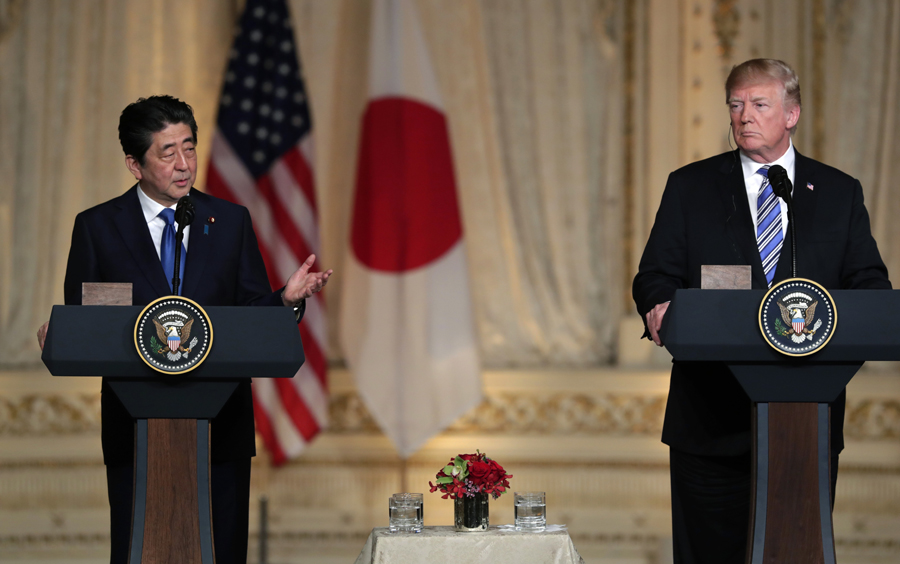
At their meeting in Mar-a-Lago, Florida, on April 18, US President Donald Trump rebuffed Japanese Prime Minister Shinzo Abe's request that Japan be exempted from US new tariffs on steel and aluminum.
In March, Trump announced that the US would impose tariffs of 25 percent on steel and 10 percent on aluminum imports. But he granted the European Union member states exemption until June 1. He also extended the tariff waiver to Mexico and Canada pending negotiations with the United States on the North American Free Trade Agreement. And the Republic of Korea has been exempted from the tariffs after agreeing to lower its steel import quota.
Japan is the only major US ally not exempted from the US' new tariffs, which will amount to about 50 billion yen ($450 million) a year for Japan despite Abe working hard to cultivate a close relationship with Trump-on the golf course and over the telephone.
Informing the World Trade Organization that it reserves the right to take countermeasures against US tariffs, Japan has now decided to stand up against the US. Opposed to Trump's protectionist policies, Japan has signed or is negotiating multilateral trade agreements, which, it believes, will boost its economy.
Besides, the Japanese parliament is working toward ratifying the Comprehensive and Progressive Agreement for Trans-Pacific Partnership, or the TPP-11 for short. As the largest economy in the group, Japan sees the TPP-11 as a cornerstone on which it can establish its economic and diplomatic power in the Asia-Pacific region.
Japan concluded negotiating a free trade agreement with the European Union, too, in December, and the two sides are making arrangements to sign the FTA deal in July at the annual summit in Brussels. Also, they aim to implement the FTA by late March next year when Britain exits the EU.
Two months ago, 16 countries reached a consensus to complete a basic framework for the Regional Comprehensive Economic Partnership within the year. After they reach an agreement, it will produce the most populous, diverse and energetic free trade area in the world, as Chinese Foreign Minister spokesperson Hua Chunying said.
At a trilateral summit in Tokyo on May 9, the leaders of China, Japan and the ROK advocated economic globalization and free trade, and agreed to accelerate negotiations on a China-Japan-ROK free trade agreement.
In addition, Japan has effectively joined the China-proposed Belt and Road Initiative. On May 9, during Premier Li Keqiang's visit to Japan, Beijing and Tokyo agreed to establish a public-private council to discuss joint projects in third-party markets related to the Belt and Road Initiative.
Moreover, Japan does not want to negotiate a two-way trade agreement with the US because Trump despises multilateral frameworks.
The good news is that Japan is not alone in squaring off with the US. Russia and Turkey have warned the US of potential retaliation against its tariffs on steel and aluminum. And India and the EU have given the WTO lists of the US products that could incur high tariffs in retaliation for the US tariffs.
The higher tariffs on autos and auto parts that the Trump administration is exploring could backfire worldwide, further isolating the US from the international community. And Trump's protectionist policies will give Japan the leverage to overcome the US pressure to seal a bilateral FTA.
The bad news is that Japan has to rely on the US for security. Leveraging its military strength, the US has asked Japan, as well as its other allies, to shoulder a larger share of the costs for hosting US troops. This could strengthen Japanese conservatives' appeal that Japan should build a strong military of its own. This in turn could prompt Japan to intensify its efforts to strengthen its defense force.
And given that Japan's defense budget has already been rising every year under the Abe administration ending a decade of military budget cuts, this could disturb the security balance in the region.
The author is China Daily Tokyo bureau chief.





