



Abe fears being sidelined as DPRK peace process gathers momentum









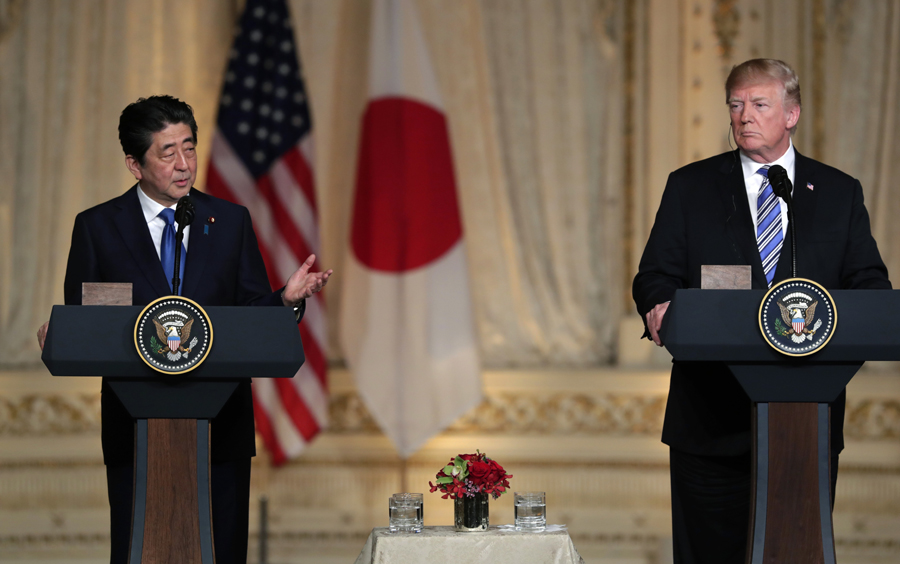
US President Donald Trump is known for his unpredictability, and Japanese Prime Minister Shinzo Abe responds to this with constancy.
Whatever decisions Trump has made on his planned summit with Democratic People's Republic of Korea leader Kim Jong-un, Abe has supported him.
When Republic of Korea National Security Adviser Chung Eui-yong announced the historic Trump-Kim summit, Abe, caught off guard, called Trump on the phone the same day to applaud "Donald's courage" in holding face-to-face talks with the DPRK leader.
When Trump called off the planned summit, Abe respected his "judgment". And when Trump changed his mind again on the meeting, Abe again backed him.
Abe keeps in lockstep with Trump because he fears Japan might be left out of the process of resolving the Korean Peninsula issue.
This year, the DPRK has had frequent contacts with China, the ROK, Russia and the United States. These countries, along with Japan, are part of the Six-Party Talks aimed at peacefully resolving the peninsula issue. Kim has met with President Xi Jinping and ROK President Moon Jae-in twice, and held talks with US Secretary of State Mike Pompeo. And Russian Foreign Minister Sergey Lavrov traveled to Pyongyang on Thursday to hold talks.
With diplomacy heating up, Japan's fear of being sidelined has intensified. Abe is mulling sending its Foreign Minister Taro Kono on June 9 to Singapore, which is expected to host the planned Trump-Kim meeting, to seek the city-state's cooperation to share information on the meeting. Besides, Abe is seeking a meeting with the DPRK leader after the planned Trump-Kim summit.
Abe will visit the US again on June 7 to apprise Trump of Japan's concerns including the release of Japanese citizens allegedly abducted by the DPRK in the 1970s and 1980s. The release of the Japanese citizens is Tokyo's precondition for normalizing relations with Pyongyang.
The DPRK has said the abduction issue has been settled, and criticized Japan for "trying to take a free ride on the wind of peace" without playing its part. The DPRK released five of the abductees in 2002 and says the other eight have died. And it has stressed that the four other Japanese that Tokyo says were abducted never entered the DPRK.
Critics in Japan say Abe's foreign policies are heavily dependent on Tokyo-Washington relations, particularly his "personal rapport" with Trump, without making sufficient efforts to improve Japan's ties with its neighbors. His approach, as the Asahi Shimbun said, has undermined Japan's diplomatic clout in the region.
No meeting between Abe and Kim is in sight. But what would Japan bring to the table if Abe had a chance to meet with Kim?
When Trump threatened the DPRK with "fire and fury", Japan supported sanctions, even military action against Pyongyang. It is still the strongest advocate of "maximum pressure" on Pyongyang.
In May, Japan and 18 Pacific island countries and regions issued a statement demanding maintaining pressure on the DPRK to force it to abandon its nuclear program after their leaders' meeting in Iwaki, Fukushima.
Also, given Korean resentment against Japanese colonization and wartime atrocities, it is hard to imagine Pyongyang forging a strong relationship with Tokyo. Japan and the ROK agreed in 2015 to settle the issue of "comfort women", a euphemism for girls and women forced into sexual slavery by the Imperial Japanese army before and during World War II. Japan paid 1 billion yen ($8.3 million) as compensation to the ROK victims.
But Hitoshi Tanaka, chairman of the Institute for International Strategy, says Japan will "never" pay the DPRK to settle the wartime issues. And Japan still frames the DPRK as the most serious threat to the country since World War II, and is set to spend $19 million to acquire medium-range air-launched cruise missiles so it can strike DPRK sites.
No wonder Japan has little leverage over any possible negotiations with the DPRK.
The author is China Daily Tokyo bureau chief. caihong@chinadaily.com.cn





