



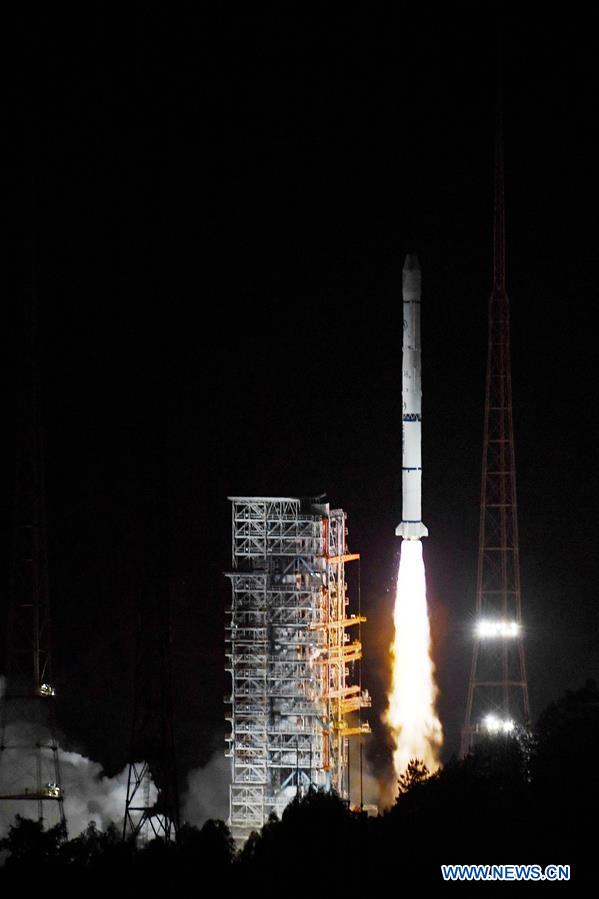
China launches meteorological satellite to benefit Belt and Road countries









The adjustment will enable the Fengyun series satellites to acquire meteorological data over a wider range, improve weather forecasting accuracy and the ability to cope with climate change and mitigate losses caused by natural disasters, Zhao said.
Equipped with a scanning radiometer and space environment monitor, Fengyun-2H will provide real time cloud and water vapor images and space weather information to clients in the Asia-Pacific region, said Wei Caiying, chief commander of the ground application system of Fengyun-2H and deputy director of the National Satellite Meteorological Center.
The Belt and Road region, which is mainly high mountains, deserts and oceans, lacks meteorological information. Damage from natural disasters, especially meteorological disasters, in the region is more than double the world average.
After four months of in-orbit tests, Fengyun-2H will provide data to help Belt and Road countries better cope with natural hazards, Zhao said.
"The move shows China's willingness to construct a community with a shared future," said Zhao.
It also addresses a WMO request to strengthen satellite observation of the Indian Ocean to fill a gap in the region, which is China's contribution to the international community as a major power of the developing world, Zhao said.
China will offer data of the Fengyun series free to Belt and Road countries and APSCO member countries, said Zhao.
China has helped establish ground stations to receive the data in some APSCO member countries, including Pakistan, Indonesia, Thailand, Iran and Mongolia. China plans to upgrade the stations and provide training to technicians in those countries.


- Hong Kong sectors voice strong support for Jimmy Lai's sentence
- Mainland official extends greetings to Taiwan compatriots ahead of Chinese New Year
- Legislator highlights AI, tech and awareness to reduce weather risks
- Hong Kong's investment attraction scheme receives over 3,000 applications
- Brain network dysfunction central to Parkinson's disease identified
- Namesake villages across the Strait











