Give 'grand-parenting' elders their due









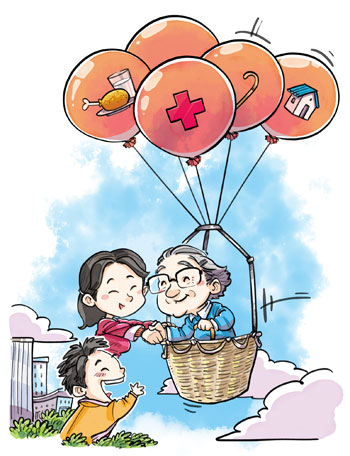
Due to the drastic social changes brought about by urbanization and the emergence of nuclear families, an increasing number of senior citizens have to migrate to major cities far from their hometown to take care of their grandchildren. In fact, theirs is a new migration phenomenon in China.
Since the launch of reform and opening-up, and the resultant rapid economic development, many Chinese have migrated from rural areas or towns to major cities for work. And since many of these people have no other family member except a working spouse, their parents have to take care of their children. This is a case of one migration followed by another (rather forced) migration.
According to National Health and Family Planning Commission's statistics, China has about 18 million migrant senior citizens, or 7.2 percent of the overall migrant population of 247 million. And 43 percent of these elderly people migrated to the cities to take care of their grandchildren.
The migration of elderly people is a result of China's ever-increasing urbanization level and the unique dual structure of its urban-rural household registration system. But it also highlights the necessity of elderly people's support for family and the reality of "grand-parenting".
Still, the senior citizens who migrate to the cities to take care of their grandparents face three major problems.
First, many senior citizens feel homesick because they are "forced" to live in the cities to take care of their grandchildren. Since the elderly people, in general, prefer to stick to the thought process and lifestyle they have developed over the decades, they are more likely to feel at home with acquaintances rather than strangers. So it is difficult, even painful for them to leave their acquaintances and comfortable environment and step into a milieu they find strange.
Given these facts, the elderly people are more likely to be under constant pressure and feel a sense of estrangement when they shift to a city they don't know, and this compromises their quality of life. Especially, those elderly people who migrate from a rural area to a city without their spouse are more likely to feel lonely.
Second, the differences in the lifestyles, way of parenting and values from one generation to another may cause parent-child friction and intergenerational conflict. In fact, many of the senior citizens who leave their hometown to take care of their grandchildren consider themselves free nannies of their grandchildren given their lack of authority and importance in decision-making regarding the child they take care of.
Perhaps this migration trend cannot be changed, but the young people can surely maintain "distant intimacy" with their elderly parents right after shifting base to a city so as to make them feel more at ease when they have to stay in the city to take care of their grandchildren.
Third, many such elderly people face a "half-urbanization" problem. Many of them lack sufficient social support such as old-age security and medical insurance. Along with the lack of social interactions, these increase the risk of elderly support. The 2016-17 Beijing Social Management Development Report describes such senior citizens as "invisible persons" in the community, because they can hardly take part in local community activities due to the differences in their dialect, lifestyle and social network.
To deal with the issue, the authorities should establish a social support system that focuses on eliminating the differences in old-age support based on the urban-rural hukou (household registration) system, and take measures to establish a unified medical insurance payment and settlement system nationwide.
The senior citizens who take care of their grandchildren, no matter whether they have an urban or rural hukou, should be able to enjoy the social welfare benefits wherever they are. For that, proper coordination should be established between the departments in charge of the hukou system and the social welfare system. For instance, such elderly people should be able to access the medical and old-age support services through the Internet Plus technology, which, in fact, could help build an up-to-date social security system for migrating elderly people.
In short, China should establish an old-age support system based on the principle of protecting the disadvantaged people, promoting fairness and guaranteeing old-age security as well as social security. To achieve that goal, the authorities have to establish a national "bottom line" old-age social protection system to enable the disadvantaged group, including the "empty nest" senior citizens, those who have lost their only child and the physically challenged elders, to live life with dignity in their sunset years.
The author is a professor at the Institute of Population Research, Peking University.