



Domestic tech giants are venturing overseas









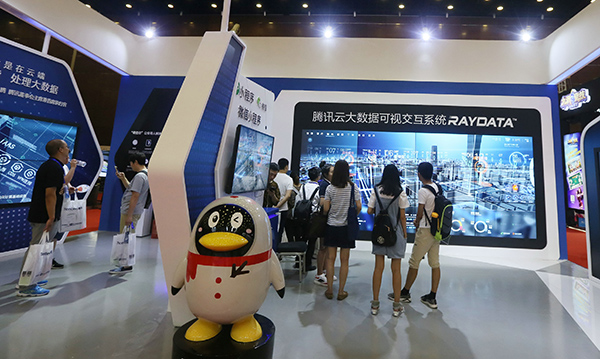
Chinese companies enhance presence in cloud service sector with new centers
Chinese tech giants are deploying their cloud services overseas, and moving up the sector's global rankings as they do so.
According to Charlie Dai, principal analyst at consultancy Forrester, there are two key drivers behind their bid to tap into global markets-to better serve Chinese customers' globalization strategies and to extend their own digital territories.
"They could replicate their Chinese market successes in global regions, just as Amazon Web Service and Microsoft are doing in China," he said.
According to Gartner Inc research director Kevin Ji, cloud computing is essentially about economies of scale for service providers. Expanding their coverage lowers average costs and pushes forward global infrastructure delivery.
To date, only a handful of Chinese players, including Alibaba Group Holding Ltd, Tencent Holdings Ltd and Huawei Technologies Co Ltd, have appeared as emerging forces in a market currently dominated by Western competitors led by Amazon.com Inc and Microsoft Corp, he said.
"Only Alibaba Cloud, Tencent Cloud and Huawei Cloud have straightforward globalization strategies, each with a distinctive approach," Ji said.
The cloud computing arm of internet conglomerate Tencent announced in March the opening of four new data centers to enhance its international cloud computing presence. The new centers offer a range of solutions including storage, cloud security, big data, and artificial intelligence.
Together, they lay the foundation for an integrated cloud service with high speeds and reliable network connectivity for international companies looking to scale efficiently, the company said.
"Globalization is an important part of Tencent Cloud's strategy," said Qiu Yuepeng, vice-president of Tencent and president of Tencent Cloud.
"By offering our advanced cloud computing infrastructure across the globe, we can not only share Tencent Cloud's technology and expand our portfolio of industry solutions, but also lower costs and increase efficiency across a variety of industries."
Data centers, or supporting data nodes, are essential to enabling Chinese companies' global expansion, which has already become a major driving force in the global economy, Dai said.
"Choosing the same vendor will help simplify the architecture and management complexity, and ensure consistent user experience."
According to Tencent, its new data center in Hong Kong serves as Tencent Cloud's second financial sector-focused facility in the city. Two new data centers in the United States-in Silicon Valley and Virginia-ensure coverage across the country's east and west coasts. The fourth new data center, in Mumbai, India, will serve as a core hub for Tencent Cloud in South Asia, boosting its total number of available cloud computing zones to 42.
Alibaba's cloud computing unit launched its first data center in Indonesia in March, aiming to address the growing demand for reliable and scalable cloud services among the country's small and medium-sized enterprises.
The data center underscores the company's commitment to support an Indonesian government-backed initiative to create 1,000 viable startups worth a combined $10 billion by 2020, according to Alibaba Cloud.
Geographical proximity and close ties between the two nations provide the company a particular advantage, said Alex Li, general manager of Asia Pacific at Alibaba Cloud.
"We are uniquely positioned with cultural and contextual advantages to provide innovative data-intelligence solutions and computing capabilities to customers across this region," Li said.
Alibaba Cloud has so far entered in 18 countries and regions. Its latest push saw the company's cloud services extend to Turkey in April through a partnership with e-Glober, an Istanbul-based business-to-business services provider.
According to Ji, Alibaba is banking on Asia and the Middle East to better tap into the Belt and Road Initiative, whereas Tencent is more closely following the steps of its clients, be it bike-sharing business Mobike, online brokerage platform Futu Securities, or mobile gaming company Supercell.
Meanwhile, Huawei's strength lies in its ties with leading foreign telecom operators, such as Deutsche Telekom, Orange and Telefonica, helping them to build their public cloud capability using Huawei technology.
Thanks to solid financial and technical backing from home, marching into developed cloud computing markets such as the United States and Europe could help Chinese service providers improve their offerings by catering to more demanding customers, said Neil Wang, president of Frost & Sullivan in China.
"Their competitiveness includes cost-efficient services and providing solutions based on their experience serving the world's most populous nation," Wang said.
With only a few years of development, some Chinese companies in the sector have started to climb the global rankings. A Gartner report released last year highlighted Alibaba's high potential, ranking it No 4 globally for "Ability to Execute", ahead of IBM Corp and Oracle Systems Corp.
"Their strengths are clearly their business insight into existing customers, their competitive pricing strategy and their commitment to professional services," said Dai.
Despite their rapid development, however, Chinese companies still lack genuine technological breakthroughs and innovation, meaning they have very little in the way of unique differentiation compared with other providers, Ji of Gartner said.



















