



Providing more protection for fast-paced innovations









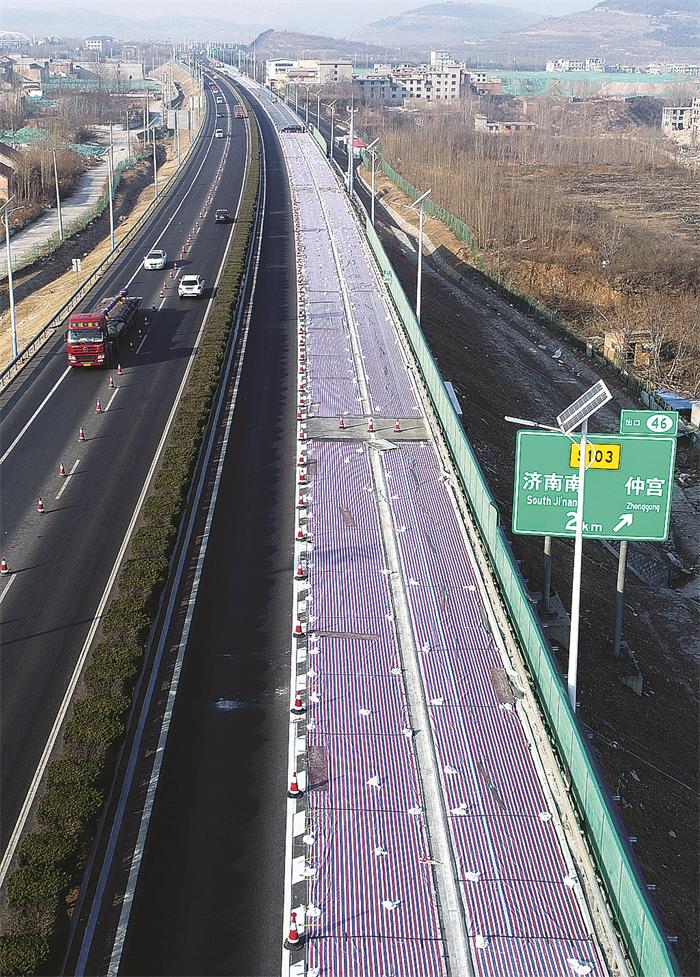
In the city of Jinan, Shandong province, some traffic now travels over an expressway that doubles as a solar electricity generator.
China hails this project in the provincial capital as the world's first photovoltaic highway. The 1-kilometer stretch includes two lanes and an emergency area and comprises three layers: transparent concrete on top, photovoltaic panels in the center and insulation at the bottom.
It is said to have the capacity to handle 10 times more pressure than the usual asphalt highway and can also generate 1 million kilowatt-hours of electricity each year, which will go toward powering street lights and a snow-melting system.
Best of all, it can supply power to charging stations for electric vehicles in the future.
Given China's shift toward greener vehicles and more environmentally focused intellectual property, the new highway design will likely come in very useful.
For now, the experimental highway is too expensive to be commercially viable. It currently costs about 3,000 yuan ($470) per square meter to build — a much higher cost than regular roads.
Nonetheless, this project and other developments highlight China's wide and ever-increasing capacity, and ambition, for innovation.
With innovations increasingly emerging, domestic companies see a growing need to protect their intellectual property rights.
On April 10, in his keynote speech at the Boao Forum for Asia, President Xi Jinping emphasized that there would be greater protection of IPR.
"We will strengthen protection of intellectual property rights. This is the centerpiece of the system for improving property rights protection, and it would provide the biggest boost to the competitiveness of the Chinese economy," he said.
Tim Lee, the founder and CEO of mobile payment service QFPay, believes an increase in regulations, including stronger IPR protection, is highly commendable. He feels it is a necessity for all industries and innovations to advance.
"Besides protecting intellectual property, it also helps any industry to maintain safety and quality standards," Lee says. "Though the lack of restrictions is great for innovations to initially emerge, regulations do help to light their path going forward."
As Xi said in his Boao speech, it will also serve to "increase China's economic competitiveness".
This is good news for domestic companies, especially with a boom in research and development in China.
Data from the World Bank indicates that China currently produces about 1,177 R&D researchers per million of its population — three times the number of researchers that the country produced in the 1990s and in line with the world average. Though the United States produces 4,321 researchers per million of its population, China has a population about four times larger.
And the number of Chinese researchers will undoubtedly continue growing.
China now enrolls more than 40 percent of its students in tertiary education, according to the United Nations Educational, Scientific and Cultural Organization. This marks a staggering rise from the 0.1 percent in the 1970s.
China produced almost 500,000 scientific papers in 2016. According to analytics company Elsevier, the country came in just behind the US, which produced 600,000 such papers. It is worth noting that the gap between the two has been halved in just five years.
And with China's drive to become an advanced manufacturing hub, the number of innovations from the country is likely to soar.
"What we want to gradually release to the world are upgraded, middle-to high-end products," Premier Li Keqiang emphasized in 2016 at the Boao Forum for Asia.
China is already leading the region in innovation in many areas.
"We definitely look to China for innovation inspiration. When I go to Beijing, for example, I'm amazed at how cashless all the transactions are. I find myself still looking for cash while everyone else pays for everything through their phones there," says Quek Siu Rui, co-founder and CEO of Singapore-based e-commerce platform Carousell.
"The rest of the world needs to catch up with China," Quek adds.
This might help allay the fears of international businesses.
According to a survey conducted last year by the American Chamber of Commerce in China, member businesses were divided on their views of China's IPR laws and regulations.
William Zarit, chairman of the chamber, recently issued a statement saying that its membership "wants a level playing field and reciprocal treatment to improve market access in China".
Chinese authorities have been hard at work to combat the source of such worries.
"China's business environment is more regulated than before. IPR protection is a typical example," Vice-Premier Wang Yang said during a China-US Joint Commission on Commerce and Trade in Washington, DC, in 2016.
Since 2013, China has investigated and handled more than 1 million infringement and counterfeiting criminal cases and sentenced more than 70,000 people. China has opened IPR courts in Beijing, Shanghai and Guangdong.




















