



Building healthcare in China









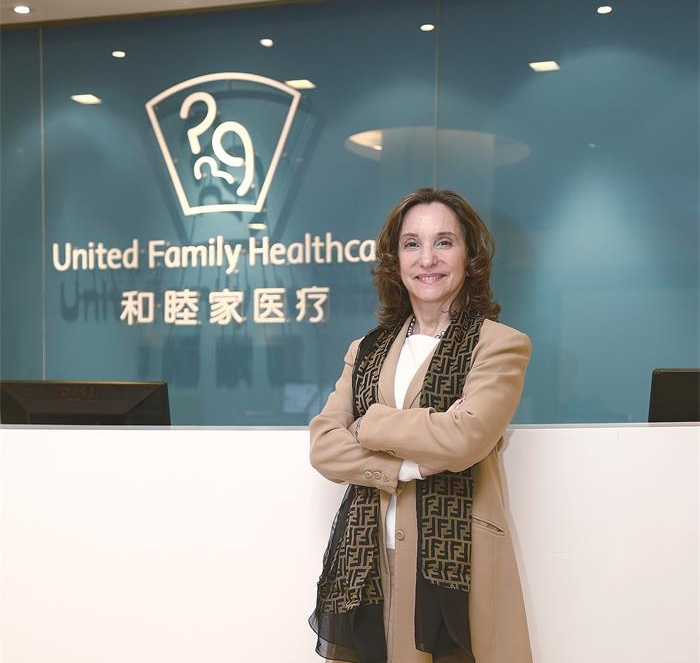
Roberta Lipson, CEO of United Family Healthcare, has developed a network of hospitals and clinics in major Chinese cities
It is very hard to build a successful business anywhere, even in your own country in a simple industry that does not require large amounts of capital or technology. Since she arrived in Beijing in 1979, Roberta Lipson, CEO of United Family Healthcare, has built, from scratch, a company that includes comprehensive hospitals as well as primary care clinics in Beijing, Shanghai, Tianjin, Qingdao and Guangzhou. Four more hospitals will open this year.
How did she succeed in the difficult, complex and capital-intensive healthcare industry in a socialist country undergoing fundamental reforms?
Lipson says she developed a deep interest in China in college, about the time of President Richard Nixon's trip to Beijing in 1972. "We were seeing a glimpse of what was going on in the country, and it was so interesting to me because it was a country that had taken a very different path, and it was just becoming accessible. As things started accelerating in terms of the relationship between the US and China, and also because of China's opening-up and reform, I wanted to be part of it. So I continued my Chinese language studies and then went to business school so I could develop a career related to China."
"From an early day, I saw that I could perhaps make some kind of contribution in the healthcare world as it related to the overall societal development. This was too attractive to walk away from," she adds.
Lipson was unable to find a job in China immediately after finishing business school in 1977, so she took a job working for a pharmaceutical company, which tied in with her interest in healthcare. Two years later, she got a job in Beijing working for a US trading company that mostly imported commodities such as crude oil, iron and steel and the metallic element molybdenum. The company hired her to find US technologies, especially medical technologies, that could be useful in China.
She recalls that, at that time, foreigners were required to live in designated hotels. "For the first 10 years I lived in Beijing, I lived in a hotel room and took every meal in a hotel dining room. In the dining room, only one fruit or vegetable was available. You never had both cucumbers and tomatoes. But compared to the way most people were living, we were living a very luxurious life. There was separation between local people and foreigners. We could interact on our formal business, but it was very difficult for foreigners to interact in a personal basis with local people."
"Wow! So much has changed over the years," she says.
In 1982, she and another American woman founded Chindex. They initially imported many kinds of equipment, including big machines for ports and mines. But they soon specialized in medical equipment.
"China was closed for the whole 10 years of the 'cultural revolution' (1966-76) and the hospitals when we got here had nothing in terms of hardware. We saw that opportunity and I think we helped to change the way healthcare was delivered at that time. Before, the doctors had their stethoscope and their two hands to rely on. We brought the first ultrasound, the first MRI, the first patient monitors, the first electrosurgical generators, the first ultrasound scalpels. Later, the first surgical robot. So many technologies we brought for the first time really changed the tools that doctors have to do their business with," she says.
However, even with the new technologies, Chinese and foreigners alike were unhappy with healthcare in the early 1990s.
"We had the idea we could build a small hospital in Beijing that could cater to the needs of the expat community. At the same time, we believed it could be a demonstration site for many tweaks that we thought could be useful in China," Lipson recalls.
When she first pushed this idea, there was skepticism from Chinese healthcare authorities as well as US investors. "It was met with a certain amount of disbelief that an American for-profit company would be interested in building a hospital in a socialist country."
"In 1994, after Deng Xiaoping's 'southern tour', it became clear that attracting foreign investment was a priority for China." So, arguing that Western healthcare was important to attract foreign workers and investors, she persuaded the government to give the green light for the hospital in Beijing.
Wall Street was skeptical. "China was still very much a place of mystery for the finance community in the US. So it wasn't so easy to convince them of this plan to build healthcare in a socialist country. We did end up having an IPO on NASDAQ in 1994," she says.
In 2014, Lipson concluded that the stock market did not account for the long-term value of the company, so United Family Healthcare was taken private and outside shares were bought by management and private equity investors TPG and Fosun.
UFH started small. At first, it occupied just two floors of a building, with an international school occupying the upper floors. Most of the first clients were expats.
But that changed. Today, 80 percent of the patients at UFH are Chinese. "We didn't know if Chinese people would eventually want to be our clients or not. Some Chinese people started coming. At the beginning they were a smattering of returnees who had experienced foreign healthcare and maybe came back to China with insurance. Then the sports stars and movie stars. One of their big motivators was privacy. On the other hand, when they came to have babies with us, they were always excited to talk about their experience with the media afterward. As a result, the things that were different about UFH got talked about more and more in the press," Lipson says.
Lipson, who has devoted her entire professional life to improving healthcare in China, says that she is a big fan of the Healthy China 2030 blueprint laid out by President Xi Jinping in October 2016.
"China has made a lot of investment in the top-tier hospitals in urban centers. They have done a lot on medical research. The problem is that there are still great disparities," she says.
"Healthcare reform in any country is very difficult. It is very complex. There are a lot of vested interests and it is very hard to change. But China has been trying really hard and is finally making some really big progress. Over the last 10 years, they have gone from not many people being covered by social health insurance to the 98 percent covered now. That is huge progress."
"Healthy China 2030 focuses on grassroots issues. It emphasizes sharing responsibilities with individuals for their own health. At the same time, it will develop grassroots primary care doctors to keep people healthy through various programs - public health education, vaccinations, getting people active, encouraging healthy lifestyles and participation in sports and individual fitness," she adds.
"It is extremely important that Healthy China 2030 focuses on the training of primary care physicians. Medical education has been overspecialized and there are not enough trained primary care physicians. This has been hard to overcome, but the government recognizes how important it is to improve the primary care that is available at the grassroots level. The government is really working hard to implement a tiered system where people can get more care at the primary level," she says.
Lipson says she will have her hands full in the next year guiding the building of four hospitals, but, after that, her goal is to build a new world-class medical school.
Although the Chinese economy is much more developed than when she first arrived, Lipson believes there are still big opportunities for foreigners as well as Chinese in China.
"Sometimes young people ask me if I think there are opportunities for entrepreneurs in China today. I think there are. China continues to be developing and changing at such a rapid rate. Maybe there is not an opportunity to start a medical equipment distribution business - other people have already done that. But because of the rate at which technology is changing and the rate at which Chinese consumer needs are changing and the rate at which the government openness is changing, I think there are still huge opportunities. It is just a matter of finding them."
Contact the writer at davidblair@chinadaily.com.cn










