



Does Brexit mean capital gains or losses?









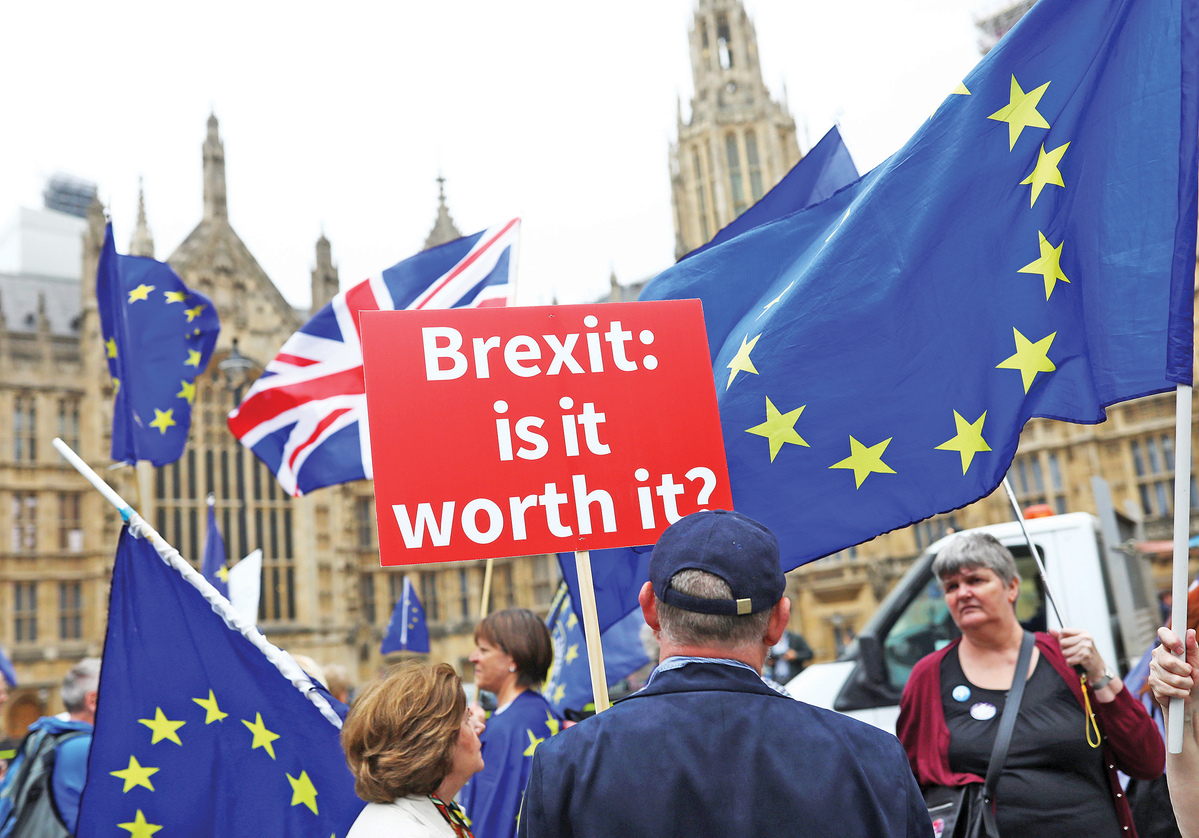
How will Britain leaving the European Union affect the relationship with China?
On Thursday, June 23, 2016, the day of the referendum about Britain’s membership of the European Union, parts of London were hit by a huge storm that left people reeling.
Thunder, torrential rain, and lightning strikes saw the London Fire Brigade receive an entire day’s worth of calls in 90 minutes. Roads were flooded and there was transport chaos. But on Friday, June 24, people woke up to something even more shocking. Out of the 72 percent of eligible voters who turned out to take part in the referendum nationwide, a slim majority — 51.9 percent — had voted to leave the trading bloc. London, by contrast, had voted 60 percent in favor of remaining in the EU. The process known as Brexit had begun.
Fast forward two years, to 2018, and the outlook remains unsettled. Then prime minister David Cameron, the man who called the referendum, resigned as soon as its result became clear. His successor, Theresa May, who as home secretary had made a speech in April 2016 in which she said “remaining inside the European Union does make us more secure, it does make us more prosperous, and it does make us more influential beyond our shores,” had inherited the task of overseeing Britain’s departure from the EU, which is scheduled for the end of March 2019. This is proving to be a spectacularly complex process.
The pronouncement of International Trade Secretary Liam Fox that Britain’s post-Brexit free-trade deal with the EU would be the “easiest in human history” has proved to be anything but, and given the uncertainty over what divorce terms Britain will manage to secure, many international companies seem to be erring on the side of caution and drawing up plans to relocate from the UK to mainland Europe.
Frankfurt, home of Germany’s financial industry, seems to be benefitting, and in April 2018 the Independent newspaper quoted Tarek Al-Wazir, the economy minister for the state of Hesse, where the city is situated, as saying “we’ve got 18 entities ... that have committed”. He was confident more would follow. Morgan Stanley has confirmed it is moving up to 10 percent of its United Kingdom workforce, and Goldman Sachs has also shown signs of having itchy feet, gradually increasing its presence in mainland Europe. Chief executive Lloyd Blankfein was quoted by City AM newspaper in March as saying “every month, incremental steps are being taken, and at some point we’re going to do things that are not going to be undone”.
Given the uncertainty that surrounds Britain’s future relationship with its nearest neighbors, and the unpredictable behavior of its previous best friend, the United States, the country is casting its eyes around for new trading partners and friends for the coming years. And few nations look quite as attractive as China.
Fortunately for Britain, the cultivation of this relationship is not beginning with a standing start. Long before Brexit was a reality, President Xi Jinping had already made a high-profile trip to the UK and met Cameron, ushering in what is known as the “golden era” of Sino-British relations. And, early in 2018, May visited China to strengthen those ties.
On the face of it, Britain would seem to be in a strong position. Early in 2018, Xinhua reported that Britain was China’s second-largest trading partner within the EU and that China was Britain’s second-largest non-EU trading partner.
Trade between the two countries rose in 2017 to $79 billion, an increase of almost 6.2 percent on the previous year. And British exports to China went up 19.4 percent.
Tony Samuels, a solicitor and notary public with Howard Kennedy LLP in the city of London, has worked closely with many of China’s leading financial institutions.
He told China Daily that, despite the challenges posed by the uncertainty surrounding Brexit, London has always held a special allure for Chinese individuals and companies, and he expects this relationship to flourish in the years to come.
“London has always been very attractive,” he said. “Pre-Brexit they were buying up lots of residential and residential block developments — for example, the area around the American embassy in Vauxhall, that was being consumed by the Chinese very quickly. They’re still buying now, but not in such big numbers.
“That’s because the Chinese are being wary. They don’t plan five or 10 years ahead like some countries, with China, it’s 20 or 30 years. It’s all about capital appreciation — they’re in it for the long term, so they’ll come to London to buy serious sites for serious money and stay for the long term.”
In a turbulent world, the ability to take a bigger picture view, and stability, are two of the key elements to ensuring security — and Samuels says these are factors that make Brexit an opportunity for Sino-British ties to become stronger than ever.
“London is the biggest financial market in the world, and finance is our biggest commonality with the Chinese. The city of London is the center of the universe as far as finance is concerned, so that’s the main lure to get the Chinese over here — to trade with them,” he said. “With or without Brexit, Shanghai deals more with London than anywhere else in the world, so pre- or post-Brexit, China is crucial to our trade going forward. The EU and USA are our main trading partners at the moment, but my guess is that in 15 or so years, China might overtake them both.”
If a country’s mood can be interpreted in any way by its movements, then the prospects for London’s long history of good relations with China are encouraging.
Earlier this month, city development 5 Broadgate was bought by Hong Kong’s CK Asset Holdings for 1 billion pounds, meaning it joins such iconic London landmarks as 20 Fenchurch Street (which is known as the Walkie Talkie) and 122 Leadenhall Street (which is known as the Cheesegrater) in Chinese ownership.
And perhaps even more symbolic than any of these individual purchases, in May the Chinese government announced that its new London embassy will be on the site of the former Royal Mint, close to both the financial heart of the city, and also the Tower of London, which is one of London’s most historic and famous landmarks. The past, it would appear, has a role in shaping the future — even if just now no-one is entirely sure what that future looks like.
“Once we’re out of the EU, whatever Brexit we get, we need trading partners, so it’s vital we do the job properly,” said Samuels. “Donald Trump will be a trading partner, without or without tariffs — there’s no special relationship, you just have to do the deal wherever you can. China’s going to be a major player here and vice-versa. The Chinese have always had a good relationship with us, and I see that only getting better with Brexit because we can negotiate directly with anyone we like.”
So, while the storm clouds that accompanied the arrival of Brexit may not yet have fully cleared, Samuels says all the signals he is receiving are that its outcome will be an opportunity for both countries, and the long-term forecast is for much improved conditions.
And while there is the minor detail of the pressing agreement that Britain needs to reach with its European neighbors, long term, Samuels says he can see the two countries’ relationship being closer and stronger than ever.
“If you asked me to predict what’ll happen a few years down the line, it’s pure speculation, but I think we will have a specific trade agreement with China, especially in finance and technology,” he said. “That’s what I’d like to see, a specific agreement with China that works for both countries for many years to come.”
- Londoners speak out two years after Brexit vote
- Blow for British PM as trade minister quits in protest at Heathrow airport expansion
- We want to say yes: UK unveils Brexit residency rules for EU citizens
- British trade official welcomes China's steps to facilitate global trade
- Brexit can bring China-UK closer together










