



Taking down language walls around the globe









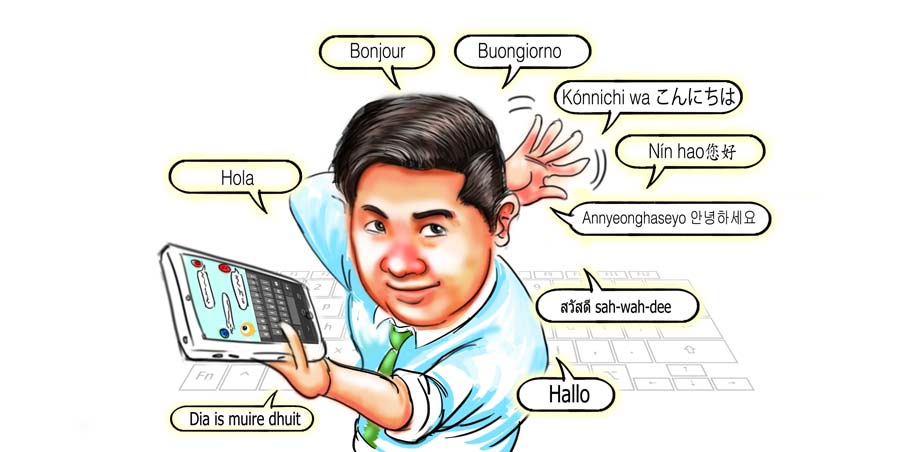
Editor's note: The communication gap between people speaking different languages in different countries may now be a thing of the past. Artificial intelligence has made it possible for those barriers to be removed, potentially driving translators into oblivion.
When Wu Meng successfully came up with an input tool while he was schooling in the 1990s, and when computers were still in their infancy, he never thought it would turn out to be his lifelong career.
For Wu, it was purely an interest back then. But now, he sees great business potential in it at a time when artificial intelligence and other technologies are reshaping the landscape of nearly everything.
People around the globe transmit billions of messages among them every day, and a large part of them are made internationally, says Wu, founder and chief executive officer of Shenzhen startup Shenzhen AOE Network Technology.
When international communication becomes more and more frequent in a connected world, language emerges as a major problem. For example, how to ensure smooth communication between a French and a German, both of whom would probably have difficulty conversing in English?
Wu's answer lies in an intelligent input tool with an instant translation function. He calls it iMore Keyboard.
Compared with its counterparts, iMore Keyboard is smarter. When one types a message using his or her mother language, the software translates the message simultaneously. The translated version, provided by Google Translate, Microsoft Translator and other tools, is shown in another box right above the input box.
Once the message is finished and the sender clicks "send", the person on the other side of the computer or mobile phone will receive the information in his or her own language.
"We hope iMore Keyboard could solve the difficulty of cross-language communication among people from different parts of the world, enabling them to communicate freely with each other using their familiar language," says Wu.
Input tool is high frequency application software used by smartphone users, he points out, but the function of the original one installed in the system is not diversified and personalized enough to meet users' growing social networking needs.
"On the Chinese mainland, the market has been overwhelmingly dominated by third-party software companies such as Sogou and Baidu inputs. There is little space left for us. In overseas markets, however, the original input tool still takes up 70 percent of the share due to an undeveloped mobile internet network in many countries and regions, leaving a lot of space for third-party developers like us to explore," Wu tells China Daily.
Determined not to let the business opportunity slip past, Wu has set his battleground overseas, especially in Europe, where cross-language communication among people in various countries is very common in everyday life.
He boasts that iMore Keyboard has garnered 20 million users globally, with active daily users reaching two million since its official launch in February last year. The software now supports more than 80 input languages and is able to translate messages into more than 140 languages.
Talking about the device's business model, something that apparently has nothing to do with economic benefits, Wu says his company is "close to breaking even" with revenue generated mainly from advertising and online consumption among its users for buying emoji packages and other related products.
"People usually are highly loyal in using a certain input tool, and they use it very frequently, even higher than the rate of using WeChat. The traffic provides a steady source of our income," he says, adding that one iMore Keyboard user opens the software 400 times a day on average.
The company completed a 10-million yuan ($1.56-million) funding in February this year.
According to a report by market research firm Sootoo Research, the number of third-party input tool users on the mainland stood at 347 million in 2013 — up 59.2 percent year-on-year — thanks to the rapid growth of the smartphone market.
But as smartphone sales subsequently slowed, the annual growth rate fell to 7.5 percent in 2017. The report expected growth to wane further as the smartphone market saturates.
A veteran in the input tool industry, Wu has been with the sector for more than 15 years. He had worked for an input tool company for six years before starting his entrepreneurial adventure in 2007 with four partners and an initial capital of 300,000 yuan.
"The industry was in a chaotic situation then. At first, for every mobile device they sold, smartphone manufacturers paid a certain amount of money to input tool companies for using their products. When competition intensified, some players sold their products entirely to smartphone makers at low prices, resulting in a price war," reminisces Wu.
His first business venture, unfortunately, didn't make the grade, and was eventually acquired by a Guangzhou company.
He set out again, betting high on artificial intelligence, which he believes could bring about significant changes to the traditional industry.
"Input tool is going through a process of transformation — from traditional to intelligent. With AI technology, we can expect input tool to become smart enough to be able to recognize what you are doing and act accordingly," he forecasts.
For example, when it learns that you are driving, it could help you send a message automatically to the person who's talking to you, letting him or her know you are not available at the moment.
Wu says Shenzhen AOE Network is also developing another input tool with a special focus on female users, who account for 74 percent of its total number of users.
"We will focus on developing products that meet the needs of the general public while having a personalized feature," he says.
Liu Yanchen, deputy general manager of KKSTAR, the incubator which hosts AOE, said cross-language communication is becoming increasingly important against the backdrop of globalization.
"Development of AI technology will help the company make further progress in language recognition. It'll be a promising project," he said.




















