



Silver linings









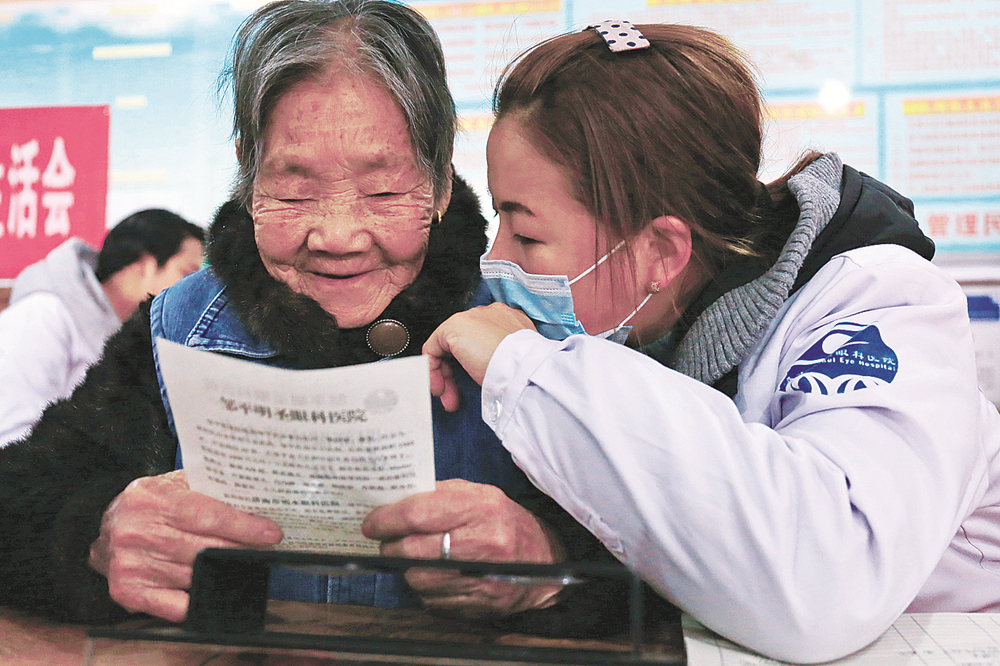
China's aging population and longer life spans have created a rising demand for more goods and services focused on the elderly and their needs
Fulfilling a dream on his fifth attempt, China's Xia Boyu, at the age of 69, recently became the oldest double amputee to scale Qomolangma, known as Mount Everest in the West.
"I knew I would make it to the top sooner or later, but I didn't expect it to take 43 years," Xia recently told China Daily while recovering from frostbite in a Beijing hospital.
Xia lost both feet to severe frostbite on his first attempt at scaling the peak in 1975. He eventually returned to try to fulfill his goal, but subsequent attempts were offset by an avalanche (2014), an earthquake (2015) and bad weather (2016).
Xia is now an inspiration, not just to mountaineering enthusiasts but also to the growing ranks of elderly people in China.
And this increasing number is opening up opportunities for healthcare providers and companies that specialize in goods and services for the elderly.
According to the China National Working Commission on Aging, 248 million Chinese will be over the age of 60 by 2020 (up from 241 million people at the end of last year), accounting for more than 17 percent of the country's total population.
The Economist Intelligence Unit expects the over-60 population to reach 369 million by 2030, when it will account for more than one-fourth of the population.
Healthy life expectancy in China is now higher than in the United States, according to the World Health Organization. Newborns in China can now expect to live 68.7 years, compared with 68.5 in the US.
"China's healthy life expectancy at birth has surpassed the US, mostly due to improved diet and medical care for women," says Dan Wang, an analyst with the Economist Intelligence Unit.
"Young-to-middle-aged Americans are also subject to much higher rates of drug overdose deaths and suicides. But adult life expectancy in China still lags that of the US, a combined result of pollution and less sophisticated healthcare."
China is now working to address this discrepancy. Under the 13th Five-Year Plan (2016-20), the country wants to raise the overall life expectancy to 77 by 2020, one year more than in 2015.
Longer lifespans and more elderly people translate into a need for more elderly care.
A recent report by the Social Sciences Academic Press, the publishing unit of the Chinese Academy of Social Sciences, said 15.3 percent of elderly Chinese need additional care, up by 9 percentage points from 2000.
The country is already working on measures to develop more comprehensive elderly care, according to the China National Working Commission on Aging.
By 2020, China wants a national medical and healthcare system to cover urban and rural residents alike, providing more elderly care.
To meet those goals, the government has launched programs to train almost 4.5 million nurses by 2020, more than three for every 1,000 people.
"Regular health examinations are necessary, especially for rural China where most people will not go to hospital unless they have a serious disease," says Wang.
A key factor in both developing the market for elderly care and delivering it will be the growth of online medical care delivery, says Karen Simpkins, a healthcare analyst at BMI Research.
"The State Council (China's Cabinet) has given the green light to internet hospitals. According to a policy agreed at a State Council executive meeting chaired by Premier Li Keqiang on April 12, medical institutions will be allowed to provide online diagnostic services for some common and chronic diseases in patients' follow-up visits to their doctors," says Simpkins.
"The top two levels of hospitals within the country's three-tier system will be encouraged to provide online services, including consultations, reservations and test result inquiries," she says.
"The initiative forms part of the Internet Plus healthcare policy and a broader strategy of using smart technology to counter increasing medical personnel shortages."
The growth will open up opportunities in the private sector.
"Internet companies will also be allowed to operate online medical services, but these will have to be tied to physical hospitals," says Simpkins.
Internet giant Alibaba is partnering with Xi'an International Medical Investment to offer internet-powered medical services. The cooperation includes building an internet-powered hospital and a medical innovation lab that harnesses artificial intelligence.
"Alibaba's internet technology, mobile payment, big data, cloud computing and other expertise will be integrated with the company's medical institutions and research centers," Simpkins says.
Alibaba attempted to launch an online hospital in 2014. Since the government decided to move forward with these initiatives, the company has entered into partnerships with hospitals in Shanghai and nearby cities.
Alibaba Health Information Technology has an agreement with Yuwell Technology to cooperate on smart healthcare devices and chronic-illness management services.
Alibaba's rivals are also exploring options in this space.
Tech giant Tencent has invested in WeDoctor, an online healthcare service based in Hangzhou, the capital of East China's Zhejiang province. The service allows patients to conduct video chats with doctors and make appointments and prescription requests online. WeDoctor plans to list in Hong Kong this year.
Ping An Insurance has partnered with Varian, a US maker of radiology machines, to establish Ping An Healthcare and Technology. The company will use AI, cloud computing and big data technologies to expand access to cancer care in China.
China has also added 89,000 hospital beds nationwide and recently exempted 28 categories of drugs from import tariffs.
Care for the elderly is not limited to those who require medical attention.
Because of China's long-standing one-child policy, many families find it hard to take care of the elderly. Infrastructural challenges and an increasingly demanding work culture also add to the burden.
"Constrained living space and competitive working environment make it difficult for young people to accommodate the elderly at home," says Wang, of the Economist Intelligence Unit.
She feels China's housing structure is not elderly friendly. "Upgrading or remodeling the current housing for use by the elderly is in high demand," Wang says.
"So far, there are few companies engaging in this area. One main reason is a lack of national standards for property developers or independent contractors to follow, so that they can avoid lawsuits if anything goes wrong."
Changing behavior is also opening up new opportunities in the sector.
"The trend is shifting to using senior care facilities over staying with offspring in big cities, albeit slowly," says Wang.
The proportion of privately owned (as opposed to government-owned) elderly care institutions in China is about 40 percent on average, with some provinces topping 50 percent. But most are understaffed.
"The current senior centers generally lack the well-trained workers, adequate medical assistance and professional management," says Wang.
A cultural bias against using senior care facilities presents challenges. A study by the Social Sciences Academic Press found that more than half of elderly Chinese prefer living with their children.
"As such, many will hire domestic workers to help the elderly as a compromise," says Wang.
This may also create a demand for additional services with a personal touch.
China's boom in the high-tech sector may provide abundant opportunities to explore robot or AI companionship for the elderly, says Wang.
According to a study by the Hong Kong Trade Development Council, elderly middle-class individuals on the Chinese mainland are willing to spend on health and lifestyle-related products like saunas and training shoes. They also prefer making their own purchasing decisions.
"Normally, many people would think that the elderly are quite passive in terms of spending, that they tend not to spend too much and wait for the children to buy things for them," says Billy Wong, principal economist for Greater China at the HKTDC.
"From our focus group discussions, what we find very interesting is the fact that ... the middle-class elderly, most of the time, make their own choices, make their decisions on what to buy and pay for products and services themselves."
The government is working to ensure its elderly population will also have the monetary power to take care of themselves and afford what they need.
"The government should ensure sufficient pension payments for the retired. Most provinces in China are running a pension account deficit and some have already run into pension arrears," says Wang.
"There are efforts to reverse the trend. The central government is trying to establish a unified national pension system, with pension funds entrusted to the National Council for Social Security Fund to obtain better returns on investment," she says.
Wang also believes the government should tap experienced retirees and bring them back into the labor force if they are interested in working.


- China-Vietnam friendship exchange to strengthen bonds, security, ministry says
- Beyond the racetrack: F1 Chinese Grand Prix showcases Shanghai culture
- AWE 2026: A glance at tech for the future
- China has broken disability-poverty link, Rome seminar hears
- Mainland slams Lai Ching-te's secessionist remarks
- Miss Jasmine on the Pleatau





