



US-China trade war elevates the risks to the global economy









WASHINGTON (AP) — The trade war that erupted Friday between the US and China carries a major risk of escalation that could weaken investment, depress spending, unsettle financial markets and slow the global economy.
The opening shots were fired just after midnight, when the Trump administration imposed a 25 percent tariff on $34 billion of imports from China, and Beijing promptly retaliated with duties on an equal amount of American products. It accused the US of igniting "the biggest trade war in economic history."
Because of this first round of hostilities, American businesses and, ultimately, consumers could end up paying more for such Chinese-made products as construction equipment and other machinery. And American suppliers of soybeans, pork and whiskey could lose their competitive edge in China.
These initial tariffs are unlikely to inflict serious harm to the world's two biggest economies. Gregory Daco, head of US economics at Oxford Economics, has calculated that they would pare growth in both countries by no more than 0.2 percent through 2020.
But the conflict could soon escalate. President Donald Trump, who has boasted that winning a trade war is easy , has said he is prepared to impose tariffs on up to $550 billion in Chinese imports — a figure that exceeds the $506 billion in goods that China shipped to the US last year.
Escalating tariffs are likely to slow business investment as companies wait to see whether the administration can reach a truce with Beijing. Some employers will probably put hiring on hold until the picture becomes clearer. The damage could risk undoing some of the economic benefits of last year's tax cuts.
"Trade disruption is the greatest threat to global growth," said Dec Mullarkey, managing director of investment strategies at Sun Life Investment Management. "The direct effects will be amplified as business confidence drops and investment decisions are delayed. Markets are still hoping that the key players return to the negotiation table."
The rift with China is the most consequential trade conflict the administration has provoked. But it's hardly the only one.
Trump is also sparring with the European Union over his threat to tax auto imports and with Canada and Mexico over his push to rewrite the North American trade pact. And he has subjected most of America's trading partners to tariffs on steel and aluminum.
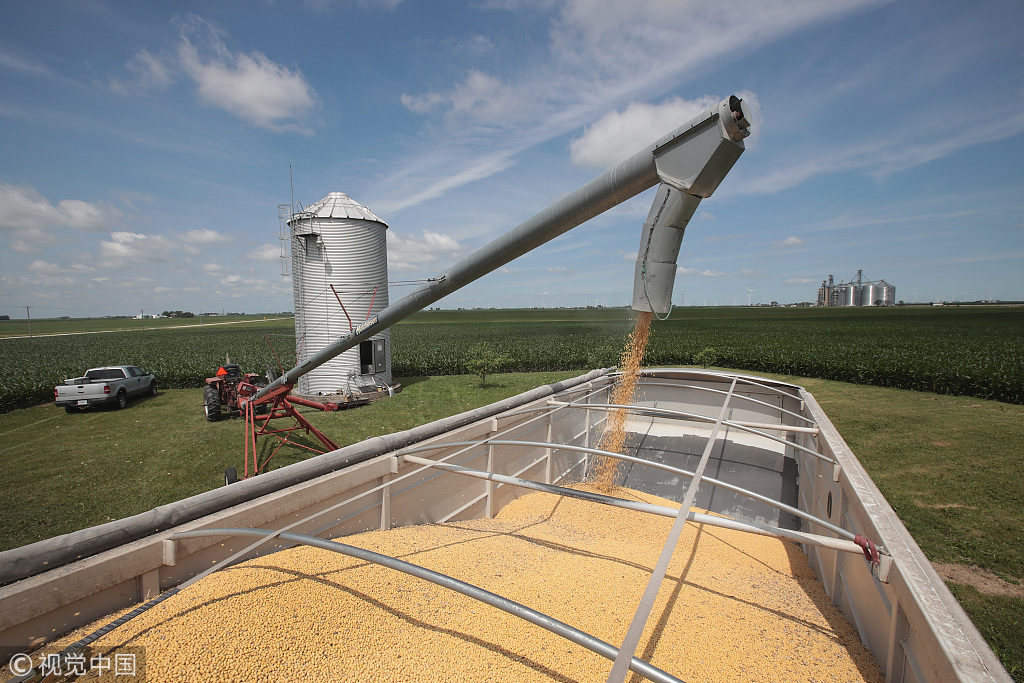
Many caught in the initial line of fire — US farmers absorbing tariffs on their exports to China, for instance — are fearful. The price of soybeans has plunged 13 percent over the past month on fears that Chinese tariffs will cut off American farmers from China, which buys about 60 percent of their soybean exports.
"For soybean producers like me, this is a direct financial hit," said Brent Bible, a soy and corn producer in Romney, Indiana. "These tariffs could mean the difference between a profit and a loss for an entire year's worth of work out in the field, and that's only in the near term." Christine LoCascio, an executive at the Distilled Spirits Council, said she fears China's tariffs on US whiskey will "put the brakes on an American success story" of rising exports of US spirits.
Even before the first shots, the prospect of a trade war was worrying investors. The Dow Jones industrial average has shed hundreds of points since June 11. But the risks are now priced into the market, and the Dow actually rose nearly 100 points Friday to 24,456.48.
China's currency, the yuan, has dropped 3.5 percent against the dollar over the past month, giving Chinese companies a price edge over their US competition. The drop might reflect a deliberate devaluation by Beijing to signal its "displeasure over the state of trade negotiations," according to a report from the Institute of International Finance, a banking trade group.
The Trump administration sought to limit the impact of the tariffs on US households by targeting Chinese industrial goods, not consumer products, for the first round of tariffs.
But that step raises costs for US companies that rely on Chinese-made machinery or components. And it could force them to pass those higher costs on to their business customers and, eventually, to consumers.
If you like Chick-fil-A sandwiches, for instance, you may feel the effects. Charlie Souhrada of the North American Food Equipment Manufacturers said the tariffs could raise the cost of a kind of pressure cooker Chick-fil-A uses.
The administration has placed "these import taxes squarely on the shoulders of manufacturers and, by extension, consumers," Souhrada said.
One way the tariffs will squeeze farmers, landscapers and construction firms is by raising the price of excavators and loaders made by Bobcat, which uses attachments imported from China. US suppliers rarely make these attachments, so the company must import them.
Jason Mayberry, Bobcat's assistant general counsel, said in a filing submitted to the US Trade Representative's office that the company would have to raise prices to offset the tariff. Bobcat's raw material costs have also risen because of the administration's steel and aluminum tariffs.
The Federal Reserve is picking up signs that the trade war is causing businesses to rethink investment plans. In the minutes from its June meeting, the Fed noted that some companies have delayed or reduced plans to buy or upgrade equipment.
And if Trump extends the tariffs to up to $550 billion in Chinese imports, consumers won't be able to avoid getting caught in the crossfire: The taxes would hit products like televisions and cellphones.
That's what happened to imported washing machines, which were hit by separate Trump tariffs in January. Over the past year, their price has surged more than 8 percent.
American trade groups are urging the two countries to resume talks.
"Tariffs will bring retaliation and possibly more tariffs," said Jay Timmons, president of the National Association of Manufacturers. "No one wins in a trade war."
AP



















