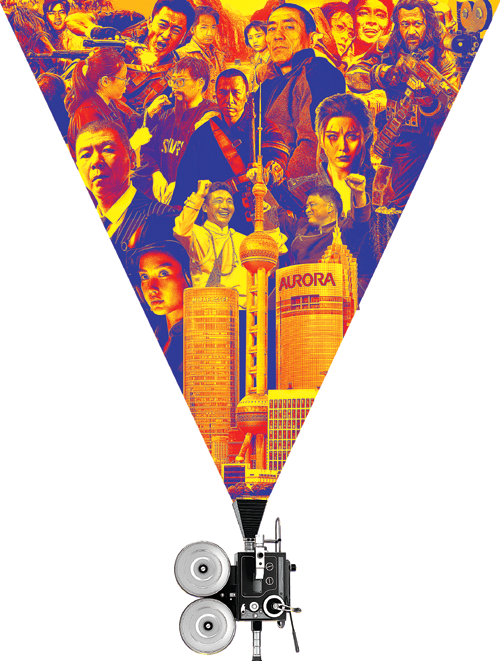
China's impact in the global film industry has never been more apparent.
Eager to tap into the growing consumption levels of the country's middle class, Hollywood productions have been frequently introducing Chinese actors into their cast to draw viewers from China.
In 2014, Fan Bingbing, one of China's most famous thespians, became the first Asian character in the world of the X-Men when she starred in the film X-Men: Days of Future Past. Angela Yeung, more popular known by her stage name Angelababy, made an appearance in Independence Day: Resurgence in 2016, while veteran Chinese actors Jiang Wen and Donnie Yen flew the China flag in Rogue One: A Star Wars Story that same year.
Despite bombing in other markets, the highly anticipated 2016 action fantasy movie Warcraft was ultimately a commercial success thanks to massive takings from box offices in China. Meanwhile, Dalian Wanda Group's $3.5 billion acquisition of Hollywood production company Legendary Entertainment in 2016 raised eyebrows all over the world.
Chinese movies, however, have not been able to achieve the same impact in overseas markets.
"I always judge a movie based on how well the story is told, the technical aspects and the level of creativity," said Liu Haibo, vice president of the Shanghai Vancouver Film School (SHVFS). "Right now, Chinese movies are still lacking in these areas."
The need to produce better films has become more urgent in recent times. In December, the Shanghai municipal government announced that it would be aiming to develop the city into a global cultural and creative hub by 2035.
It also released a document containing 50 measures to boost the cultural and creative industry, among which is the plan to build a high-tech film production base in Songjiang district within the next few years. This base would consolidate the city's filmmaking resources that are currently scattered across districts such as Jing'an, Putuo and Xuhui.
Another measure involves the enhancement of talent training in the city. Government officials have pointed out that the SHVFS, along with other institutes such as the Shanghai Film Art Academy and the Shanghai Institute of Visual Arts, will play a key role in this aspect.
Established in 2014, the SHVFS is branded as the only institute in the country that adheres to Hollywood standards. It is a joint venture between Shanghai University and Vancouver Film School, which is widely regarded as one of the most prestigious entertainment arts institutions in the world.
Among Vancouver Film School's roster of graduates is Academy Award-nominated screenwriter Neill Blomkamp who directed the highly successful 2009 science fiction movie District 9.
According to Liu, the school currently hires 50 professors, half of whom are foreigners who are experts in the filmmaking industry. In addition, professionals from Hollywood are often invited to teach and share their experiences with the students.
Luis Calandre, vice president of education at SHVFS, pointed out that the school has experienced significant growth despite being around for such a short time. For example, enrollment has grown from 80 students in its first year to the present 200, and there is now an additional enrollment intake in spring. Previously, students could only apply for the autumn intake.
"It normally takes many years for a university to build its brand, but we have managed to do so in less than four years. Today, the SHVFS brand is considered one of the most prestigious in China, and this is in part due to the effectiveness of our courses and the quality of our instructors," said the Spaniard.
"By combining specialized programs with an intense learning environment, state-of-the-art technology and teachers who are experts in their fields, we impart valuable skills to our students that allow them to hit the ground running upon entering the industry. Employers tell us that SHVFS students have much more knowledge and capacity to adapt to the working environment than others," he added.
Liu noted that the nature of their students also lends credence to the quality of their courses.
"Many of our students are post graduates who are aged over 35. Some of them already have degrees or careers in filmmaking but they know that they can improve even further if they study at SHVFS," he said.
A history of moviemaking
The move by Shanghai authorities to turn the city into a film production hub comes as no surprise, considering how the city has traditionally been known as the movie capital in China. The industry's roots can be traced back to the late 1890s when Shanghai became the first city in China to screen films on a regular basis.
The domestic movie industry soon expanded rapidly and had by 1930 become the home of most of the country's film production companies. Such was the city's reputation that it was even dubbed "The Hollywood of the East" starting in the late 1920s.
Chinese classics such as Legend of Tianyun Mountain, Evening Rain and The Herdsman were produced in Shanghai. The city's reputation for filmmaking endured till the 1990s when it became the first Chinese city to have its own international film festival. Today, the festival holds an A-list status by the International Federation of Film Producers Associations, and is one of the largest and most prestigious in Asia.
However, Shanghai's movie output over the past few decades has been a far cry from its glory days. Liu pointed out that the city is today better known as a place where filmmakers can find investment dollars instead of produce movies. The problem, he said, lies in the shortage of production talent.
"There are a few factors behind the dearth of film production talent. In the 1990s, the television industry boomed and was more profitable than the movie sector, so many film professionals crossed over. The gaps left by these people were never filled," said Liu.
According to a 2016 report by Oxford Economics, China's TV industry directly employed 865,000 people that year. In contrast, the film production and distribution sector only had 79,000 workers. Exacerbating matters is the fact that many of these film workers lack the necessary training.
"Apart from the creative team, everyone else on a Chinese film set today are just unskilled laborers," said acclaimed director Feng Xiaogang during the 2016 China Film Investment Summit Forum.