



Not a nuke novice but a tech titan









Chinese atomic power companies' breakthroughs take the world's electricity industry by storm
China's nuclear power industry truly came of age June-end, making global peers sit up and take notice.
The world's first European Pressurized Reactor or EPR located in Taishan, South China's Guangdong province, was successfully connected to the national grid on June 29.
The next day, the world's first AP1000 nuclear power plant based in Sanmen, East China's Zhejiang province, started power generation.
Together, the two landmark events encapsulate a fascinating tale of how China, until recently a nuclear energy novice, evolved into a power technology titan.
In the beginning, there was heavy reliance on imports and foreign nuclear power technologies. Then, in sync with China's economic revival over the last 40 years, the domestic nuclear power industry unbelievably grew from strength to strength.
From design expertise to construction of reactors and power installations, to third-generation nuclear power facilities to export of facility management and indigenously developed technologies - progress, enabled by learning and innovation, was in leaps and bounds.
And now, with energy holding key to global economic growth, the future is pregnant with exciting possibilities, industry experts said.
Chinese nuclear power companies have the potential to become the next major technology suppliers on the global stage as their technologies have been well-tested by now. So business from Canada, France, Russia, South Korea and the United States can be expected, said Joseph Jacobelli, a senior analyst of Asian utilities at Bloomberg.
The more new reactors China commissions domestically the stronger its track record would be, which would help a great deal as the country is initiating new nuclear power projects across the world, he said.
Besides, environmental concerns arising from air pollution caused by fossil fuels like coal have put the focus back on clean energy sources like nuclear power stations.
According to China's National Bureau of Statistics, total energy consumption in China increased by 2.9 percent in 2017, from about 4.36 Gtce (billion tons of standard coal equivalent) in 2016.
Hence, all aspects of the nuclear power industry - design, construction, technologies, maintenance, management, security, investment, returns, future projections, so on - are receiving heightened attention of experts.
For instance, Taishan's unit one and unit two are the third and fourth reactors being built worldwide with EPR technology, or third-generation pressurized water reactor design.
The plant is operated by a joint venture in which China General Nuclear Power Group has a 51 percent stake, French energy company EDF has 30 percent and the provincial Chinese electricity company Yuedian 19 percent. It is the largest cooperative energy project between China and France.
On the other hand, Sanmen's unit one, which is capable of generating 1,117 megawatts of electricity when at full power, is also the first of a fleet of four new AP1000 plants in eastern China.
Jacobelli said the commissioning of the two reactors could also help globalize the country's homegrown third-generation Hualong One reactor as well as future nuclear technology exports.
For, China General Nuclear Power Corp, China's largest nuclear operator, is already working on using Chinese Hualong One technology in the Bradwell project in the United Kingdom.
The Bradwell project consists of two Hualong One reactors, each with an output of 1.15 gigawatts. It is the first nuclear project in a developed market using a Chinese reactor.
In emerging markets, the first Hualong One reactor was erected by China National Nuclear Corporation as part of the Karachi nuclear power plant unit 2 in Pakistan.
The reactor's construction started in August 2015, and its unit three started in 2016. China National Nuclear Corporation has also agreed to supply Argentina with two nuclear power reactors, and one of them will use Hualong One and start construction in 2020.
Thailand, Indonesia, Kenya, South Africa, Turkey, Kazakhstan and the Czech Republic have shown an interest in the technology, said CGN.
However, the performance of the new reactors will have to be extensively tested as global confidence in the technology needs to be built, said Jacobelli.
Despite the construction of both third-generation nuclear reactors kicking off some 10 years ago, delays have dogged them, said Lin Boqiang, director of the China Center for Energy Economics Research at Xiamen University.
China has learned lessons from the construction process and will likely accelerate the industry's development in the country, he said.
Lin further said the Taishan and Sanmen reactors are highly secure with optimized installations and a small chance of being damaged even in the face of natural hazards like earthquakes.
China has also been looking for nuclear know-how abroad. As per China National Nuclear Power Co Ltd's agreement with Rosatom, Russia's state-owned firm will build four nuclear reactors in China at a reported cost of $3.62 billion, the biggest nuclear energy deal between the two giants over the last decade.
Under the deal, Russia is set to build four generation three-plus VVER-1200 reactors in China: two at the Xudabao power plant in Liaoning province, and two more at Tianwan in Jiangsu province.
Jacobelli said the developments confirm China's ongoing commitment to boost the country's nuclear sector against a challenging backdrop. Many countries, including Japan, Germany, and Switzerland, have abandoned nuclear power project plans in the wake of the Fukushima disaster in 2011, while others, including the United States, are back to focusing on fossil fuels.
Nuclear plants can help meet China's goal of reducing greenhouse gas emissions, providing air pollution-free energy at a lower cost to consumers, he said.
In order to phase off coal and cut down pollution while continuing to grow its economy, the Chinese capital is increasingly turning to nuclear energy to meet the country's demand for power in a more sustainable way.
"The commissioning of the two reactors as well as ambitious nuclear capacity targets in coming years definitely show Chinese clean commitment to ensure that nuclear power is a key contributor to its electricity, especially against the backdrop that many countries are abandoning nuclear in the wake of the Fukushima incident," said Jacobelli.
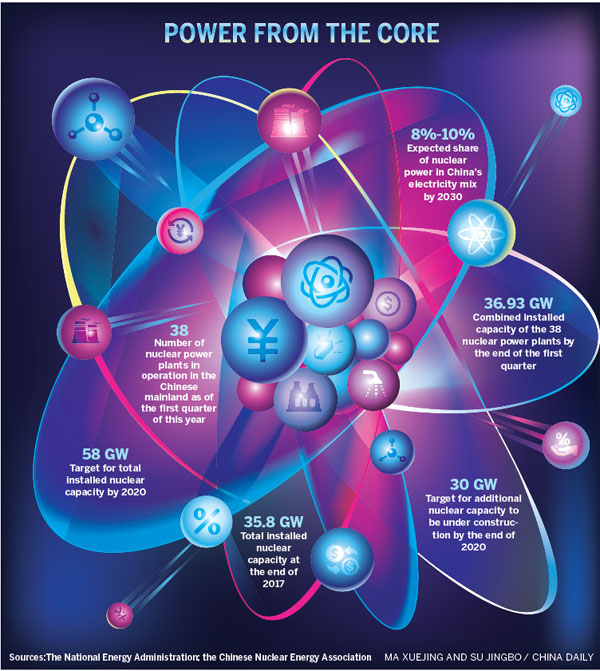
According to the 13th Five-Year Plan (2016-20) for power production released by the National Energy Administration, nuclear power is expected to provide 8 percent to 10 percent of China's electricity needs by 2030.
As of the first quarter in 2018, there were 38 nuclear power units in operation in the Chinese mainland with a combined installed capacity of 36.93 million kilowatts, according to data from the Chinese Nuclear Energy Association.
China has vowed to raise its total installed nuclear capacity to 58 GW by 2020, up from 35.8 GW at the end of 2017. It also aims to have another 30 GW under construction by the end of 2020.
However, Jacobelli said with no new reactor project approved in the country for more than two years, China might not be able to accomplish its 2020 targets.
"It is unlikely that by 2020 China will have commissioned 58 GW," said Jacobelli. "But it will be shifted forward so that China would still end up with 88 GW or more before 2025."




















