



Don't panic over bad doses, experts advise









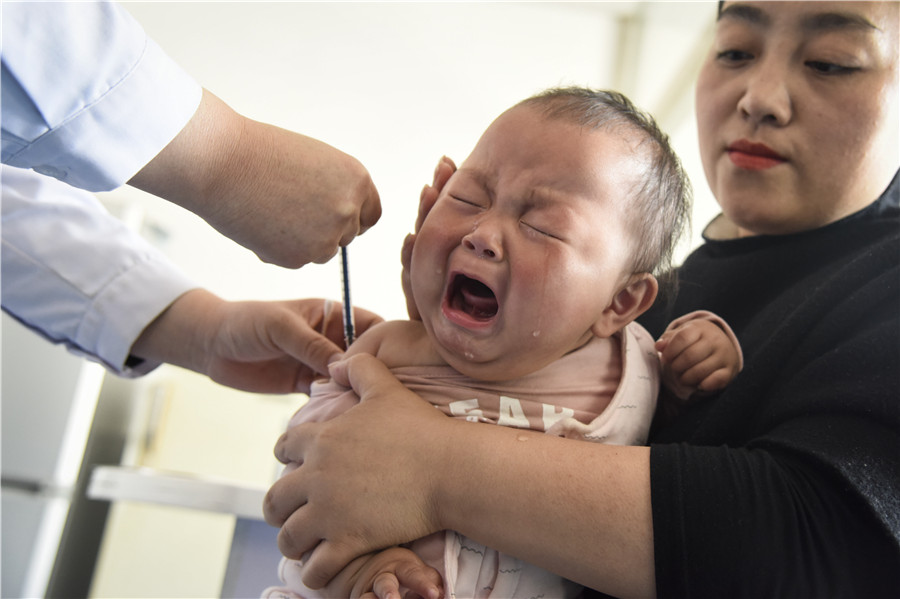
Vaccines in China are deeply mired in a crisis of trust, as public concerns about safety continue in the wake of recent scandals.
Meanwhile, experts are calling for a rational attitude toward immunization.
"Vaccination is the most effective and safest way to prevent diseases. If parents refuse to have their children vaccinated - especially vaccinations on the priority recommended list - they will put their children at much higher risk," said Zeng Guang, an epidemiologist at China's Center for Disease Control and Prevention.
Zeng expressed worry that the recent vaccine crisis may result in some people refusing vaccinations. That's even more risky than being vaccinated with substandard vaccine, Zeng said.
Changchun Changsheng Bio-tech Co, which was found to have falsified production records for freeze-dried rabies vaccines for human use, was also linked to substandard diphtheria, tetanus and pertussis (DTaP) vaccines for infants.
The company admitted in November that 252,600 doses of its DTaP vaccine didn't meet standards. The doses were all sold in Shandong province.
By Monday evening, an online topic tagged "Changsheng vaccine problem" had been viewed more than 100 million times on social platform Sina Weibo. About 46,000 comments were posted, with many people worried about whether it was safe to choose domestic vaccines in the future.
"Those DTaP vaccines are less effective, but they won't harm people's health," Zeng said. "Nor does getting those vaccines mean that the immunization is in vain. Parents should ask their doctors to help decide whether their children need to be vaccinated again."
The DTaP vaccine, which protects young children from diphtheria, tetanus and whooping cough, is part of the country's national immunization program that is required for school admittance. Most children who have had the DTaP vaccine will be protected throughout childhood.
Many more children would get the diseases if vaccinations ceased, the Chinese CDC said. Unvaccinated children face much higher risks of severe diseases, including heart failure and breathing problems that can lead to death.
In 2011, the World Health Organization announced that China's top food and drug authority and affiliated institutions had met all WHO standards for a functional vaccine regulatory system.
Major qualifications include licensing of vaccines, post-marketing surveillance and monitoring of clinical trials and adverse reactions.
"Domestic vaccines meet the quality standards of the World Health Organization and provide users a cheaper price," said Tao Lina, a medical expert from the Shanghai Center for Disease Control and Prevention.
"Problems such as what the authorities found in the two scandals should be severely punished. But they shouldn't lead to a death sentence for all vaccines made domestically," he said.
China is the world's biggest vaccine producer and has more than 40 vaccine manufacturers that produce 63 kinds of vaccines - with an annual production of about 1 billion doses - that can prevent 34 diseases, according to the CDC.
More than 90 percent of vaccines in the Chinese market are made domestically. A total of 561 million doses of the top 20 recommended vaccines were produced last year, including the DTaP and vaccines for hepatitis B and polio.
Between 2008 and 2017, a total of 944 batches of vaccines were inspected by the State Drug Administration to guarantee their safety. Inspections covered the full spectrum, from production to transportation and use. Overall, 99.6 percent met national standards.
In recent years, four vaccines made in China have earned the WHO's vaccine prequalification certification - for UNICEF and other UN agencies that purchase vaccines.
"It indicates that the quality of domestic vaccines is reliable and meets international standards," said Li Jianming, director of the State Drug Administration's Center for Food and Drug Inspection.


- 9.41 billion cross-regional trips made during 2026 Spring Festival travel rush
- Rapeseed festival boosts rural vitalization in Sichuan
- Chinese astronomers discover star formation in high-velocity cloud
- China's rail network sets new Spring Festival travel records
- Yunnan trains offer stools for standing passengers without seats
- China releases full text of government work report





