



Balancing growth and inflation over tea









China Reform and Opening – Forty Years in Perspective
Balancing growth and inflation over tea
Editor’s note:Laurence Brahm, first came to China as a fresh university exchange student from the US in 1981 and he has spent much of the past three and a half decades living and working in the country. He has been a lawyer, a writer, and now he is Founding Director of Himalayan Consensus and a Senior International Fellow at the Center for China and Globalization.
He has captured his own story and the nation’s journey in China Reform and Opening – Forty Years in Perspective. China Daily is running a series of articles every Thursday starting from May 24 that reveal the changes that have taken place in the country in the past four decades. Keep track of the story by following us.
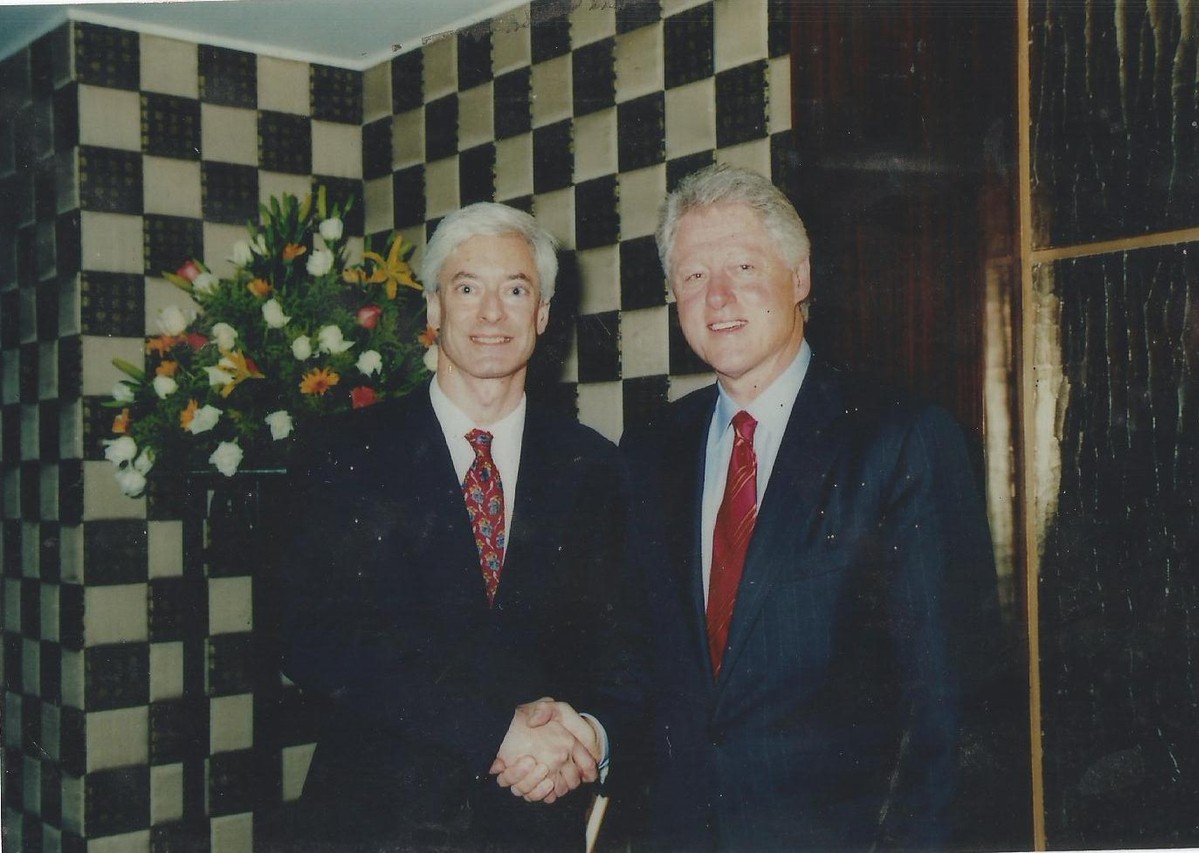
As cups of hot Longjing Dragon Well tea were served and placed carefully on the table between us, I asked then-premier Zhu Rongji how he balanced the odds when making key decisions on economic and financial policy. What did he actually consider in those critical moments when coming to a final decision?
Premier Zhu thought pensively for a moment then replied with his characteristic directness, “Everyone knows, within economics there has to be a social-psychology effect. I call it the effect on a mass of sheep.”
Frankly, I expected to get some lecture about an economic formula or policy framework. His answer was just down-to-earth. The key point I learned from Zhu was the importance of psychological affect when determining economic policy.
When Zhu Rongji was promoted from mayor of Shanghai to the vice-premier of the State Council in 1992 his biggest challenge was managing an economy of high growth while controlling inflation. Following China’s inflation shock in the late 1980s, concern over an inflation re-bout pre-occupied the leadership’s concerns. As China’s economy re-kick-started in the early 1990s, focus shifted away from controlling inflation to sparking growth. Obviously, high growth carries with it the possibility of inflation. The question was how to balance both?
Inflation lessons from attempts at applying shock therapy in the late 1980s were still raw. Shock therapy had failed as a reform methodology. Moreover, it was packed with western ideology. People wanted Chinese pragmatism not American theory. The Soviet Union’s collapse and ensuing mess in Eastern Europe were stark lessons of exactly what China did not want. China needed its own economic model, not something fantasized in a Harvard classroom that was irrelevant for China. Instead of shock, the leadership talked about gradual sequencing. He called it, “crossing the river by feeling the stones one at a time.”
Thereafter China began focusing on high growth rates. In 1998 Zhu promised during his press conference at the National People’s Congress no less than 8 percent per annum growth during his term that ended in 2005. After that the economy maintained over a decade growth rates averaging well above 9 percent. But by that time it was just blind growth, led mostly by government driven fixed-asset investments, often creating as much disruption to communities and environment as contributing to the health of China’s economy.
The introduction of the market as a concept into China’s economy sent signals that everything was open for business, even if regulatory frameworks were not yet in place. It also raised expectations unrealistically. Everyone sought some way to get rich quick. The sudden freeing of China’s economy stimulated rocket inflation, which hit 21.7 percent by 1993. Controlling inflation now became China’s number one priority.
Zhu Rongji was then vice-premier holding portfolios for production and economics. Amid mounting crisis he was then given the financial portfolio as well. He personally took over the central bank as acting governor, while serving as vice-premier. This gave him effective control over the banking and finance portfolios as well opening the door for a series of experiments in combining planning tools with market that would become the foundation of fusion economics .
The concept of a “macro control” market economy really began in June 1993 when Zhu introduced “Sixteen Measures for Macro-Economic Control” that unabashedly combined western market levers of fiscal and monetary policy with outright state administrative controls. These measures carried both the punch of socialist planning together with monetary and fiscal tools of a market economy. Zhu sidelined ideology and theory instead applying this pragmatic framework to all aspects of China’s economic transition. To everyone’s surprise, it worked.
The “Sixteen Measures for Macro-Economic Control” would become famous in the lingo of Chinese economists. Their almost Zen simplicity and practicality disregarding all fancy language and theory flew right in the face of neo-liberal economists. Observers in Washington and Europe were stunned. Zhu was challenging neo-liberal market fundamentalism on its face. Observers in Asia, Africa, and South America however watched with gleeful fascination as this experiment unfolded, offering an alternative path that they could build on .
The “16 Measures” were: 1) controlling money supply, 2) prohibiting raising capital illegally, 3) actively leveraging interest rates, 4) prohibiting “chaotic” fund raising, 5) controlling lending, 6) paying back depositors, 7) strengthening financial reforms, 8) reforming investment and financing structures, 9) national debt issues, 10) refine the management of issuing and trading shares, 11) restructuring the foreign exchange market, 12) strengthening control over the real estate market, 13) tightening tax loopholes, 14) stopping construction projects, 15) price controls, 16) controlling purchasing power.
The “Sixteen Measures” were drafted in one night by Zhu’s monetary policy advisor Li Jiange, then a vice-minister of SCRES and Lou Jiwei who later would become vice-minister of finance and Chairman of China Investment Corporation, the nation’s sovereign wealth fund. Li Jiange became one of my closest friends in China and we often spoke at great length about monetary policy concerns throughout Zhu’s term and for years after. I would turn to him for advice nearly two decades later when drafting policy for China’s green economic growth the initial draft framework of which would be based on the Sixteen Measures.
The effect of the Sixteen Measures was by 1995 inflation had dropped to 15 percent. A year later it dropped again to 6.1 percent while growth was successfully maintained at 9.7 percent. In 1997 inflation dropped to 0.8 percent while growth stayed at 8.8 percent. By 1998, at an international press conference held in Beijing’s cavernous Great Hall of the People, Premier Zhu Rongji explained the success of his fusion economics policy pronouncing his “three guarantees”: 8 percent growth, 3 percent inflation, and no currency devaluation. These “three guarantees” gave people the confidence they needed to allow China’s next stage of major reforms to push forward – the restructuring of State-owned enterprises.
As Zhu said to me over Longjing tea, “If people are skeptical about your policy, even if it is correct, it will be difficult to implement and will be useless in producing any effect.” This was the point that he drove home. Economic theory, for the sake of proving a theory, can be bad medicine for an economy.
In the west so much of our economic theory is brainstormed by academics to win awards, but has little relevance to how a person in the street eats, or lives their life. If people do not buy-in, or are not sufficiently motivated by a policy decision, the underlying economic theory is useless.
Please click here to read previous articles.





