A town changed by one minute









by Xinhua writers Lyu Qiuping, Deng Zhonghao and Wang Hui
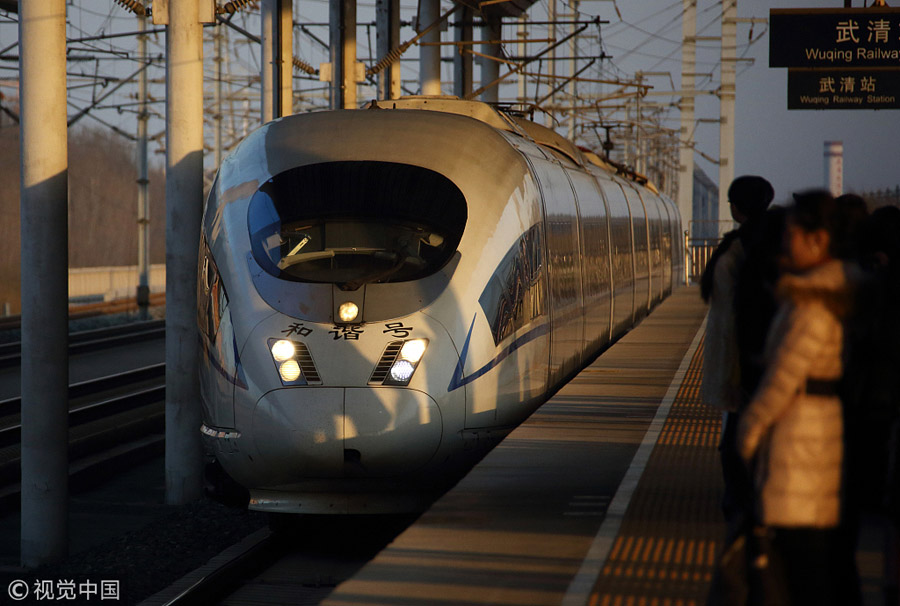
TIANJIN -- While approaching the Wuqing Station, the C2205 high-speed train slows its speed and stops for one minute. Wang Ye, 33, disembarks.
Wang, a technical manager, takes this train every morning to work.
On weekdays, Wang gets up at 5:40 am, leaves her home in Haidian district, Beijing by 6:15, and boards the train scheduled to depart at 7:18 at Beijing South Railway Station.
In 24 minutes, the train takes her to Wuqing, where Wang works at Tieke Zongheng, a train part manufacturing factory affiliated with the China Academy of Railway Sciences.
Among the 150-plus employees in the factory, more than 20, including Wang, commute between their homes in Beijing and the company every day.
"Some of us don't have to get up super early if we live near the (Beijing) south railway station," said Wang. "High-speed trains have made the cross-city commute possible."
Wang, the mother of a four-year-old boy, prefers to travel every day to accompany her son rather than rent an apartment near her company. "Some people working in Beijing have a longer commute on their way to work."
Tieke Zongheng, which develops and produces train parts like brakes, is among the 8,200 projects transferred from Beijing over the past five years, as part of China's national strategy for the integrated development of Beijing, Tianjin and Hebei. Investment of these projects has totaled 51.6 billion yuan ($7.6 billion), according to the investment bureau of Wuqing district government.
Wuqing district, Tianjin municipality, is located between the urban areas of Beijing and Tianjin, some 70 km from Beijing city proper.
After the Beijing-Tianjin high-speed train services were launched on Aug 1, 2008, despite only stopping for one minute, the stop at Wuqing brought prosperity to the once deserted water transport hub.
While Wang travels to Wuqing every day, Zhou Yujie commutes in the opposite direction.
Zhou, from Inner Mongolia autonomous region, works in a biotech company in Beijing's Chaoyang district. The company, Novogene, has moved part of its business to Wuqing, one of the reasons Zhou decided to locate his family there.
Every day, he leaves home in Wuqing at 8 am and arrives at the company in Jiuxianqiao at 9:30 am, first by train and then Subway Line 14.
Holding a household registration in Wuqing, he will be able to send his children to local schools, which are reputable in Tianjin Municipality.
"There is no 'urban disease' like traffic congestion, and we like the peaceful and slow life here," Zhou said.
Wuqing used to be a water transport hub through which cargo was carried to Beijing along the Grand Canal, the world's longest man-made waterway during the Yuan, Ming, and Qing dynasties.
The town gradually lost its shine when railway and highway delivery replaced water transport, until the Beijing-Tianjin line, China's first high-speed railway line, helped modernize the region.
"Like the ancient canal that brought prosperity, high-speed railway is a new kind of 'canal' that has revived Wuqing," said Chai Liang, with Wuqing investment bureau.
Chai recalled that in 2008, contracted investment in the district almost doubled to 11 billion yuan. The investment volume sky-rocketed to 50.5 billion yuan last year.
High-speed trains bring not only high-tech employees and investment but also tourists.
One overpass away from Wuqing railway station, a shopping center called Florence draws many tourists from Beijing and Tianjin.
The center is known for its luxury brand outlets that offer much lower prices than the stores in downtown Beijing and Tianjin.
Sun Zhiqin, from Heilongjiang province, who sells jewelry in Beijing's Chaoyang district, has come to shop here several times. This time, she asked her friends in Tianjin to join her.
"It's very convenient to come by train and shop here," Sun said.
Tao Jingyan, director of the Wuqing tourism management service center, said the tourism industry of the district was developed based on nothing.
"Unlike resort cities with mountains or coastal resources, Wuqing would have no tourists if high-speed trains did not stop here," she said.
Wuqing has no tourism bureau. The tourism center, a state-owned company in charge of tourism management and planning in the district, was not set up until 2012.
Tao said the district also developed resorts like a cherry garden, an amusement park and a camping site for motor homes near the Grand Canal.
Over the past six years, the number of tourists had quadrupled to 18.8 million by 2017, with tourism revenue increasing over 80 times to 9 billion yuan.
At the Wuqing railway station, retiree Xuan Yumei and her friend awaited their train to tour around Beijing.
Xuan and her husband, from Changchun, Jilin province, bought an apartment in Wuqing in 2016 so that their son, who started an IT company in Beijing, could come to visit often.
"The housing price here is much lower than Beijing, and it takes just 10 minutes to walk home from the station," she said.
Yao Bing, master of the Wuqing railway station, said only six trains stopped daily at the station ten years ago. The number has now jumped to 23 at most, as an average 8,000 passengers board the train from Wuqing every day, compared with only 300 passengers in 2008.
To meet the demand of the increasing number of passengers, the station was expanded in 2014, with its floor space doubled to 4,400 square meters.
"As soon as the expansion was completed, we realized the station wasn't big enough," he said, adding further expansion is being planned.
"The station has become a landmark here," he said.
- Historical Han Dynasty slips go on display in Hohhot
- Shanghai unveils steps to build sci-tech innovation corridor in Yangtze River Delta
- Xiangchao concludes with Yongzhou claiming championship
- Answers
- CPC leadership meeting urges steadfast implementation of eight-point decision on improving conduct
- Ethiopian coffee trading center unveiled in Zhuzhou