'America First' policy dooms US' Indo-Pacific strategy to failure









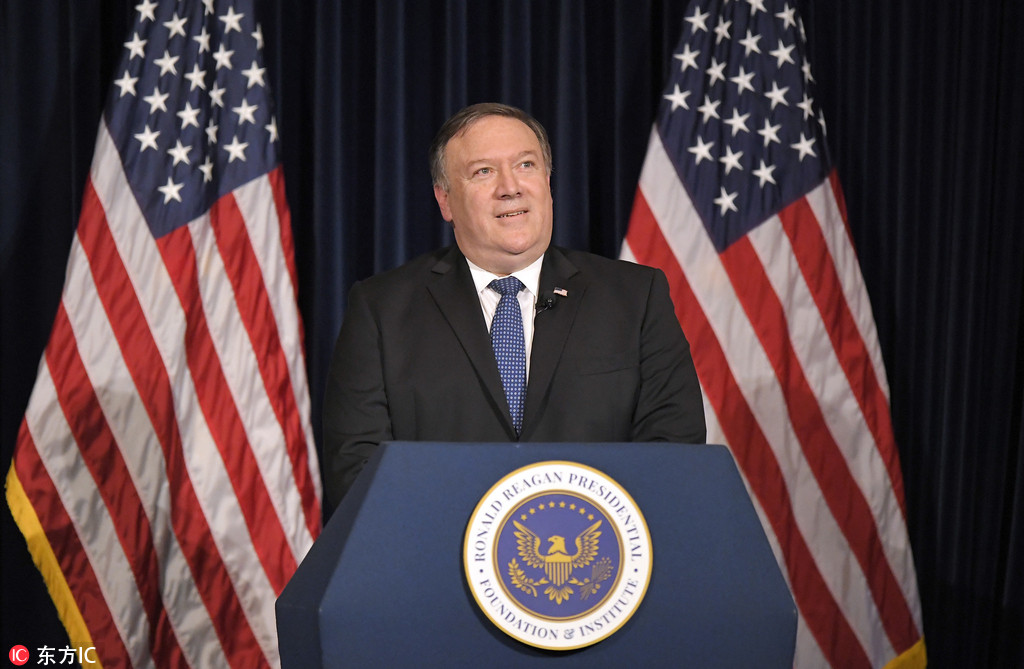
While US Secretary of State Mike Pompeo's elaboration on a free and open Indo-Pacific at a business forum in Washington on Monday, two days before he embarked on a trip to Asia, was not short of lofty words and promises, it did lack honesty, sincerity and substance.
In defining the strategy, Pompeo said the United States seeks "partnership, not domination". Yet it is clear that the latter is exactly what the US does want. Having been the dominant power in the region since the end of World War II, it now feels that position is threatened by China's rise. The Donald Trump administration's so-called Indo-Pacific strategy is a rebranding of the pivot to Asia strategy of the Obama administration with the same aim of countering China's growing influence in the region, which is viewed by Washington as a challenge to its dominance.
Pompeo and other senior State Department officials have tried to depict the Indo-Pacific strategy as inclusive and not meant to contain China, but such words are not credible.
The Trump administration in May abruptly canceled its invitation to China to the Rim of the Pacific naval exercises despite the fact that China participated in the drills in 2014 and 2016 when tension in the South China Sea was much higher.
The tension is substantially lower now, with China and the members of the Association of Southeast Asian Nations actively pursuing a Code of Conduct in the South China Sea. The US, not a claimant to maritime territories there, should not sabotage the peaceful settlement of disputes.
Make no mistake. China, as the world's largest trading nation, has more at stake than any other country in ensuring freedom of navigation in the South China Sea.
Pompeo talked about committing US investment in the region's infrastructure. However, with the Trump administration still struggling to fund its $1 trillion domestic infrastructure initiative, such a pledge is an empty promise.
Pompeo did not mention the Asian Infrastructure Investment Bank whose mission is to address the shortfall in infrastructure investment. The US is among a few countries in the region which are not AIIB members.
China's Belt and Road Initiative, a bid to build connectivity in the region and beyond, has also been supported by most countries in the region.
It is true that the AIIB and Belt and Road Initiative both have room for improvement, yet the US' doubts about them show that Washington is too obsessed with its own dominance and geopolitics rather than peace and prosperity of the region.
China-haters in Washington have been celebrating the administration's Indo-Pacific strategy, especially the so-called Quad alliance, which brings together the US, Japan, Australia and India in concerted efforts to contain China.
But close observers know their interests are not aligned and it will be difficult for them to bring them into alignment. Indian Prime Minister Narendra Modi explicitly stated at the Shangri-La Dialogue two months ago that India seeks an "inclusive" Indo-Pacific and will not isolate any country, a clear message to the US.
What really undermines the entire Indo-Pacific strategy is US President Donald Trump's "America First" policy, which contradicts everything Pompeo tried to sell to the region.
By withdrawing the US from the Paris climate accord, the Iran nuclear deal, the Trans-Pacific Partnership, and UNESCO, and by disdaining the World Trade Organization and the international trade system, Trump has seriously damaged the credibility and leadership of the US in the region.
East Asian economies, which embrace globalization and multilateralism, and are well integrated in the global supply chains, stand to suffer the most from the trade wars being waged by the Trump administration.
Unable to claim the moral high ground and without the power of setting a good example for the region, the US will hardly succeed with its flawed Indo-Pacific strategy.
The author is a columnist at China Daily. chenweihua@chinadailyusa.com