



Campaign aims to give disabled people dignity, independence









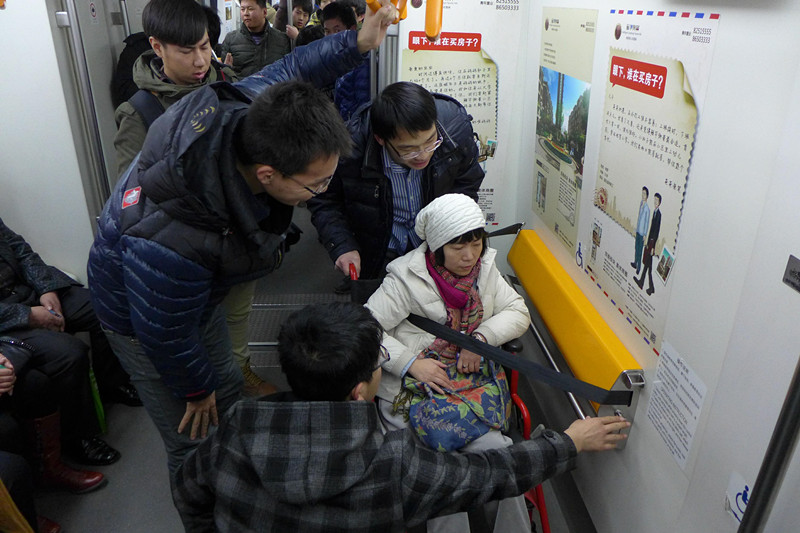
Introducing improvements
China began improving access for the disabled in 1989, when the federation teamed up with the Ministry of Civil Affairs and the then Ministry of National Construction to roll out construction standards for urban roads and buildings.
The standards, which set parameters such as gradients for urban roads and the width of doors in public buildings, marked the beginning of compulsory disabled access in public spaces. Designs that failed the requirements were rejected.
The cause was further boosted in the run-up to the 2008 Olympic Games in Beijing. It was the first time the Games had been held in China, meaning the country and its infrastructure came under intense global scrutiny.
In response, Beijing and other large cities invested heavily to improve disabled access to public transportation and other facilities, such as sports centers. Official figures show that 14,000 accessibility-related projects were carried out in Beijing between 2001 and 2008, surpassing the number undertaken nationwide in the previous two decades.
The Olympic year also saw revisions to the laws related to discrimination against the disabled, and the addition of more-detailed rules outlining the role of accessibility in construction plans.
In 2012, the country rolled out its first specific regulation on ensuring access in all spheres, and a short while later a number of cities passed legislation allowing guide dogs to ride subway trains with their owners.
Better access
However, despite 30 years of efforts, a lack of access to major buildings or poorly conceived arrangements at such facilities mean that few of China's 85 million registered disabled people are able to visit many well-known public places.
Elevators are still a luxury at some subway stations, while tactile paving-raised areas on sidewalks to guide blind people-sometimes terminate at walls or are blocked by inappropriately situated lampposts, and some wheelchair ramps are too steep to be used safely. Moreover, many toilet stalls reserved for disabled people lack handrails.
According to a 2012 survey conducted by the federation, only one-third of supposedly accessible facilities in Beijing accorded with international standards, and almost 70 percent of disabled people nationwide voiced discontent with the level of access to public spaces.
Moreover, irresponsible parking and the growth in shared bicycles left at random on sidewalks and outside buildings are reducing access to many places, according to Nie Zhongyuan, a media professional who has directed three TV adverts designed to raise awareness of the correct use of such amenities.
The 29-year-old said the situation is at its worst in community-based facilities, and it is essential that disabled people are provided with suitable access to roads, transportation and shopping malls. Inadequate access to residential properties means few disabled people leave their homes, so they enter a vicious circle.
"When we don't see something often enough we tend to ignore it. Thus, the disabled are becoming 'invisible', making every encounter with them shocking, even scary, for some people," said Nie, creative director at Huagan Creative Communication Co in Nanchang, Jiangxi province.
"So they are cursed, disliked, bullied and pitied, which forces them to accept the false perception that they are not members of society-that they are not needed, that they are not loved."


- State Council to oversee probe into fatal explosion in Shanxi province
- Jing'an marks 2026 Year of the Horse with light show, Shanghai-style fair
- Flu activity drops in China, but authorities warn of potential virus risks amid holiday travel rush
- China issues action plan to revitalize theatrical arts
- Jimmy Lai sentenced to 20 years in prison
- Beautiful Hebei episode 11: Discover red tourism destinations












