How US is hurting itself in the tariff war









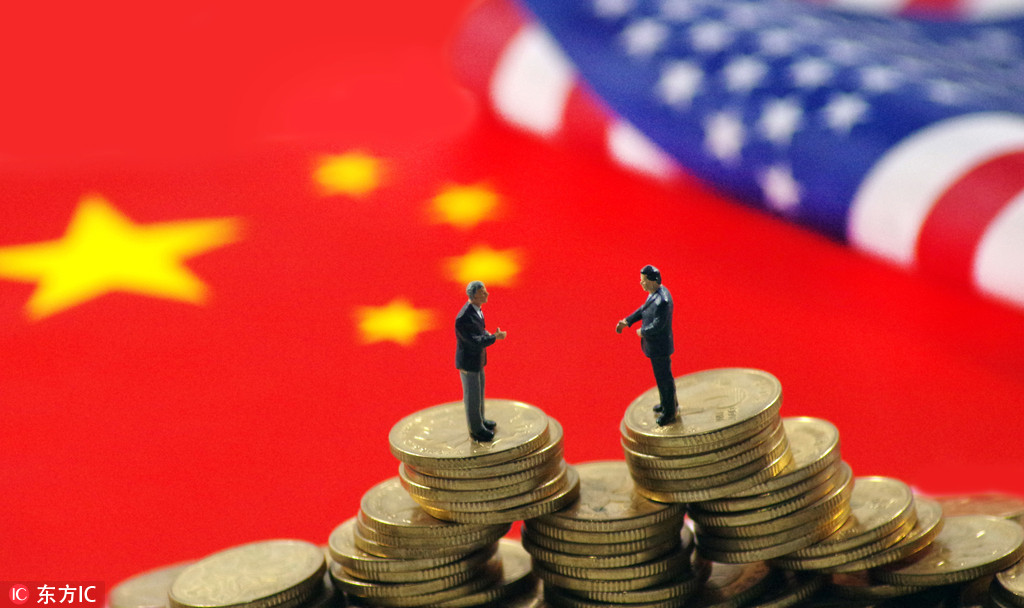
After months of trade threats, the Donald Trump administration announced its 25 percent tariff on $34 billion of Chinese imports effective in early July, while threatening levies on another $16 billion of imports. To defend its sovereign interest, China responded by imposing 25 percent tariffs on $34 billion of US imports, and recently announced an additional tariff of 25 percent on $16 billion of US imports effective on Aug 23.
Last year, US President Donald Trump's threats caused Chinese investment in the United States to plunge to $29 billion from $46 billion, partly due to deleveraging in China but mainly thanks to very stringent US regulatory reviews of inbound acquisitions. After months of tariff war, Chinese investment in 2018, asset divestitures included, is negative in the US.
Ironically, much of the collateral damage will hit the US, however. Historically, advanced economies tend to enjoy service surpluses but goods deficits in trade, thanks to higher productivity and added value. And US-Chinese trade ties are no exception.
US has surplus against China in service trade
According to most recent data (2017), US goods exports to China are $130 billion, whereas imports from China are $506 billion. As a result, US trade deficit with China amounts to $375 billion. In contrast, US services exports to China are $54 billion, while services imports from China are $16 billion (2016 figures). Consequently, US trade services trade surplus with China is $38 billion.
As China exports far more goods to the US than vice-versa, Chinese retaliations already cover more US goods (85 percent) than US tariffs cover Chinese imports (50 percent). So as the ongoing trade conflict shifts from goods tariffs to non-tariff actions in services, China is likely to target US services. But China will not be the first to do so.
A few weeks ago, when Trump unleashed a tweet storm against Germany and the European Union, German Chancellor Angela Merkel rightly pointed out that it is misleading to focus on goods trade, in which the US has deficit against the EU, when the US excels in services trade, in which it has a surplus against the EU. With other EU leaders, Merkel is backing a "digital tax" against US multinationals such as Amazon, Facebook and Google, which have come under fire for shifting earnings around Europe to pay lower taxes.
Ironically, Trump's tariffs have the potential to undermine the US' most important competitive advantage in the postwar era-h(huán)igh-value, high-margin services, which range from the technology sector to the pharmaceutical sector.
Collaboration with US states bearing fruits
Since 2001, US services surplus with China has increased nine-fold. A major beneficiary of the surplus is Houston, Texas. Last fall, Mayor of Houston Sylvester Turner led a business delegation to China with energy executives, hospital administrators, physicians, medical researchers and entrepreneurs. The visit fostered many collaborative projects, including a medical center based on imported technology and consulting services from Houston.
Much of US services trade surplus with China can be attributed to Chinese travelers' spending on US business, medical treatment and education, as well as an increasing number of innovative Chinese companies spending on US licensing fees and royalties for intellectual property. Yet, in Texas, Trump's tariffs are now endangering major projects that took years to build.
As collateral damage will spread, so will the costs. If US metropolitan centers will take severe hits, the stakes will be much higher for US states. Last year, California's trade with China totaled $170 billion, covering electric cars, engines, auto parts and aluminum. "A trade war is stupid," warns California Governor Jerry Brown, and for a reason. Among the US states, California, which is already facing a $1.6 billion budget deficit, stands to suffer the greatest pain if Trump intensifies his tariff war.
All US sectors will be hit if a trade war breaks out
Yet this could be only the beginning. If a trade war spills from goods to services, neither Silicon Valley nor Hollywood will remain immune.
By upping the stakes in its trade war, the Trump administration is endangering US services surpluses not just with China, but also with its other "deficit targets". Trump's dream is to defeat China in a trade war and then use that "demonstration effect" to force others-the EU, Canada and Mexico, Japan and the Republic of Korea-on their knees. That's the White House's ultimate goal: First to "shock and awe" its trade adversaries, and then to negotiate the best terms for the US-"America First".
However, the White House severely underestimates the resilience of the Chinese economy and its people. Moreover, US tariff wars against its partners in Europe, North America and the Asia-Pacific region are not a matter of principle, just a matter of time.
The author is the founder of Difference Group and has served in the India, China and America Institute (USA) and as visiting fellow at the Shanghai Institutes for International Studies (China) and the EU Centre (Singapore).