Typhoon signal hoisted









China Reform and Opening – Forty Years in Perspective
Typhoon signal hoisted
Editor's note:Laurence Brahm, first came to China as a fresh university exchange student from the US in 1981 and he has spent much of the past three and a half decades living and working in the country. He has been a lawyer, a writer, and now he is Founding Director of Himalayan Consensus and a Senior International Fellow at the Center for China and Globalization.
He has captured his own story and the nation's journey in China Reform and Opening – Forty Years in Perspective. China Daily is running a series of articles every Thursday starting from May 24 that reveal the changes that have taken place in the country in the past four decades. Keep track of the story by following us.

With Zhou Nan (R), former Xinhua News Agency Bureau Chief in Hong Kong. Zhou Nan was a key negotiator and strategist in the run up to Hong Kong's return to China on July 1, 1997. [Photo provided to chinadaily.com.cn]
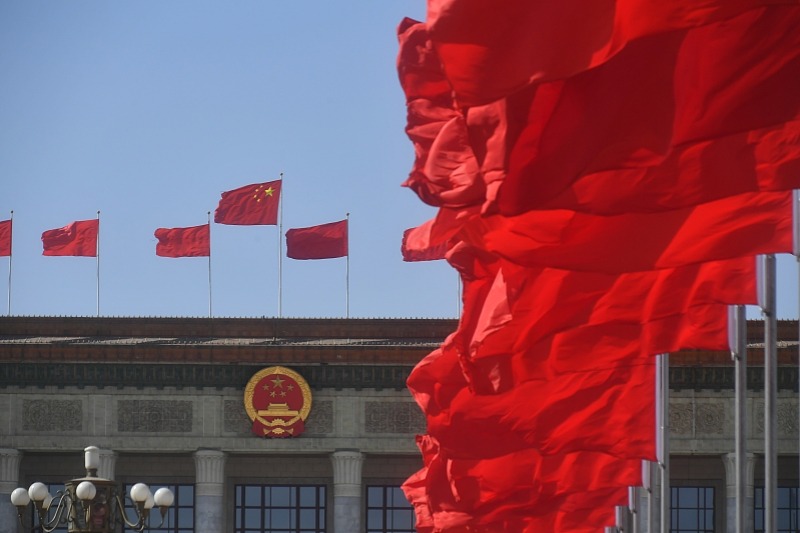
On the eve of June 30, 1997, Hong Kong was abuzz. The Chinese flag hung from virtually every rooftop, shop restaurant and entertainment outlet that was about to become a special administrative region of China.
Despite the heavy rain that had continued throughout the night, the party raged on into the early hours. Those who were still awake the following morning came onto the streets carrying small Chinese flags to welcome People's Liberation Army as it drove right into the old Tamar British garrison- once known as the Prince of Wales Building- in the center of Hong Kong’s financial district.
I had the unique opportunity to watch the closing British ceremony at Tamar naval base where Prince Charles and Governor Christopher Paton stood under a deluge of rain. Then to watch the actual event on big screens at the Hong Kong Foreign Correspondent’s Club, standing room only as journalists and business leaders packed in to watch the coverage. In the morning, I was invited by a China’s State Council to attend the founding ceremony of the Hong Kong SAR. In one night from dusk to dawn, I witnessed all sides and aspects of the event.
Amid all of the excitement surrounding Hong Kong’s return to China, few paid much attention to the international foreign-exchange markets, much less those of nearby Thailand. On July 1, 1997, speculators managing international hedge funds relentlessly attacked the Thai baht. By a strange coincidence, this occurred precisely on the day Hong Kong was returned to China---an event which went smoothly, despite the numerous doomsday scenarios speculated in some of the Western press. To support its besieged currency, the Thai government threw its foreign-exchange reserves at the market trying to buy back baht. The hedge funds were overwhelming and, within a matter of days, had brought about the collapse of both the baht and the government of Prime Minister Chavalit Yongchaiyudh. Imagine what kind of support must have been behind the speculators to enable them to mobilize funds with enough force to bring down a nation's government. More governments would soon follow.
At the time, it was hard for many in Hong Kong to fathom a direct connection between Thailand’s financial collapse and celebrations in China. There seemed to be little in common between the financial, economic and political systems of the two countries. However, an eerily consistent pattern-of speculator attack and government response, IMF bailout attached to specified conditions, social disorder and government collapse – was to unfold within the region over the weeks and months that followed.
Matters became acute in Hong Kong, and clearer in Beijing, when the currency attack shifted to the Hong Kong dollar. When the hedge funds came to Hong Kong's doorstep, the then-secretary of the Hong Kong Monetary Authority, Joseph Yam, challenged the speculators, warning that "those who speculate on the Hong Kong dollar will be burned". Hong Kong's own reserves at the time were about $88 billion. Nevertheless, despite Hong Kong’s strong reserves, speculators struck the Hong Kong dollar consistently following Hong Kong's return to China.
Many were confused as to what was really going on. Was the objective of these speculators to somehow try and bring down Hong Kong's financial system, or to try to weaken the Hong Kong dollar, in turn affecting the renminbi? The worst attack was in September 1997. The currency held, with public faith encouraged largely by statements from China's leaders to the effect that the Renminbi would not be devalued and the national reserves would be behind the Hong Kong Special Administrative Region (SAR). The Hong Kong Monetary Authority played the speculators at their own game by drawing on Hong Kong's own foreign exchange reserves to buy Hong Kong dollars, and the Hong Kong dollar remained firm. Joseph Yam had the confidence to play the speculators' game hard enough to win. Why was he so confident when the monetary authorities of other Asian countries were being beaten at the game?
The fact was that public faith in the Hong Kong dollar was ultimately being backed by China's own foreign-exchange reserves. This became clear on March 22, 1998, when, in answering questions from foreign and domestic media concerning the effects of the Asian financial crisis, Zhu Rongji said that "If the Hong Kong SAR Government for some reason requests assistance under special request, then the central government will provide unlimited support to establish Hong Kong's financial stability". Knowing that the People's Bank of China was standing by as provider of last resort gave the Hong Kong Monetary Authority the confidence to do battle against speculators. Zhu understood that this psychological support was the most important factor when considering reactions of international capital markets. These lessons are very relevant today.
Please click here to read previous articles.