As Beijing prepares to host the 7th Summit of the Forum on China-Africa Cooperation (FOCAC) on September 3-4 focusing on political and economic cooperation, recent data highlights how China has intensified its efforts to enhance the cultural dimension of its relations with African partners by establishing over 70 Confucius Institutes and classrooms across the continent in the last 14 years.
From zero presence in Africa before 2005, the number of Confucius Institutes has risen to a total of 48 in 2018, according to data compiled by Development Reimagined, a Beijing-based international consulting firm working in the field of China-Africa relations.
The data also shows that between 2007 and 2018, China has set up 23 Confucius Classrooms in Africa with seven more planned by the end of 2019.
"Cultural exchanges are crucial for Chinese and African people to understand each other and for the two sides to further consolidate their relations," David Monyae, co-director of the Confucius Institute at University of Johannesburg, South Africa, told Xinhua News Agency in an interview last month.
"People-to-people exchanges should be a priority in China-Africa relations since the two sides need to better understand each other's culture, history and even law. There's a growing interest among the African youths to know more about China," Monyae said, explaining the significant jump in the numbers of Chinese cultural centers in the continent.
The Confucius Institute program began in 2004 and is overseen by the Office of Chinese Language Council International, also known as Hanban. The institutes operate in co-operation with local affiliate colleges and universities around the world, and financing is shared between Hanban and the host institutions. The related Confucius Classroom program partners with local secondary schools or school districts to provide teachers and instructional materials.
A striking progress
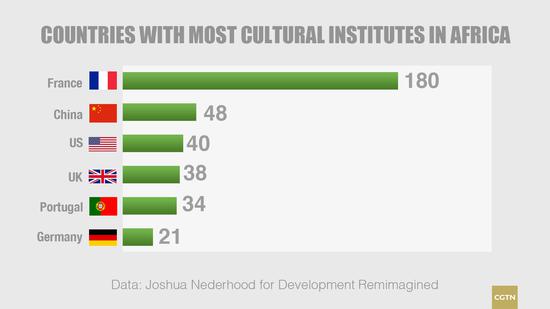
The 48 Confucius Institutes put China just behind France – with 180 centers of Alliance Francaise – when it comes to the number of international cultural centers in Africa, and much ahead of the US (40 centers), the UK (38), Portugal (34) and Germany (21).
Most of the Western cultural institutes – such as France's Institut Francais, Germany's Goethe Institute and the UK's British Council – started operating in Africa in the late 19th and early 20th century. The Alliance Francaise was established in 1883 while the British Council was established in 1934.
In comparison, the first Confucius Institute was set up in December 2005 at the University of Nairobi in Kenya. This is what makes the rapid outreach of the Chinese cultural centers more striking.
"With the strengthening of China-Africa ties in recent years, more African countries are doing business with China and naturally there's more curiosity about the country and willingness to understand its culture," South African journalist Omphitlhetse Mooki told CGTN Digital, explaining the phenomenal surge in the number of Confucius Institutes in the continent.
"I think China is also doing its part in an effort to get the world to understand it. If you open up you've got a lot of work to do to get people to understand you," said Mooki, who's currently in Beijing as part of the China-Africa Press Center exchange program.
Having analyzed the data on cultural institutes in African countries in depth, Joshua Nederhood of Development Reimagined observed that the Confucius Institutes "tend to flourish in countries that value China's culture more than its investments."