



Sharing leads to harvest of progress









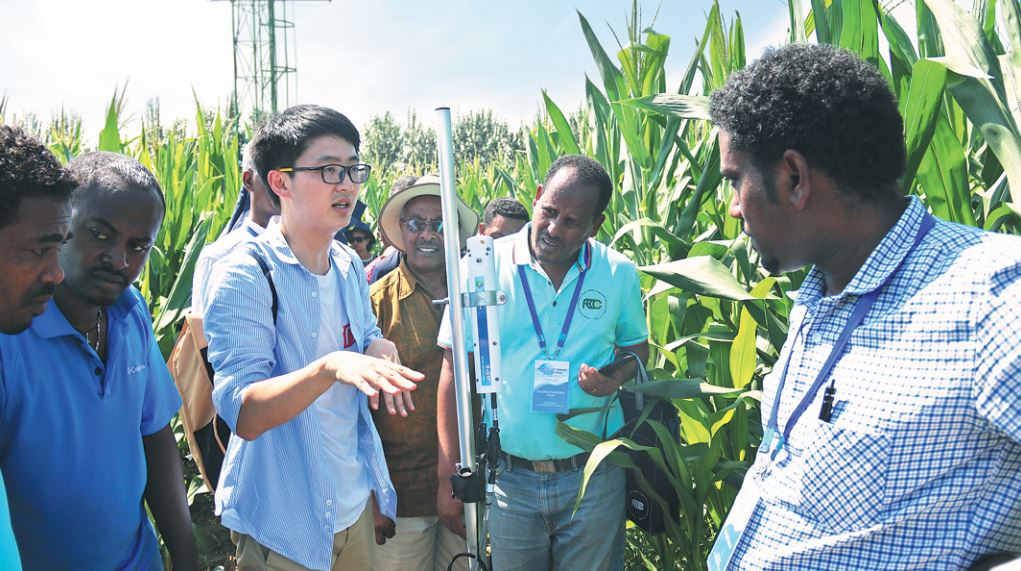
Ethiopian officials reap the benefits of China's rich agricultural experience
Elias Awol had a packed schedule with his group on a 10-day trip to China: attending lectures, taking field trips to farms and talking with farmers and business owners.
The official from the Ethiopian Ministry of Agriculture and Livestock Resources visited Beijing and Gansu province in August to garner China's expertise in irrigated agriculture (control of water supply to targeted areas).
"We could not afford complacency because we have a lot to learn, and we are in a race against time to put what we have learned into practice next year," said the director of Ethiopia's Small Scale Irrigation Directorate.
The development of irrigated agriculture is now a priority for the government of Ethiopia, the second most populated country in Africa that relies heavily on sporadic rainfall for its agriculture, to ensure food security and boost its economic growth. Last year, some 5.6 million people needed food aid in Ethiopia, which has been hit by a series of back-to-back droughts, according to the United Nations.
Awol's group is only one of many study tours hosted by China to share its experience on development with African countries in areas including agricultural production. China has hosted more than 200 study tours of this kind starting from 2006 to help African countries train government officials and technicians, according to the Ministry of Agriculture and Rural Affairs.
China has pledged to help Africa ensure its food security in the Forum on China-Africa Cooperation Johannesburg Action Plan.
In the plan, China and Africa said they would cooperate with each other in key fields such as exchanges on agricultural policies and related infrastructure improvement, as well as the development of support services. The plan also highlighted the need for China to help African countries develop water conservancy and irrigation projects.
In a speech delivered at the BRICS Business Forum in Johannesburg, South Africa on July 25, President Xi Jinping called for greater efforts to conduct cooperation with African countries in programs including poverty alleviation and food security.
Ethiopia is not alone among African countries facing the challenge of drought. Almost 13 million people across northeast Africa need aid due to insufficient rainfall, including 2.7 million in Kenya, 2.9 million people in Somalia and 1.6 million people in Uganda, Reuters reported in March 2017.
Only about 7 percent of the arable land in Africa is irrigated, and Africa has only made use of 4 percent of its renewable water resources, according to the Foreign Economic Cooperation Center of the agricultural ministry.
Teklu Tesfaye, a senior official with the World Bank in Ethiopia who was with the group, said lack of irrigation is a bottleneck factor that constrains agricultural development in many east African countries.
"If you look at Ethiopia's GDP, there have been many studies that showed clearly that GDP growth corresponded to the amount of rainfall that year. When the amount of precipitation falls, the GDP growth goes down as a result," he said.
He noted that for eastern African countries like Ethiopia, droughts are more frequent.
"With climate change, we are experiencing drought every two to three years. Previously, we used to have drought once every ten years," he said.
For some countries like Ethiopia, investing in irrigation is a way to ensure food security, he said.
In June, the World Bank approved a grant of $55 million to support the government of Mozambique's Smallholder Irrigated Agriculture and Market Access Project that aims to improve rural livelihoods through increased productivity, production, and access to markets.
Mozambique's agriculture productivity levels are lower than the average of comparable countries in southern Africa, and only about 2.5 percent of the country's cultivated land is irrigated.
Awol said irrigation is of crucial importance to ensuring Ethiopia's food security, as well as for the country's exports, including high-value crops.
He noted that the leadership of Ethiopia made a decision to learn from other countries, especially China, about irrigated agriculture.
China has a long history of irrigation, and has fine-tuned its technologies over the years, he said.
Tesfaye said that it would be an advantage to most African countries to learn from the experience of China, because the trajectory China has gone through is more or less like what the Africans are going through.
"If China can feed such a large population with such a small average arable land area, Africa should be better off. There is a lot that Africa can learn from China," he said.
However, cooperation is not only about China offering help in infrastructure development, but also sharing of China's experience in policy making and training of technicians.
"Policy makers need to learn what it takes to promote irrigated agriculture, both in terms of policies, strategies and regulations, institutions," he said.
Awol said the Ethiopians are also keenly interested in learning about China's experience in government institutions and the linkup of government departments, both at national and regional levels.
"It is also very important for us to look at the regulatory aspect, the making of regulations and policies," he said.
Teaching irrigation and dividing water rights among the farmers, and marketing agricultural produce, are also among the issues that he wanted to learn about, he added.
"How can we learn? What is it that the Chinese have done to get to where they are today? What was the challenge? What are the lessons?"
"I think for Africa, we must learn from mistakes made by China in the past, and build success on both its success and its failures," he said.
Li Xiaoyun, a professor who has conducted research into agricultural development in Africa, said China's decision to help Africa boost its agricultural productivity will also help to solve food security problem.
"Most importantly, it will help Africa to reduce poverty on a large scale," he said.
Li noted that the potential for agricultural development in Africa is so huge that the food produced by African nations could feed the world.
Awol said the development of irrigated farming in Ethiopia will also open the market for Chinese investors.
"As China beefs up its support to African countries, it is also important to ensure that Chinese enterprises can show its interests at the same time," he said.
He also pointed out that for enterprises to invest in Africa, it is also important to facilitate the transfer of technologies and step up capacity building for locals.










