



Many Chinese regions give incentives for birth of 2nd child









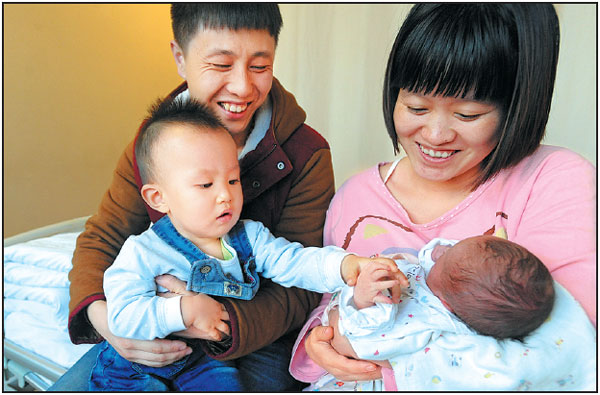
Since 2017, many regions in China have offered incentives to parents who give birth to a second child, as the country battles the problem of an aging population, the People's Daily has reported.
Chinese parents have been lukewarm to the universal second-child policy, which took effect on Jan 1, 2016, with many saying it is too costly to raise a child.
More policies emerge
To encourage more births, many regions have rolled out a flotilla of supporting policies related to childbearing and nursing, as well as a variety of subsidies and rewards, such as subsidies for childbirth, longer maternity leave and flexible working hours for new moms.
Liaoning province in Northeast China said in a recently issued plan that it will improve policies concerning taxes, education, social security and housing for those with second children.
It also encourages employers to provide flexible working hours and other conveniences for pregnant women and lactating women.
Xianning city of Central China's Hubei province also issued a similar policy, encouraging government agencies, enterprises and institutions to extend maternity leave for women with two or more children to six months, and paternity leave to one month, and to implement flexible working hours.
Many places around the country have introduced similar measures in the past few years. For instance, Shihezi city in Xinjiang Uygur autonomous region offered special allowances for giving birth to a second child, and offered allowances for formulas to families with a second child aged between 0 and 3.
Aging population
These regional policies come as the pressure of an aging population mounts.
Currently, the number of women of childbearing age is decreasing year by year, and the low birthrate and aging of the population is getting worse.
Take Liaoning province as an example. Official data show that the proportion of seniors aged 60 and above is 20.6 percent, while people aged 0-14 years constitute 10.4 percent. In 2015, the total fertility rate of the province was only 0.9, far lower than 2.1, the level needed for stable population replacement.
Nationwide, China has more than 240 million people aged above 60, accounting for about 17.3 percent of the total population, while those between 0-15 account for 17.8 percent. Meanwhile the birthrate remains low, with the labor population declining every year. 2017 saw 17.23 million new births, 630,000 fewer than in 2016.
Childbirths matter
"Having children seems to be a private matter for a family, but the quantity and quality of the population is key for a country's long-term development," said Yuan Xin, a professor at Nankai University.
"Encouraging more births is a good start and will help promote the balanced development of the population in the long run," he added.
Zheng Zhenzhen, a researcher at the Chinese Academy of Social Sciences, said that the government should help create a favorable environment for those who are willing to have more children.
"It's good local governments have taken measures to lighten the burden of families with two children, but it's just a start," said Yuan.
Yuan analyzed the main factors that affect having a second child. First and foremost, compared with the high expense of childrearing, such as costly education and expensive housing, the one-time birth allowances are just a drop in the ocean.
Also, taking care of children aged 0-3 is a big issue for new parents. One study found that, due to a lack of caregivers for babies, 60.7 percent of the mothers surveyed had one child but didn't intend to have a second one.
There are other reasons too, such as the conflict between childbirths and career as well as some only children's reluctance to have babies.
"It's easy to give birth to a second child, but it's so difficult to raise one," an internet user said on the Chinese social media site Weibo.





