Trump's levies challenge global commerce regime









Latest actions viewed as assault on international order
US President Donald Trump's latest move to impose tariffs on a further $200 billion of Chinese imports is seen by many as a major challenge to the rules-based global trade system.
The tariffs come on top of the $50 billion already announced and are clearly an escalation of the trade tensions by the Trump administration.
The new tariffs came into effect on Monday at a rate of 10 percent, and this will be raised to 25 percent on Jan 1.
Beijing responded immediately, slapping tariffs on an additional $60 billion of US products covering 5,207 categories.
Levied at two levels, 10 percent and 5 percent, these tariffs also took effect on Monday.
Trump, who has threatened to pull the US out of the World Trade Organization, which he claims no longer acts in his country's interests, seems intent on disrupting an international order that has been in place since the end of World War II.
The WTO, formerly the General Agreement on Tariffs and Trade, was one of the three pillar institutions to emerge as a result of the Bretton Woods Conference of 1944, alongside the International Monetary Fund and the World Bank (originally the International Bank for Reconstruction and Development).
With Trump's tariffs affecting 2.5 percent of world trade, according to Dutch financial group ING, many now see his actions as a major assault on global commerce.
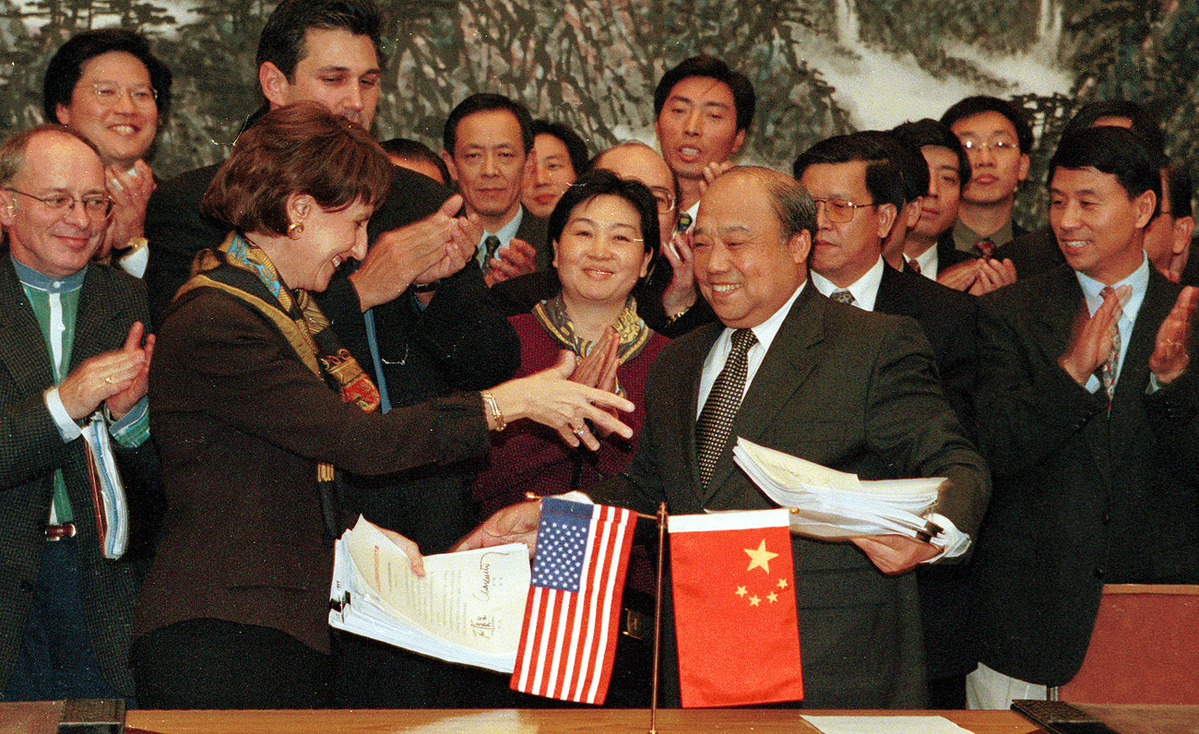
Meanwhile, China, which played no role in the birth of the existing order and only joined the WTO in 2001, is now seen as one of its strongest defenders. President Xi Jinping has frequently extolled the virtues of globalization, most famously at the World Economic Forum meeting in Davos in January last year.
He Weiwen, a former economic and commercial counsellor at the Chinese consulates in New York and San Francisco at the time of China's accession to the WTO, said Trump's challenge to the WTO order is unprecedented.
"During my time in the US (1997-2003) neither (President Bill) Clinton nor (President) George W. Bush went totally against WTO rules. They were not pursuing an America First policy. Under Bush, there was a case of a steel import surcharge but that was an isolated case," he said.
"The Trump administration has not only challenged China but also the multilateral trade system, launching hostile conflicts against Mexico, Canada, the European Union and others."
China is right to respond to the US' unilateral action with its own tariffs and must steer clear, unlike South Korea, of being intimidated into caving in to trade negotiations, He said.
Power shifting
US Commerce Secretary Wilbur Ross said in March that South Korea would not have made concessions-allowing US automakers greater access to its market and reducing steel exports to the US-if there had not been the threat of tariffs on steel and aluminum exports.
"This goes against the whole system of trade rules. If we all behave like South Korea, then what is the point of the WTO? When its rules are undermined like this, the whole world trade order is in jeopardy."
Paul Cheng, a businessman and former Hong Kong politician and also author of On Equal Terms: Redefining China's Relationship with America and the West, said Trump's actions are indicative of the US now showing the same disrespect for the WTO as it has for countries it has previously backed and then dumped.
"America would support some country and when they didn't want to support it anymore, they would just drop it. Now this is not a country but the WTO. They were a big supporter of the WTO at the beginning, but now the power is shifting, they don't like it. They are no longer calling the shots," he said.
Wang Huiyao, counselor for the State Council, China's Cabinet, and founder and president of the Center for China and Globalization, the Beijing-headquartered independent think tank, said the US' recent trade actions suggest that it is becoming more unilateral while China is becoming increasingly multilateral on the world stage.
"It is not that China cannot see the faults in the current global governance system. There are numerous problems. These include inequalities between rich and poor and multinational companies out of control in terms of jurisdiction. The solution, however, is not to tear everything up."
Wang, however, does not believe it is just the US that is undermining the global trading order with there now being a sense of the developed world as a whole, including the European Union, wanting to act in its own interests.
"The US and EU are trying to talk about a zero tariff agreement. Both Japan and Canada have reached free trade agreements with the EU. It looks-particularly from China's and other emerging nations' perspectives-that the developed world is trying to create some sort of alliance of its own," he said.
"This is very unwise because the emerging market countries will provide the growth engine for the world economy over the next three or four decades."
Stephen Roach, senior fellow at Yale University's Jackson Institute for Global Affairs and author of Unbalanced: The Codependency of America and China, said that despite Trump's threat to pull out of the WTO, he does not believe this signals "a major move in the pendulum against a rules-based trade order."
"I do not see the United States in large part abdicating its global leadership role," he said.
"What I think the Trump administration is all about is maintaining leadership but on different terms than have been evident over the past 10 years."
Kerry Brown, director of the Lau Institute at King's College London, said that to understand the current trade situation it could be important to reflect on the writings of Carl von Clausewitz, the Prussian military strategist.
"Clausewitz said in his great treatise on war that if the battlefield is dominated by confusion then things are often not what they really look like. I actually don't think the US is walking away from the WTO. It is just creating an enormous amount of faff just to get what it sees as a fairer deal. It may be as a result that China has to recalibrate the way it does trade with the world."
Rana Mitter, director of the University of Oxford China Centre, said the US stance does not make a great deal of sense, since it has largely benefited from the current system.
"It is not logical because the United States is the country that has done the best out of the global international order over the past 70 years or so. It may have many flaws but it seems essentially to produce stability and prosperity, and to turn against does not quite add up.
"I don't think it is strange either that China is now such a defender of the current system. China's impressive development over recent years has partly been a result of it incorporating itself into that order, particularly since joining the WTO."
One of the major questions is to what extent the Bretton Woods system is now under threat from the trade dispute.
Roach, also a former chairman of Morgan Stanley Asia as well as its chief economist, said the world could descend into a very dark place if this is the case.
"What we are seeing now is skirmishes but if we get into a full-blown trade war then you can conjure up all sorts of draconian scenarios. What is not clear to me is what would emerge to replace it, if anything. The world might be a very fragmented and disorderly place for a while."
Brown, also author of the just-published China's Dream, believes the direction of travel of a new global order will not be one that favors the US more, but one that accommodates China's rise as a major economic power.
"China eventually will want more of its own space. It has set up the AIIB (Asian Infrastructure Investment Bank), launched the Belt and Road Initiative and set up the Shanghai Cooperation Organization. These are setting out the stall for allowing it more space. It will be just a reflection that China is such a huge economy. There is clearly going to be some growing pains over this change."
Mitter, at Oxford University, said the Bretton Woods system has been tested before, not least in 1971 when President Richard Nixon ended the direct convertibility of the US dollar into gold, which had been the mainstay of the former system.
"The classic Bretton Woods system was blown up rather suddenly by Nixon at the same time as he was opening up to China. So it is not the first time the system has faced challenges," he said.
"Currency is still key to the global order. Until China or any other international actor has an internationally tradable currency that is seen as safe and stable across the entire financial and trading world, then it is very difficult to see who could take that rapprochement role the United States currently has in being at the center of the global order."