



Machines replace humans as labor costs keep rising









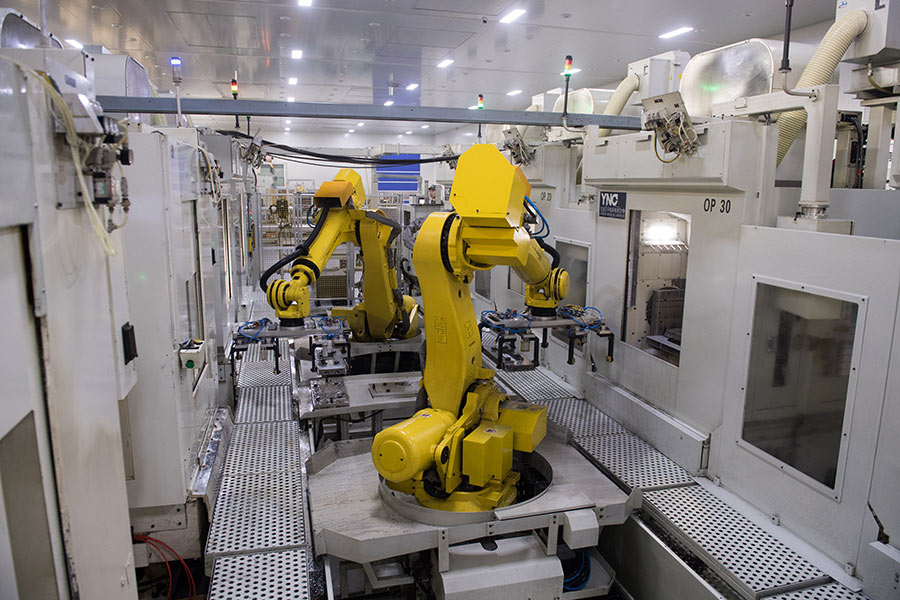
On one side of the roaring factory, machine arms cut, weld, press and gauge a steady flow of circuit breakers, while self-driving carts carrying piles of products shuttle between assembly lines and storage areas.
On the other side, dozens of young workers, side by side at their workstations, do the same job manually - assembling the electrical products that protect people's homes from short circuits.
These kinds of low-voltage electric products produced in Yueqing, a county-level city of Wenzhou, Zhejiang province, are installed in almost every city in the country and are shipped overseas for orders from across the globe.
Local people fondly call Yueqing China's capital of electrical apparatus.
But manufacturers here are sensing a grim future looming ahead, with fewer migrant workers coming to the city and rising salary expenditures on their balance sheets.
"Replacing humans with machines" - that's the term used by local entrepreneurs and officials to sum up their solution to the imminent problem.
Chint Group produces 600 million circuit breakers every year. Thousands of workers were required on its assembly lines to meet orders during peak season.
The group estimated that in the past five years, the average salary for assembly line workers has risen by 45 percent.
In recent years, the problem has worsened as a result of surging staff mobility - many migrant workers don't stay in Wenzhou for long due to rising living costs and increasing job opportunities in their hometowns.
All of these have pushed the company to automate part of its production line.
Yang Yi, deputy director of the group's general office, said the group has invested 200 million yuan ($29.2 million) since 2015 in building automated assembly lines for two of their products, circuit breakers and AC contactors, which were put into production this year.
"This is just to test the water - there will be more," he said.
Now, on the newly installed automated assembly lines, only 18 workers are needed to monitor circuit breaker production, for which around 200 people were needed previously.
Nan Cunhui founded Chint Group in 1984 with eight people and an investment of 50,000 yuan. He said the reform and opening-up policy adopted 40 years ago has changed the lives of many people, including himself.
"Smart manufacturing is another revolution that's underway. It offers a peek into the future - one with a lot more opportunities and potential for development," he said. "We will increase our investment in automating our factories and assembly lines to unleash the productivity brought by smart manufacturing."
Just like Chint, companies across Wenzhou are putting money into automating their traditional assembly lines to replace human roles with machines.
In the Wenzhou Economic and Technological Development Zone, 35 automation projects were registered with a total investment of 619 million yuan in the first half of 2018.
The local government has supported this trend, with loans and grants made available for small and medium-sized companies' automation projects. According to local officials, such upgrade projects can access subsidies of at least 8 percent of the investment amount, and one single project can receive a grant of up to 5 million yuan.
The figures were 5 percent and 1.8 million yuan respectively last year, said Dai Jianghong, deputy director of the publicity department of the Southern Zhejiang Industrial Cluster Zone in Wenzhou.




















