Space lab to finish its service in July









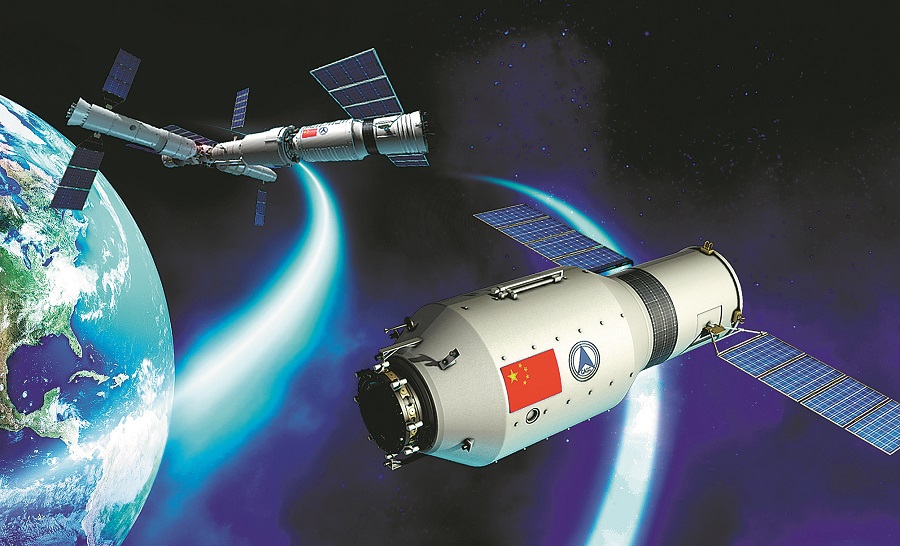
Tiangong-2, China’s space lab orbiting Earth, will be safely removed from orbit under manual control after July, senior space engineers said on Wednesday.
Launched on Sept 15, 2016, Tiangong-2 has fulfilled all its planned missions within its designed two-year life span. It will focus on conducting experiments and testing new space applications that can benefit society during its remaining days, said Lin Xi-qiang, deputy director of the China Manned Space Engineering Office.
These benefits include providing valuable geological data for research and disaster relief, and enhancing local economies in Ningxia and Yunnan provinces, home to many sectors of the Chinese space industry, he said.
Much like Tiangong-1, its predecessor, plans call for Tiangong-2 to descend on a guided track through the atmosphere, where most of its structure will burn up, and the remnants will fall safely into the ocean. Tiangong-1 was taken out of orbit on April 2, and it blazed through the atmosphere before falling into the southern Pacific Ocean.
Tiangong-2 has served as a symbol of national pride and science education, Lin said. One notable achievement onboard Tiangong-2 is the cold atomic clock, the world’s first and most accurate timepiece, which would take 300 billion years to lose one second.
“All of Tiangong-2’s payload modules are functioning properly and in good condition,” Lin said.
On Sept 20, the management committee for Tiangong-2 decided the space lab would finish its service in July, and then would be taken out of orbit under manual control, he added.
Zhu Zongpeng, chief engineer of Tiangong-2, said the space lab has many built-in fail-safe and self-processing systems that can automatically deal with emergencies and ensure its safe descent.
“Even if it drifted out of our detection zone, Tiangong-2 would enter a self-pilot mode that can guide it back into the zone, ensuring the platform’s safety,” Zhu said. Scientists will also be monitoring more than 300 key data points and have developed more than 300 fault countermeasures for Tiangong-2, ensuring the space lab can leave orbit safely and under control, he said.
Zhu said the success of Tiangong-2 has laid a solid foundation for China’s future space station. “We will keep developing space technologies and transform China into a space powerhouse. These are our dreams.”
Engineers also are busy building the prototypes for main systems onboard China’s first space station, and all development is going according to schedule, Lin said.
“The future space station will allow space applications and tests both within and outside of its cabin,” Lin said. “The application payloads can also be changed in orbit. It will carry 10 times more payloads than Tiangong-2 just at the station’s initial entry into orbit.”
Tiangong-2 carries with it 14 application payloads, weighing around 600 kilograms in total. These payloads involve research ranging from particle physics to material science to remote sensing technologies, according to the space engineering office.
Lyu Congmin, deputy chief engineer of the space applications system for China’s manned space program, said the future space station will conduct more than 30 types of research during its 10-year designed minimum life span, with emphasis on frontier science, space and life sciences.
The station’s interior will house 13 experiment racks, and the exterior will have room for installing telescopes and other major equipment, he said. “Progress on these applications is going smoothly, according to plan.”
Also, China’s manned space program is expanding its global cooperation and exchanges to promote global space technology development, Lin said. In May, China and the UN agency jointly invited other countries to conduct experiments on China’s future space station.
“The Chinese space station will help create globally influential scientific achievements in basic research, and contribute to humanity’s exploration and understanding of the natural world,” he said.





- Pact to boost China's gold market
- Annual lantern festival opens in Shanghai
- Work teams dispatched after earthquake hits Diebu county in Gansu
- Zhangjiajie National Forest Park transforms into a winter paradise
- Thousands enjoy freshly cooked laba porridge in Sichuan
- Short videos highlight the beauty of Hebei