Artist aims to heal environment through art









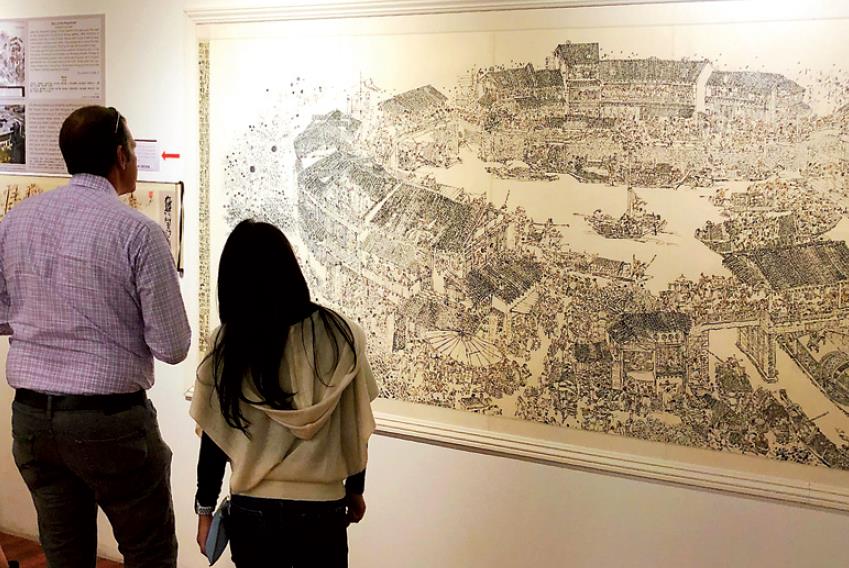
From deserted islands and denuded cliffs to polluted canals, a Chinese ink painting artist spent decades toiling to restore modern China’s landscapes destroyed by man.
Zhu Renming, director of the Research Center for Ecological Restoration at Zhejiang University, has recently opened an art museum in Sunnyvale, California, to introduce American audiences to the accomplishments of his “Art Saves Ecology” project.
All the works, including more than 40 duplicates of his ink paintings and projects illustrated in over 60 photo panels, stem from the artist’s philosophy: a hands-on ecology through art and artistic intervention to save the planet.
“When I was crippled 40 years ago, I thought a lot about my life: how to put my art at the service of my country, the environment and mankind,” said Zhu, 69. He then turned to architecture and landscape design to practice his art and philosophy.
As a pioneer and early practitioner in the eco-landscape design field, he started to build the discipline of Human Ecological Restoration in the 1980s, pioneering the aesthetic concepts of “saving the environment through art” and the theory of “spiritual, natural, and cultural ecologies”.
He explained that his process of creation occurs in three phases: spiritual ecology, which is meditating on and developing the projects; natural ecology, which is completing the projects in the environment, and cultural ecology, which is spreading this philosophy of life to the younger generation.
In the 1980s, Zhu purchased the island of Putuo Lotus to rescue it from a local housing development system that planned to bulldoze the site and erect new buildings.
“It had almost disappeared because of land reclamation. I also became the first private owner of an island in China,” said Zhu.
He spent 15 years and 70 million yuan ($19.2 million) on planning, designing and construction on the island, which is open and free to the public.
Another project is a desert area east of the Yellow River, which after six years had been transformed into Lake Mingcui National Wetland Park.
He also turned a section of China’s Grand Canal in downtown Hangzhou from an open-air sewer into a gourmet district in 2008.
Dating back 2,500 years, the Beijing-Hangzhou Grand Canal is one of the world’s most ancient, longest and largest canals. However, because of urban development and other factors, several sections of the canal became open-air waste dumps.
Zhu created a scroll painting of the Grand Canal as a blueprint, in which all the buildings, bridges, landscaping and sculptures are designed with traditional Chinese characters.
Another project on display at the museum is “Potala at the Sea”, an ecological landscape restoration project that turned the damaged bare cliffs in front of the Mount Putuo pier into a stylish site resembling the Potala Palace.
“Beyond the ecological and environmental side of things, I think what’s unique about his work is the way he incorporates not only his own artistic vision but also cultural ecology and local craft traditions, local folk designs and folk art motifs in these large architectural projects,” said Richard Vinograd, Christensen Fund Professor in Asian Art in the Department of Art & Art History at Stanford University.
“So that kind of unified approach to the notion of ecology, which is not just physical ecology but also cultural, is very impressive,” said Vinograd.