Dogs and cats have a 'pet economy' of their own









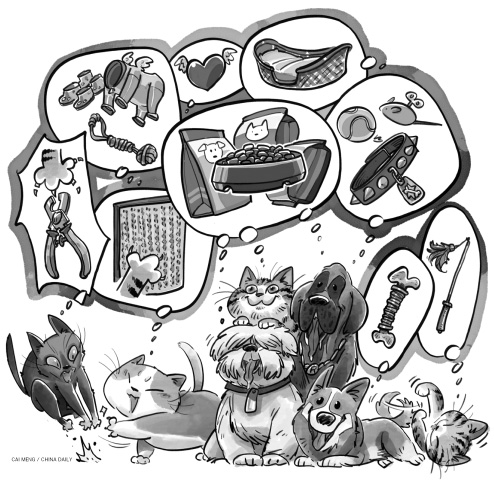
People's increasing consumption capacity will create lucrative segment markets in the pet industry, writes Wang Yiqing
Raising pets, especially dogs or cats, has been part of modern life. But in recent years, raising pets has become a stylish and cash-burning lifestyle in urban areas, which has given rise to what the media call a "pet economy".
People have been raising animals for centuries for food, and as house guards or hunting guides. But today, animals, especially pets, also serve people's emotional needs.
In a way, the establishment of China Small Animal Protection Association in 1992 signaled the evolution of animals as human companions. Today, many people are willing to spend a small fortune to raise a pet, which they treat more like a family member.
Since 2000 the number of pets has rapidly increased in China so much so that it is almost impossible to ascertain the exact number of pets in the country. Take the example of common pets, such as dogs and cats. According to the China Pet Industry 2018 White Paper, a non-official document jointly issued by the online pet community Goumin.com and Pet Fair Asia recently, more than 91.49 million dogs and cats are being raised as pets in China's urban areas. To prepare the "white paper", the two organizations conducted a survey which covered more than 52,870 people in 34 provincial administrative regions.
Pet owners comprise 9% of urban population
The "white paper" says an estimated 73.55 million people in urban areas have pets, meaning about 9 percent of China's overall urban population of 813.47 million in 2017 had pets.
The high degree of urbanization and people's rising incomes are the main reasons why pet raising has become so popular. Beijing, Shanghai, Guangzhou, Tianjin and Chengdu are the top cities where pet raising is most popular. The fact that the residents of these first-and second-tier cities have comparatively high dispensable incomes has played a critical role in popularizing pets.
The increasing popularity of pets in urban areas has given rise to a whole industrial chain, which in turn has helped build a "pet economy", comprising pet consumption including food, medical treatment and even funeral and interment expenses.
In fact, the scale of this "pet economy" is far bigger than we can imagine.
National Bureau of Statistics data show the compound growth rate of China's pet industry was 49.1 percent from 2010 to 2016, the highest among all industries. According to the pet industry's white paper, the "pet economy" is worth 170.8 billion yuan ($24.87 billion), and has been growing at the brisk rate of 27 percent year-on-year. The white paper also said on average a pet owner in 2017 spent 5,016 yuan a year on one cat or one dog, 15 percent more than the previous year.
Food and other daily requirements of pets and their medical treatment are the three major parts of the pet consumption market. Food and other daily necessities account for a majority of pet owners' expenditure, which has been upgrading with the passage of time. The sales of high-quality and expensive pet products have grown rapidly as people are willing to spend more money on pets, and more and more segment markets for pet products are emerging to meet the increasing demands of pet owners.
For the pet owners, medical care is an unavoidable expense for pets. The "white paper" estimates that pet service accounts for about 30 percent of a dog's "consumption" and 20 percent of a cat's "consumption", with the biggest pet service demand being medical care. On average a dog owner spends 1,557 yuan a year on the dog's medical care, and a cat owner 1,446 yuan.
But almost half of the pet owners are unsatisfied with the existing medical care system for pets, due to such factors as "unqualified" veterinarians and "unreasonable" charges for medical treatment.
A catalyst for other businesses
The rising popularity of pet raising has also promoted other forms of businesses. For years, pets, especially dogs and cats, have been used as IP characters in many countries, fuelling the growth of a new kind of "new media economy" in China in recent years.
A study on "cat economy" by Tencent Research Institute shows the image of a "cute" cat draws increasingly high online attention and helps cultivate new commercial models. Weibo, the Chinese version of Twitter, has become an important platform of "cloud cat-raising", which refers to the phenomenon of netizens watching photographs or videos of cats for entertainment.
According to the study, till January this year about 5.5 million Weibo account users had used the tag "cat" to identify themselves. In 2017, more than 330,000 cat-related articles went "viral" on WeChat public accounts. And the market value of a famous pet Weibo account "Huiyi Zhuanyong Xiaomajia" is estimated at 235 million yuan.
Also, in recent years, the number of pet owners has grown. According to the "white paper", more than 85 percent of the dog and cat owners are women, and half of them have a bachelor's or higher degree. And the majority of the pet owners belong to the post-1980 or post-1990 generations, which shows their strong consumption capacity.
Thanks to people's increasing consumption capacity, more segment markets of the pet industry, especially the pet-related service sector including pet training and pet shipping, are expected to grow at a faster pace, further expanding the "pet economy".