



CASC helps nation reach for the stars









Space contractor makes a mark in the global arena as policies boost development
The success of China Aerospace Science and Technology Corp (CASC) in the global space arena during the past four decades is rich testimony to the success of China's reform and opening-up policy since late 1978.
The Beijing-headquartered, State-owned space and defense giant now has more than 170,000 employees, eight large academies and a dozen listed companies. It was ranked 343rd in the Fortune Global 500 list in 2018, making it the fourth largest aerospace enterprise in the world by revenue after Boeing, Airbus and Lockheed Martin.
The success of the company is also testament to China's decision in 1978 to embark on reform and opening-up. In the 11 years from the start of the reform and opening-up to the end of 1989, China conducted 16 space missions and all of them were satellite launches. During the 1990s, 39 carrier rockets were launched, and the last of them ferried the first prototype of the Shenzhou spacecraft into space, opening China's manned space age.
From 2000 to November 2012, a total of 111 rockets sent hundreds of satellites, four manned spacecraft with eight Chinese astronauts as well as one space laboratory into space.
Since then, 124 space launches have been carried out during the past six years, evidence of China's relentless efforts to become a space power.
Almost all of the nation's space missions were fulfilled by the China Academy of Launch Vehicle Technology, China Academy of Space Technology and Shanghai Academy of Spaceflight Technology, all units of CASC.
Long-held aspirations
The Chinese people had long wished to realize their dream of "flying above the skies". Chinese scientists drafted a plan in the 1970s to develop a manned space program. However, they were unable to make it happen because of the nation's weak capabilities in space technology and manufacturing sector back then.
In 1986, a group of top Chinese scientists suggested that the government should consider the possibility of manned space flights and submitted a roadmap, which was approved by the Party leadership in 1992.
Thanks to CASC and its predecessor, China Aerospace Corp, the country moved fast toward its goals in manned space programs.
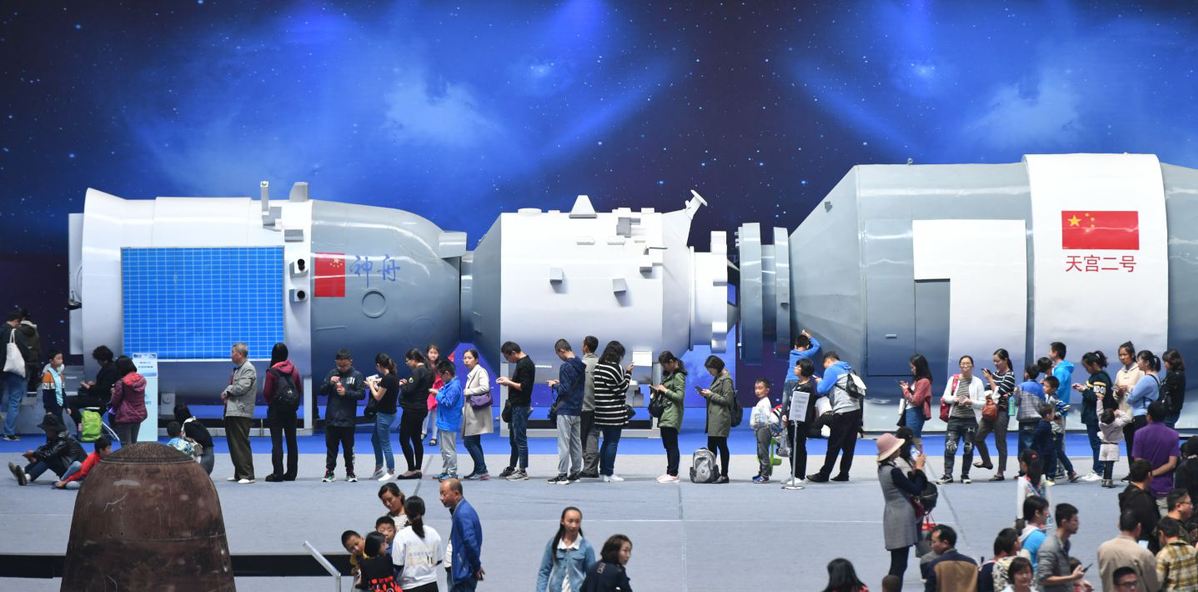
In October 2003, China carried out its first manned space mission, sending Yang Liwei to a 21-hour journey around the Earth in the Shenzhou V spacecraft.
Till date, six manned space flights have been conducted, totaling 68 days and circling the Earth 1,089 times. Chinese astronauts traveled more than 46 million kilometers in the space and executed over 100 scientific experiments during these missions. They have fulfilled extravehicular activities, several multiple-day missions inside the Tiangong-1 and 2 space labs, as well as a 40-minute space lecture watched by more than 60 million Chinese students from around 80,000 schools.
Chinese scientists have also launched a cargo spaceship to conduct several docking and in-orbit refueling operations with Tiangong-2, verifying technologies and equipment designed for space station.
These accomplishments have become a source of national pride and people's confidence in the nation's capabilities.
To meet the needs from manned space programs, engineers at China Academy of Launch Vehicle Technology designed and built multiple new rocket models including the Long March 5 and Long March 7.
As the strongest and most technologically sophisticated rocket ever made by China, Long March 5 has a liftoff weight of 869 metric tons, a maximum payload of 25 tons to a low-Earth orbit, or 14 tons to a geosynchronous transfer orbit. The gigantic vehicle is tasked with transporting parts of China's future manned space station and fulfilling Mars explorations.
In addition to manned space flights, CASC has also helped the country realize another traditional dream - to explore the moon, a distant silver sphere deemed by Chinese myths as some goddesses' palace.
The company started sending robotic probes to the moon in 2007 and carried out several lunar missions since then. It landed the Chang'e 3 probe, which carried the first Chinese lunar rover, on the moon in December 2013. The Chang'e 3 mission marked the first soft-landing - opposite to hard impact - by a manmade spacecraft on the moon in nearly four decades.
The company launched a relay satellite into space in May as the first step in the Chang'e 4 lunar mission, which will explore the far side of the moon and is scheduled to be made before the end of this year.
Compass in heavens
Along with the exploration and scientific endeavors, CASC has been working with Chinese space authorities to set up a vast navigation and positioning satellite network and a high-definition Earth observation satellite system to facilitate public and economic sectors.
The Beidou network, mainly constructed by CASC, is one of the four space-based navigation networks along with the United States' GPS, Russia's GLONASS and European Union's Galileo.
Since 2000, when the first Beidou satellite was placed in the space, 42 satellites have been launched for the system and several in them have been retired. Beidou began providing positioning, navigation, timing and message services to civilian users in China and parts of the Asia-Pacific region in December 2012.
China has planned to place 18 third-generation Beidou satellites into space before year's end.
According to government plans, the network will be made up of 35 satellites before the end of 2020 - several now in orbit will be decommissioned by then - to give Beidou global coverage.
CASC also cooperates with space departments in designing and establishing a space-based, high-resolution Earth observation network that has had eight satellites.



















