



US may have scuppered Abe's bid to attract more tourists









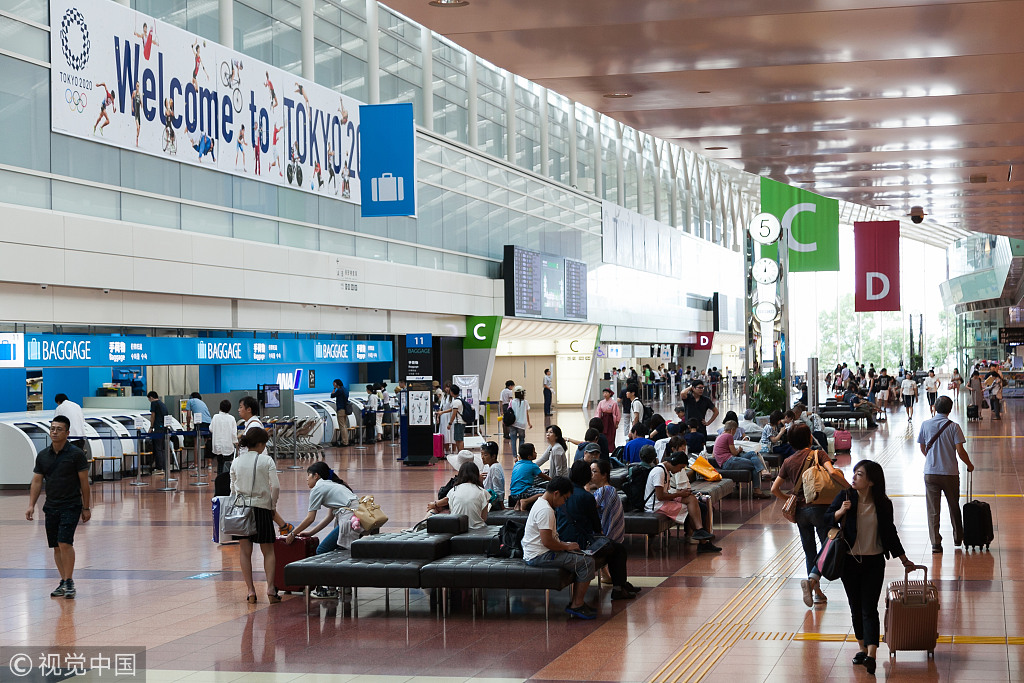
Japanese Prime Minister Shinzo Abe wants to increase the number of tourists to the country to 40 million by 2020. To reach that goal, Japan is mulling allowing more international flights from Tokyo's Haneda Airport. The planned route passes through an area where the US Yokota Air Base handles air traffic control.
The Abe administration has been negotiating with the United States over Washington's permission for Japanese planes to fly in the area and Japanese controllers to navigate aircraft. However, US seems likely to nix the idea.
The result let people in the country debate again whether the US-Japan Security Treaty violates Japan's sovereignty.
The security treaty, signed in 1951 and revised in 1960, grants the United States the right to military bases in Japan in exchange for a US pledge to defend the East Asian nation in the event of an attack. Tokyo pays dearly for the US military presence-around 54,000 US military personnel are stationed on the Japanese soil.
The US forces are spread out across a number of Japan's islands, with most of them on the island of Okinawa and the US Forces Headquarters at Yokota Air Base outside western Tokyo, which serves as the primary hub. Large areas of skies over and water around Japanese territories as well as huge land spaces are reserved for the training of US Forces.
Skies over Japan's airports such as Narita, Haneda, Kansai and Fukuoka are under the control of US Forces Japan. As a result, many commercial airplanes coming in and out of Japan have to fly low or take a detour costing extra time and fuel.
The Yokota airspace, which expands over the west of Haneda Airport, came under the US-led Allied Powers' control at the end of World War II. The US military took over its traffic control after the Allied Powers' occupation of Japan ended.
In May 2006, Japan and the US agreed on the Yokota airspace's partial reversion as a step in the process of realigning US forces in Japan. In October 2008, the United States returned 20 percent of the airspace's area and 50 percent of its volume. In the past, civilian aircraft were allowed to pass through the airspace with permission from the US military. For safety and other reasons, however, the greater part of civilian airplanes from Haneda Airport to such destinations as Kyushu, Republic of Korea and China turned and made a steep climb over Tokyo Bay to fly over the Yokota airspace.
The extraterritoriality US service members enjoy in Japan has also been a source of contention. US military personnel are exempted from local Japanese laws. The Japanese government has difficulty dealing with the cases of crimes, accidents and environmental destruction caused by US military personnel due to limited sovereignty.
Cases involving rape, vehicular homicide and other violent crimes perpetrated by US service members against Japanese civilians have caused increasing resentment.
US military personnel are granted other privileges, such as use of any Japanese facilities without cleaning or restoring them, access to any port without paying a fee, priority over Japanese citizens in using public services, and exemption from passport and visa requirements.
However, despite the public opposition, the Abe administration wants the United States to keep its troops in Japan.
It takes Japan's alliance with the US as the cornerstone of its security and foreign policy even if that comes at the expense of its sovereignty. So the US refusal of new international flights from Haneda Airport through Yokota airspace is likely to scupper Abe's tourism-driven strategy.
The author is China Daily Tokyo bureau chief.
caihong@chinadaily.com.cn





