


Charities and social groups help promote a new vision of equality










Study struggle
By age 10, Cai struggled to read the blackboard, even when he sat in the first row of the classroom. A medical examination confirmed that he had glaucoma, which leads to damage of the optic nerve and ultimately loss of vision.
As a top student, Cai managed to stay in his mainstream school and cherished the hope that one day he could sit the gaokao, the national college entrance examination, attend a good university and find a decent job.
When he reached high school, his vision had deteriorated to the extent that he needed the teacher to read out the questions during exams. His teachers and classmates were always happy to help, but when he took the gaokao in 2004, the officials who oversaw the exam were not as considerate.
"The local admission office declined my request to have a companion to read out the questions for me," he said, adding that papers in Braille or bearing larger characters were not available at the time.
He felt as though he was being excluded from higher education, but his hopes rose again when his father read about a special college in Jilin that enrolled candidates via papers written in Braille.
"I knew nothing about the language. Luckily, my parents found a small Braille school where I studied for a year," he said.
After graduating from university, Cai joined One Plus One, the Youren Foundation's parent organization, which was started in 2005 by a group of visually impaired people who quit their jobs in massage parlors to explore other possibilities.
The group advocates full implementation of equal rights for the disabled, which are enshrined in the Chinese Constitution but often ignored, and runs programs to boost employment and education prospects for the visually impaired.
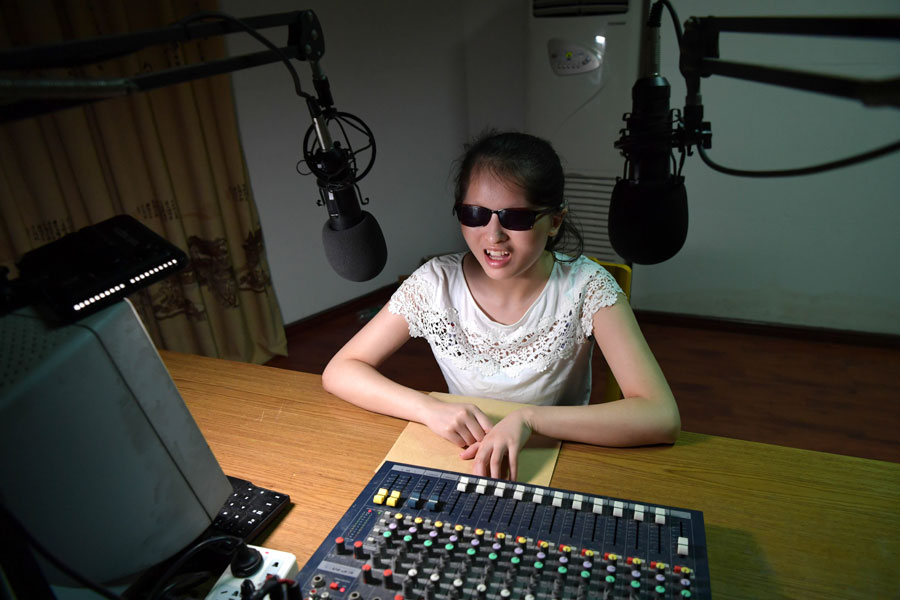
The foundation has made many attempts to help disabled people across the spectrum, including launching a radio service - The Hotline for the Visually Impaired - which is transmitted by China National Radio, the national broadcaster. It also opened a call center staffed by blind and visually impaired people, and started a (now defunct) training program for blind stenographers.
"I have respect for visually impaired masseurs, but I loathe the mantra that people like us are only capable of doing one job," Cai said.
Duan Hechuang, a visually impaired masseur in Beijing, said people in the sector often work long hours, which leads to irregular eating patterns and results in vocational illnesses such as stomach problems and arthritis in the hands and arms, along with excessive wear of the joints and bones in the neck.
"In addition, many blind or visually impaired female masseurs have reported sexual harassment in the workplace," he said.
Two-track system
The lack of access to mainstream schools, coupled with discrimination, means there is a high illiteracy rate among China's 85 million registered disabled people. The most recent available statistics - the Second National Sample Survey on Disability in 2006 - showed that 43.9 percent of disabled people were illiterate.
In response, the government invested heavily in special education, targeting students with special needs. Though well-intentioned, the move resulted in a two-track education system from primary school through university - one track is standard, while the other caters to children with disabilities.
Classes at special schools are tailored to specific disabilities and aimed at producing skilled workers who can earn a living. Schools for the blind and visually impaired often offer a syllabus dominated by massage, which officials and experts say is a good fit for the students' physical condition and an effective way of boosting employment.
Graduates of blind schools are either sent to street massage parlors or admitted to colleges via special exams that cater to the group. However, they all offer a similar curriculum.
According to the 2017 Report on the Development of the Cause of Disabled People in China, almost 20,000 street massage parlors nationwide employ people with visual disabilities, aided by government support.
Jin Ling is one of a small number of visually impaired editors in China. The Tianjin resident said her enrollment at a mainstream college in 2002 widened the scope of work open to her, but added that her case was an exception at the time.
"My parents and high school teachers begged the doctors who performed the health check to allow me to take the gaokao. I had a really good academic record and my teachers thought it would be a pity if I could not attend a mainstream college," she said.
Developments
In 2008, China ratified the UN Convention on the Rights of Persons with Disabilities.
Since then, the country has enacted disability laws and amended legislation related to physical rehabilitation, employment, social security and access to public spaces.
In 2015, the Ministry of Education and the China Disabled Persons' Federation issued a guideline that required examining bodies nationwide to offer "reasonable" assistance to disabled students taking the gaokao.
Blind and visually impaired students must now be provided with test papers written in Braille or large-print characters.
Last year, revisions to the Regulation on the Education of Persons with Disabilities, originally passed in 1994, came into force, providing students with special needs with access to mainstream schools.
Though the level of access remains imperfect, the revisions made it illegal for schools to turn away disabled people, which was once a common occurrence.
Since 2015, nearly 29,000 disabled candidates have been admitted to mainstream colleges via the gaokao, which is a sign of increasingly inclusive tertiary education, according to the disabled persons' federation.
Last year, the federation launched a two-year program at six universities - including Beijing Union University and Wuhan University of Technology in Hubei province - to gain experience in inclusive higher education and policy formulation.
The universities provide tailored academic courses for disabled students, and have established volunteer groups to help them.
Jin, the visually impaired editor, said such support systems are crucial to make education more inclusive. "I never attended a special school, and I wish my peers could receive high-quality, comprehensive education just like able-bodied people," she said.
Li Qingzhong, chairman of the China Blind Persons' Association, said despite recent progress, employment barriers still exist for visually impaired and blind people, especially in terms of mandatory health checks for people applying for vocational qualifications.
"I have made proposals at the two sessions (annual meetings of the National People's Congress and the Chinese People's Political Consultative Conference) to lift the restrictions on qualifications for teachers and government employees, and have received positive responses from the relevant authorities," he said.





