



Beijing's return to its heritage









China Reform and Opening – Forty Years in Perspective
Beijing's return to its heritage
Editor's note: Laurence Brahm, first came to China as a fresh university exchange student from the US in 1981 and he has spent much of the past three and a half decades living and working in the country. He has been a lawyer, a writer, and now he is Founding Director of Himalayan Consensus and a Senior International Fellow at the Center for China and Globalization.
He has captured his own story and the nation's journey in China Reform and Opening – Forty Years in Perspective. China Daily is running a series of articles every Thursday starting from May 24 that reveal the changes that have taken place in the country in the past four decades. Keep track of the story by following us.
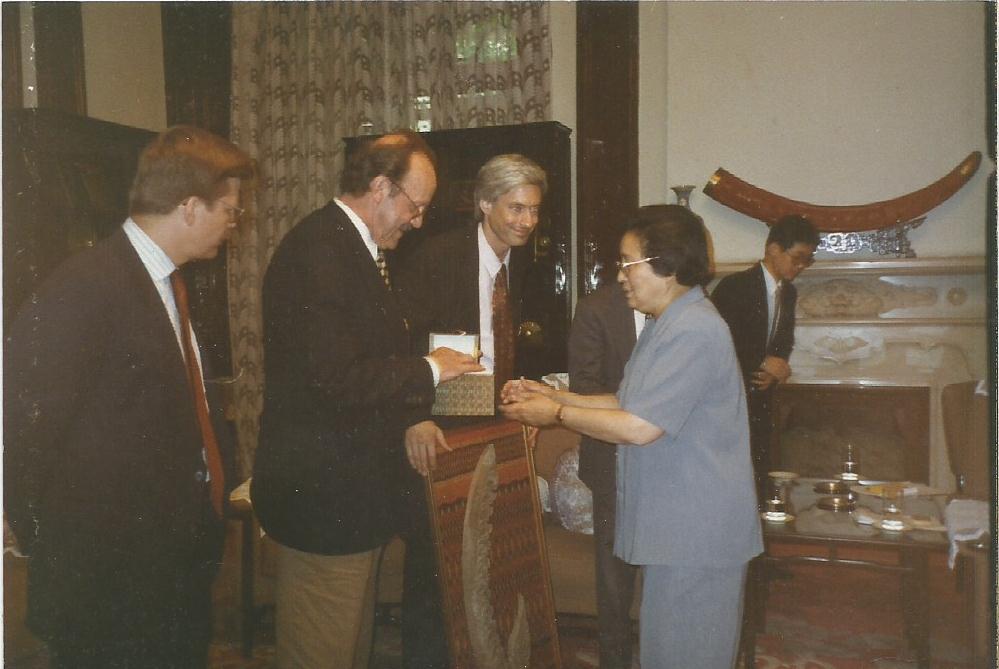
In 1992, I was living in an old Chinese courtyard house in a narrow hutong, the typical alleyway lined with trees. The courtyard was called Hao Yuan "The Good Garden." The courtyard was a state-run guesthouse, mostly for foreign experts.
The Chinese staff members working there as state employees were full of smiles and friendly to foreign guests, but became irascibly grumpy when it came to work. That was the nature of state-enterprise management systems in those days. Despite its ancient charm the place was not maintained well because nobody bothered to clean it.
People (including some Chinese) confuse the word hutong with the term courtyard or siheyuan. This is incorrect. In Beijing dialect hutong means alleyway. Actually, it is a Mongolian word for water well and dates back to the time of Kublai Khan when the original city of Beijing was laid out by an Arab architect with networks of neighborhood alleyways sharing water wells. A hutong alleyway was wide enough for six Mongolian ponies to ride through the street abreast, obviously a security control measure.
There was an old Beijing saying, "Beijing has as many hutong as hairs on the back of a cow."
The danger of losing Beijing's own cultural heritage amid a construction boom as the capital leapt into the new century with highways and skyscrapers, struck me as a dilemma. Developments in the years ahead and urban pressures would create social infrastructure demands beyond anything envisioned by city planners at the time.
On Sunday mornings I would sit under the fruit trees in the dusty courtyard of Hao Yuan drinking tea and ponder these changes and their significance. How to balance China's frenzied economic development and the social costs of cultural heritage loss. During those quiet moments in this Beijing courtyard, the power and depth of China's architecture and culture captured my imagination.
In Beijing's courtyard architecture, I saw a mirror of Chinese psychology. These homes had grey brick walls and elegant arching roofs. However, from the street, there was no way to see inside. Only by observing closely the intricacy of carvings at the gate, and the size of ancient door stones on each side, could one imagine who might live within.
I realized the architecture was coded language.
Each courtyard had a zigzag entrance, always blocked by a carved "spirit wall." There was no straight way of entering a Chinese courtyard. Once inside the middle garden was center of all activities. Adorned with fruit trees symbolizing prosperity and seeds for regeneration, all windows and doors faced inward to the center. One could not escape from an insular community. There was a strict hierarchy as to who lived where, fixed by the proportion of the buildings and height of the rooftops for the quarters of master, sons, daughters, concubines and servants. It was all laid out in a strict Confucian order and everybody had their assigned place.
Somewhere in each courtyard there was a secretive back door.
It was so different from American homes centered in a big lawn where anyone from the street can see what is happening inside. Big frame windows expose the living room. Entering the main door there is usually a stairwell that goes right upstairs to the bedroom. But everyone hangs out in the kitchen. And the garage is designed for at least two cars.
One morning, across from The Good Garden's bright red gate, a female entrepreneur named Guo Lihua demolished entire blocks of hutongs. By 2008 Guo Lihua had built the new Jinbao Jie Golden Treasure Street, and in the meantime great historic Chinese architecture, charming tree lined alleyways, millennia of cultural values were replaced by French Palace facades and glassy showrooms for Ferrari and Porsche.
Throughout the 1990s land prices went up and developers uprooted neighborhoods as they tore down old buildings and replaced them with ugly office blocks and shopping malls. New developments came up.
I had come to China fired on idealism wanting to help a nation transition out of poverty. Foreign investment achieved that, bringing both finance and technology. I still believed in this aspect of what I was doing. As a professional lawyer, I was advising some of the biggest multinational corporations – Exxon Mobil, Ericsson, Roche, Bayer, Kodak, and Chubb -- negotiating their first China deals obtaining market entry. So I was effectively a hired gun for the globalization of multinational brands. But inside, I did not like it.
On an entirely personal level, I believed it was possible to preserve local culture and use sustainable economics as a driver to achieve this. However, many disagreed.
Wondering whether it was possible to even create a neighborhood movement through small business endeavors that could give new vibrancy and strength to a community. I decided to try.
Determined to demonstrate through action how a neighborhood can be revitalized, I began bicycling through the old city each weekend searching for a courtyard to obtain and restore. I started small, thinking that a single example if done right could have multi-dimensional impact. I was the first foreigner to purchase a Beijing courtyard. Determined to save at least something of Beijing’s ancient heritage, it resulted in inadvertently pioneering a model for community development.
One day working on a restoration I received a tip that someone found old carved panel screens in a village outside Beijing. Following the lead I found the screens on the floor of a farmhouse covered in yellow sticky Beijing dust. They must have been there for some time, discarded and some badly broken. The panel screens were antique, elaborately carved. They had probably adorned a room in some wealthy person’s home in another century. The sellers explained that when developers had wrecked an old house, only these panels were saved.
On each panel was the carving of a Chinese value: shan compassion, dao, li respect, ren love, and so on. I later understood there were 10 core values in ancient China. The 10 traditional Chinese values were divided into Wu Chang (five Basic principles of humanity): Ren (mercy or compassion), Yi (righteousness or justice), Li (politeness or correct manners in relations), Zhi (wisdom or intrinsic knowledge), Xin (trust and honesty); and Wu De (ten virtues): Zhong (devotion), Xiao (respect), Jie (thrift), Yong (bravery), He (peace and harmony).
Over the coming five years I renovated three courtyards, creating a small business in each of them. The government observed closely my every move. The idea caught on and others soon followed restoring courtyards throughout the neighborhood. Boutique hotels and restaurants sprang out of the old residences.
Nanluo Guxiang evolved in such a way becoming commercial while maintaining individual character of the bars, coffee shops, restaurants and shops, opened there alongside the original residence courtyards. Our Dongsi neighborhood evolved similarly, albeit more quietly as a residential district with many film, animation, and movie production groups working from courtyards given the ambience and quiet.
Local officials kept coming back to see what was going on. When Wang Qishan became mayor of Beijing finally something shifted. The Dongsi neighborhood where we had begun our program of renovating courtyards came under protection of a heritage preservation order from the Beijing People’s Congress. I never thought we would actually win that battle. But it proved to me that pragmatic idealism works.
Fast-forwarding to 2018, I am regularly invited to the Dongsi neighborhood government offices as advisor to offer inputs on the neighborhood renovation. The local government has undertaken huge efforts to preserve the ancient architecture, investing itself into re-constructing new buildings to look ancient and taking the ancient ones and re-enforcing their structures. The neighborhood is undergoing a transformation that is not gentrification but rather rehabilitation with a strong sense of return to the heritage, which is Beijing's.
Clearly this is reflecting a re-discovered awareness in the depth of China's heritage that is essential for the nation to evolve with a set of its own values for the future. If a tree has deep roots, its branches and leaves can grow high without fear of wind or storms. If the roots are shallow, a heavy breeze will knock down the tree.
Please click here to read previous articles.





