Historical truth behind US Open Door policy toward China









Note: This is a translation of a Chinese-language article first published by Xinhuanet.com. The article reflects the author's own views.
In what was seen as the Trump administration’s first major policy speech on China, U.S. Vice President Mike Pence berated Beijing for a series of so-called wrongs, and hailed his country’s historical policy towards China. In his address, Pence said that, “When China suffered the insults and exploitations during her so-called ‘Century of Humiliation,’ America refused to join in, and instead advocated an “Open Door” policy, with the aim of developing freer trade with China, and preserving its sovereignty.” His words gave the impression that the United States had chosen not to join the ranks of the colonial powers and Japan in their aggressions at the time, but instead had acted to protect China’s sovereignty.
If that were true, the Chinese people would be giving the United States a big thumbs up. But the facts of history suggest otherwise. It’s not strictly true, as Mr. Pence suggested, that the US “refused to join in” with the imperial powers.” If that were so, then how did the inequitable Treaty of peace, amity, and commerce between the United States of America and the Chinese Empire come about in 1844? And what about the unequal China-U.S. Treaty of Tianjin in 1858?And where did the U.S. troops, found among the Eight-nation Alliance that attacked China in 1900, come from? Perhaps we should examine more closely that Open Door policy and consider whether it really was designed to “preserve” China’s sovereignty”.
By the end of the 19th century, the West was embracing monopoly capitalism, with trade in the hands of just a few people. After the Jiawu Sino-Japanese War from 1894 to 1895, the colonial powers scrambled to partition China. From 1897 to July of 1898, Germany forced the lease treaty of the Jiaozhou Bay and took Shandong as its territory; Tsarist Russia leased Lvshun Port, Dalian Bay and its surrounding waters to make northeastern China part of its territory; France leased Guangzhou Bay and its surrounding waters, colonizing Guangdong, Guangxi and Yunnan; Great Britain occupied Weihaiwei and controlled areas along the Yangtze River; Fujian fell to the might of Japan. Almost all of China’s strategically important, populous and economically advanced areas had been claimed. And yet, the United States was nowhere to be seen.
Why was that? Among the big capitalist powers, the United States was a latecomer. When it was first founded at the end of the 18th century, it was comprised of only 13 states along the Atlantic coast. Its territory soon expanded, and in 1861 a 4-year civil war broke out when southern states broke away to protect the institution of slavery. After the civil war the United States rebuilt and expanded to become an economic powerhouse. Even so, it did not have the might to invade Asia until it became a world power by the end of the 19th century. The United States fought Spain over the Philippines in 1898, but it was not an easy victory. By the time it turned its attention to China, it was already too late. The United States wasn’t strong enough to rival more powerful countries such as Great Britain and France to take territories away from them. So, it looked elsewhere and set its sights on the Sandu Gulf - a natural deep water port in Fujian Province. A U.S. navy official inspected the area and was of the opinion that, whoever controls this gulf controls the entire western Pacific; If the United States were to take possession then the Pacific Ocean would become a lake of the United States. However, Italy was also taking a keen interest, and both Germany and Britain wanted it too. These countries squabbled over the territory, with none wishing to back down, so in the end it was ceded to no one. So, it’s not that the United States didn’t want territories in China, it was simply not strong enough to get any. To quote the Chinese philosopher Mencius, “It’s because it can’t, rather than won’t.”
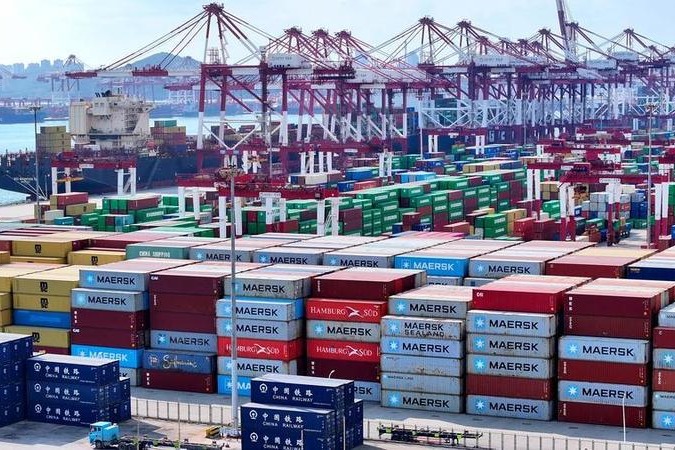
So the United States went for the next best option. To protect its commercial interests in China, it came up with its Open Door policy, the principles of which were as follows: No nation shall interfere in the sphere of influence of another in China; None shall favor their own traders at the expense of those from other nations in transportation levies; and the territorial status quo shall be maintained, safeguarding equal and free trade throughout China. To put it bluntly, it required all powers to allow US goods to enter any part of China unhindered.
So, it’s clear that the Open Door policy had no impact on the influence of the colonial powers in China in any way, nor did it alleviate the “indignities and exploitation” China suffered. The only thing the United States cared about with its Open Door policy was that its own interests in China should not be harmed in any way. What Mr. Pence sees as a policy to “preserve China’s sovereignty” was more aimed at protecting the interests of the United States while China was being carved up by others. To be fair, compared to the other powers consuming China at the time, the United States looks more attractive, but that was something neither to celebrate nor be grateful for.