
<tt id="6hsgl"><pre id="6hsgl"><pre id="6hsgl"></pre></pre></tt>
          <nav id="6hsgl"><th id="6hsgl"></th></nav>
          国产免费网站看v片元遮挡,一亚洲一区二区中文字幕,波多野结衣一区二区免费视频,天天色综网,久久综合给合久久狠狠狠,男人的天堂av一二三区,午夜福利看片在线观看,亚洲中文字幕在线无码一区二区
          Goh Chok Tong
          Emeritus senior minister, Singapore
          BORN

          May 20, 1941

          Married with two children

          EDUCATION

          1964: First-class honors in economics from University of Singapore

          1967: Master of arts in development economics from Williams College, United States

          CAREER

          1964: Joins the Singapore government administrative service

          1969: Joins national shipping company Neptune Orient Lines, going on to serve as managing director from 1973 to 1977

          1976: Elected to Parliament, where he remains an MP

          1979-90: Serves, successively, as minister of trade and industry, health, and defense

          1985: Appointed deputy prime minister

          November 1990: Becomes prime minister, succeeding Lee Kuan Yew

          August 2004: Relinquishes the premiership

          August 2004-May 2011: Remains in Cabinet as senior minister, also serves as chairman of the Monetary Authority of Singapore. Upon leaving the Cabinet, given honorary title of emeritus senior minister and appointed senior adviser to the monetary authority

          April 2017: Appointed chairman of the governing board of the Lee Kuan Yew School of Public Policy at the National University of Singapore.

          'China has done everything right'
          Former Singapore prime minister Goh hails results of reform and opening-up
          Karl Wilson
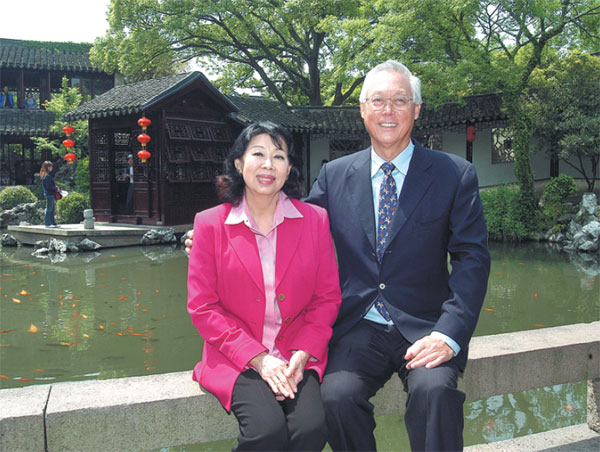
          Goh and Tan visit an ancient garden in Suzhou, Jiangsu province, on April, 2006.[Xu Zhiqiang/China Daily]

          "Mr Lee Kuan Yew noted the meeting in one of his books when he said: 'Here was this small man sitting on a chair and his feet could hardly touch the ground. But he had tremendous presence. He was curious. Asking all sorts of questions. You could sense the tremendous presence he had. He had a wide knowledge of China and a vision of what China should do and could be.'"

          Singapore officially recognized China in 1990 and was the last member of the Association of Southeast Asian Nations to do so. A large part of the reasoning was the fact that Singapore is mainly of Chinese heritage.

          "It was a balancing act," Goh said. "If Singapore had recognized China before Malaysia, it would have sent the wrong signal. Likewise with Indonesia. It was diplomacy."

          Asked what lessons developing countries in Asia can draw from China's reforms, Goh said: "The first lesson is how to grow the economy. China has done it by opening its economy and creating the right economic environment for investments.

          "This is a continuous process and we note that President Xi Jinping has promised that China will continue to open up even more.

          "This means political stability, a conducive policy framework and consistency of policies."

          He said China's pro-growth policies had "released the entrepreneurial spirit of the people and harnessed their energy".

          Goh recalled a meeting he had with a senior Chinese official in the 1990s.

          "In the 1980s and early '90s, China was sending its best and brightest people overseas to study and to learn new ideas. I asked the official, 'Aren't you afraid they won't come back?'

          "The official said, 'If 50 percent come back, it will make a big difference to our country and our people.' China knew the country would keep on growing. It was like a big magnet."

          With rapid urbanization, demographic shifts, and rising incomes and costs of production, China is continuously restructuring its economy as it moves from investment-led growth to consumption-led growth.

          "Other countries can also learn from China the importance of building an integrated, nationwide network of modern infrastructure to both stimulate and support economic growth and the demands of the population," Goh said.

          "The point is investors must have political stability and a consistency of policies to invest. If they don't, they will not invest.

          "With China, you don't have to agree with its mode of government, but it has stability, consistency of policy and the right pro-growth framework for growth."

          Despite China's many achievements following Deng's reform and opening-up, which have seen 700 million people lifted out of poverty, there are some who still deny China the recognition it deserves.

          "It is true China has not been given the recognition it deserves for its monumental achievements over the last 40 years," Goh said.

          He said Asia largely accepts the Chinese model of government and the way its society is organized, "but not liberal Western democracies".

          "The fact that China, with its centralized government, has achieved so much in such a short period of time is an economic miracle," Goh said. "We do not have to agree with the model, but we should recognize China made the right strategic decision in the late 1970s when it decided to open up without undermining the role of the Communist Party (of China).

          "That centralized system enabled them to push through tough reforms and implement decisions quickly."

          Goh said that if China had followed former Soviet Union leader Mikhail Gorbachev's strategy of perestroika (reform of the party and economy) and glasnost (openness) at the same time "the country would have probably broken up" like the Soviet Union did on Dec 25, 1991.

          He said China had taken the right path by restructuring its economy.

          "What I find is that the US and Europe currently have a genuine domestic political problem with globalization," Goh said.

          "Many countries in the West have grown significantly by exporting goods to emerging countries. These emerging countries have now become very competitive.

          "The supply chain is such that they (Western countries) have lost jobs in many manufacturing industries, giving rise to anti-globalization sentiments when the correct solution is to try to restructure the economy.

          "We have had to do it in Singapore. Restructure and move forward. If you take the US, it says no to restructuring and says it will bring the jobs back. But the jobs won't go back.

          "This is short-term politics with no long-term gains. This is the economic fear many of the developed countries now face."

          He said China's opening-up was not just a domestic development, but it also had an external dimension to it.

          The fact that it has benefited from a rules-based multilateral system means it must also support a rules-based order going forward, he said.

          "The point is China has done everything right. It joined the World Trade Organization in 2001 as a developing nation," Goh said. "At the time, its gross domestic product was about 5 percent of world GDP.

          "Today, it is an advanced developing economy, the world's second-largest, and contributes a share of 15 percent to world GDP."

          Goh said China should now start to consider proposed changes in the WTO rules that will require it to reform its economy even further.

          "Crucially, China was a friend to regional countries when it was fast rising," he said. "That goodwill and friendship is a valuable strategic asset, which must be nurtured with mutual trust and respect.

          "The rest of the world now has higher expectations of China as a global economic leader.

          "It will watch what China is doing to liberalize its economy and markets further and how it will contribute to the multilateral trading system."

          He said Singapore supports China's policy announcements to reform the financial sector, open up foreign investment rules, protect intellectual property and increase automobile imports.

          A lot has changed since Deng's reforms, Goh said.

          "When Deng visited Singapore in 1978, I sat in at his meeting with Lee Kuan Yew as a young and relatively new minister," he said.

          Deng had stayed in Singapore for two days in 1920 on his way to France. He saw what Singapore was like then and was astonished by what had changed, Goh said.

          "Even as a young man, Deng could see what was possible," he said.

          During his Southern Tour in 1992, Deng cited Singapore as a model for China's development.

          At the time, Singapore proposed the establishment of an industrial park in Suzhou, Jiangsu province, as a vehicle to transfer Singapore's experience in building, attracting investments to and managing an industrial park.

          After some initial difficulties, the joint project proved successful.

          Goh helped initiate the Tianjin Eco-city in 2008 with then premier Wen Jiabao.

          "This project was proposed because China then was rapidly urbanizing and emphasizing sustainable green development," Goh said. "We wanted to develop a model eco-city to demonstrate that it could be done and replicated in other parts of China."

          The city was built on abandoned salt pans and polluted water bodies.

          It celebrated its 10th anniversary this year as a green, thriving city with more than 80,000 residents.

          "When you sit back and look at China today, you see a country that invests in people and in projects that are ahead of their time. China is connecting the country, integrating provinces so you have one country ... one China," Goh said.

          Ending the interview, Goh used this analogy in a veiled reference to the current state of play between the United States and China over trade: "China is like a huge elephant. And fortunately for us, it is a gentle elephant. When that elephant moves into the pool, we smaller animals have to adjust. However, China must give us some warning first. But if you try to stop China from growing, that's when it turns into a rogue elephant, and when that happens you better watch out."


          |<< Previous 1 2   
          Goh Chok Tong
          Emeritus senior minister, Singapore
          BORN

          May 20, 1941

          Married with two children

          EDUCATION

          1964: First-class honors in economics from University of Singapore

          1967: Master of arts in development economics from Williams College, United States

          CAREER

          1964: Joins the Singapore government administrative service

          1969: Joins national shipping company Neptune Orient Lines, going on to serve as managing director from 1973 to 1977

          1976: Elected to Parliament, where he remains an MP

          1979-90: Serves, successively, as minister of trade and industry, health, and defense

          1985: Appointed deputy prime minister

          November 1990: Becomes prime minister, succeeding Lee Kuan Yew

          August 2004: Relinquishes the premiership

          August 2004-May 2011: Remains in Cabinet as senior minister, also serves as chairman of the Monetary Authority of Singapore. Upon leaving the Cabinet, given honorary title of emeritus senior minister and appointed senior adviser to the monetary authority

          April 2017: Appointed chairman of the governing board of the Lee Kuan Yew School of Public Policy at the National University of Singapore.

          'China has done everything right'

          Former Singapore prime minister Goh hails results of reform and opening-up
          Karl Wilson
          Goh and Tan visit an ancient garden in Suzhou, Jiangsu province, on April, 2006.[Xu Zhiqiang/China Daily]

          "Mr Lee Kuan Yew noted the meeting in one of his books when he said: 'Here was this small man sitting on a chair and his feet could hardly touch the ground. But he had tremendous presence. He was curious. Asking all sorts of questions. You could sense the tremendous presence he had. He had a wide knowledge of China and a vision of what China should do and could be.'"

          Singapore officially recognized China in 1990 and was the last member of the Association of Southeast Asian Nations to do so. A large part of the reasoning was the fact that Singapore is mainly of Chinese heritage.

          "It was a balancing act," Goh said. "If Singapore had recognized China before Malaysia, it would have sent the wrong signal. Likewise with Indonesia. It was diplomacy."

          Asked what lessons developing countries in Asia can draw from China's reforms, Goh said: "The first lesson is how to grow the economy. China has done it by opening its economy and creating the right economic environment for investments.

          "This is a continuous process and we note that President Xi Jinping has promised that China will continue to open up even more.

          "This means political stability, a conducive policy framework and consistency of policies."

          He said China's pro-growth policies had "released the entrepreneurial spirit of the people and harnessed their energy".

          Goh recalled a meeting he had with a senior Chinese official in the 1990s.

          "In the 1980s and early '90s, China was sending its best and brightest people overseas to study and to learn new ideas. I asked the official, 'Aren't you afraid they won't come back?'

          "The official said, 'If 50 percent come back, it will make a big difference to our country and our people.' China knew the country would keep on growing. It was like a big magnet."

          With rapid urbanization, demographic shifts, and rising incomes and costs of production, China is continuously restructuring its economy as it moves from investment-led growth to consumption-led growth.

          "Other countries can also learn from China the importance of building an integrated, nationwide network of modern infrastructure to both stimulate and support economic growth and the demands of the population," Goh said.

          "The point is investors must have political stability and a consistency of policies to invest. If they don't, they will not invest.

          "With China, you don't have to agree with its mode of government, but it has stability, consistency of policy and the right pro-growth framework for growth."

          Despite China's many achievements following Deng's reform and opening-up, which have seen 700 million people lifted out of poverty, there are some who still deny China the recognition it deserves.

          "It is true China has not been given the recognition it deserves for its monumental achievements over the last 40 years," Goh said.

          He said Asia largely accepts the Chinese model of government and the way its society is organized, "but not liberal Western democracies".

          "The fact that China, with its centralized government, has achieved so much in such a short period of time is an economic miracle," Goh said. "We do not have to agree with the model, but we should recognize China made the right strategic decision in the late 1970s when it decided to open up without undermining the role of the Communist Party (of China).

          "That centralized system enabled them to push through tough reforms and implement decisions quickly."

          Goh said that if China had followed former Soviet Union leader Mikhail Gorbachev's strategy of perestroika (reform of the party and economy) and glasnost (openness) at the same time "the country would have probably broken up" like the Soviet Union did on Dec 25, 1991.

          He said China had taken the right path by restructuring its economy.

          "What I find is that the US and Europe currently have a genuine domestic political problem with globalization," Goh said.

          "Many countries in the West have grown significantly by exporting goods to emerging countries. These emerging countries have now become very competitive.

          "The supply chain is such that they (Western countries) have lost jobs in many manufacturing industries, giving rise to anti-globalization sentiments when the correct solution is to try to restructure the economy.

          "We have had to do it in Singapore. Restructure and move forward. If you take the US, it says no to restructuring and says it will bring the jobs back. But the jobs won't go back.

          "This is short-term politics with no long-term gains. This is the economic fear many of the developed countries now face."

          He said China's opening-up was not just a domestic development, but it also had an external dimension to it.

          The fact that it has benefited from a rules-based multilateral system means it must also support a rules-based order going forward, he said.

          "The point is China has done everything right. It joined the World Trade Organization in 2001 as a developing nation," Goh said. "At the time, its gross domestic product was about 5 percent of world GDP.

          "Today, it is an advanced developing economy, the world's second-largest, and contributes a share of 15 percent to world GDP."

          Goh said China should now start to consider proposed changes in the WTO rules that will require it to reform its economy even further.

          "Crucially, China was a friend to regional countries when it was fast rising," he said. "That goodwill and friendship is a valuable strategic asset, which must be nurtured with mutual trust and respect.

          "The rest of the world now has higher expectations of China as a global economic leader.

          "It will watch what China is doing to liberalize its economy and markets further and how it will contribute to the multilateral trading system."

          He said Singapore supports China's policy announcements to reform the financial sector, open up foreign investment rules, protect intellectual property and increase automobile imports.

          A lot has changed since Deng's reforms, Goh said.

          "When Deng visited Singapore in 1978, I sat in at his meeting with Lee Kuan Yew as a young and relatively new minister," he said.

          Deng had stayed in Singapore for two days in 1920 on his way to France. He saw what Singapore was like then and was astonished by what had changed, Goh said.

          "Even as a young man, Deng could see what was possible," he said.

          During his Southern Tour in 1992, Deng cited Singapore as a model for China's development.

          At the time, Singapore proposed the establishment of an industrial park in Suzhou, Jiangsu province, as a vehicle to transfer Singapore's experience in building, attracting investments to and managing an industrial park.

          After some initial difficulties, the joint project proved successful.

          Goh helped initiate the Tianjin Eco-city in 2008 with then premier Wen Jiabao.

          "This project was proposed because China then was rapidly urbanizing and emphasizing sustainable green development," Goh said. "We wanted to develop a model eco-city to demonstrate that it could be done and replicated in other parts of China."

          The city was built on abandoned salt pans and polluted water bodies.

          It celebrated its 10th anniversary this year as a green, thriving city with more than 80,000 residents.

          "When you sit back and look at China today, you see a country that invests in people and in projects that are ahead of their time. China is connecting the country, integrating provinces so you have one country ... one China," Goh said.

          Ending the interview, Goh used this analogy in a veiled reference to the current state of play between the United States and China over trade: "China is like a huge elephant. And fortunately for us, it is a gentle elephant. When that elephant moves into the pool, we smaller animals have to adjust. However, China must give us some warning first. But if you try to stop China from growing, that's when it turns into a rogue elephant, and when that happens you better watch out."

          主站蜘蛛池模板: 日本视频一两二两三区| 精品国产乱码久久久久APP下载| 99热国产这里只有精品9| 国产91在线播放免费| 日韩人妻精品中文字幕| 裸体女人高潮毛片| 亚洲av中文久久精品国内| 五月婷婷中文字幕| 日本丶国产丶欧美色综合| av永久天堂一区| 日韩毛片在线视频x| 国产好大好硬好爽免费不卡| 亚洲欧美日韩成人综合网| 美女把尿囗扒开让男人添| 成人国产精品视频频| 中文字幕人妻av12| 极品少妇的诱惑| 国产亚洲国产亚洲国产亚洲| 亚洲暴爽av天天爽日日碰 | 国产乱人激情H在线观看| 国产精品亚洲玖玖玖在线观看 | 老熟妇国产一区二区三区 | 久久久久人妻精品一区三寸| 欧美 亚洲 另类 丝袜 自拍 动漫 久久久久久久久毛片精品 | 大胆欧美熟妇xxbbwwbw高潮了| 人妻无码一区二区在线影院 | 日韩精品国产中文字幕| 无码人妻系列不卡免费视频| 久久精品一本到99热免费| 欧美老熟妇牲交| 日韩精品 在线一区二区| 亚洲国产日本韩国欧美MV| 女人香蕉久久毛毛片精品| 国产精品人妻熟女男人的天堂| 老熟女重囗味hdxx69| 国产精品色内内在线播放| 五月婷婷久久草| 野外做受三级视频| 日本一区二区三区精品国产| 久久综合亚洲色一区二区三区| 婷婷亚洲国产成人精品性色|