



Online sales bringing world of opportunity









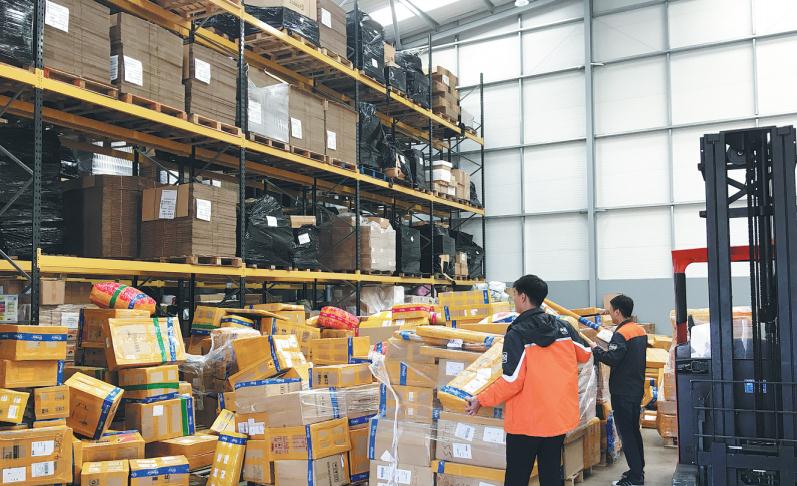
As cross-border shopping booms, Chinese e-commerce giants investing heavily in logistics to get closer to consumers
China's e-commerce giant Alibaba said on Monday that Singles Day sales on its online shopping platforms this year reached a record 213.5 billion yuan ($30.7 billion), which represented an increase of about 27 percent from 2017.
But many people might not realize that Singles Day has become more than a phenomenon involving Chinese companies alone.
Thanks to the millions of dollars that Chinese e-commerce platforms have invested in streamlining cross-border logistics efficiency, Singles Day sales have also become a golden opportunity for global brands to reach Chinese consumers.
"We'd seen a surge of activity from October onwards, growing more and more as Double 11 approached," said Eric Wang, co-founder of the United Kingdom-China cross-border logistics company 51Parcel, using the Double 11 description used by Alibaba for the discounted online shopping festival.
Although sales only take place on Nov 11, global brands and logistics companies forecast which items are likely to be popular and store them in warehouses in China, so that consumers can buy global products with the potential to be delivered the next day.
To put the trend in perspective, 60,000 international brands took part in last year's festival, including familiar items from the UK such as health products from Holland& Barrett, and chocolates, biscuits, teas and coffees from Waitrose.
At the click of a button, Chinese consumers can now enjoy the best of the world's products in no more than a week.
But Alibaba and JD, another e-commerce giant, say this is still not fast enough.
This year, Alibaba made a commitment to invest more than 100 billion yuan over five years through its in-house logistics business, Cainiao Network. Ultimately, it aims to ensure products worldwide are delivered to Chinese customers within three days.
JD has made a string of investments aimed at developing its new smart logistics solutions, including self-driving vehicles and drones. Its network of more than 500 warehouses and 7,000 delivery and pickup stations means it can fulfill one-day delivery for 90 percent of orders placed on its website.
These might sound like big investments, but the reason companies are making them is obvious, as the success of e-commerce depends almost entirely on the speed and reliability of delivery.
While customers have traditionally invested time in getting to the shops, paying for goods, and potentially returning them, sellers are now competing for that work, to do it faster and at reduced cost.
"It's all about getting closer to the consumers. Convenience drives the growth of e-commerce, and logistics is the backbone that ensures this convenience," said Zhang Tianbing, head of Deloitte China's consumer practice

Rivalry spills over
The phenomenal speed at which China's e-commerce market has expanded has taken the global retail world by storm.
In 2015, the country's e-commerce retail sales stood at $584 billion, a figure that had almost tripled by this year to $1.5 trillion. Three years ago, e-commerce only accounted for 14.7 percent of the country's retail sales, but by this year, the proportion had risen to 29.1 percent.
According to a forecast by eMarketer, by 2020 China's e-commerce market will account for 41.9 percent of all retail sales in the country, meaning about half of the products Chinese consumers buy will be purchased online.
The country's e-commerce giants have fought over everything from customer data to exclusive contracts with retailers.
More recently, that rivalry has spilled over into logistics networks and warehousing, with key operators spending millions of dollars to secure prime warehouse locations so they can shave precious hours off delivery times.
Stuart Ross, head of industrial at JLL in China, said: "We have seen a huge surge in demand for e-commerce warehousing space in China over the past few years as e-commerce giants scramble to secure warehouses in response to the boom in volume." This has led to a trend where warehouses for traditional retail storage have been converted for use by e-commerce companies. Robots in warehouses help to sort parcels, and automation systems have been installed to improve inventory tracking.
"Fierce competition for logistics efficiency in China has given birth to innovation, and these innovations are beginning to spread to the global logistics sector," Ross said.
One typical example is the international use of multilevel storage shelves that are popular in Chinese e-commerce warehouses, and elevators that allow quick access to parcels on each shelf. Such systems are beginning to be implemented by e-commerce warehouses overseas.
Increasingly, Chinese players are investing in overseas warehouses and logistics transportation networks, to make the international leg of deliveries as smooth and reliable as possible.
Alibaba's Cainiao Network has invested in creating its own warehouses in about 20 countries. Processing 100 million packages a day, Cainiao has been able to reduce cross-border shipping times from an average of 70 days to 10 days for some countries, according to Alibaba.
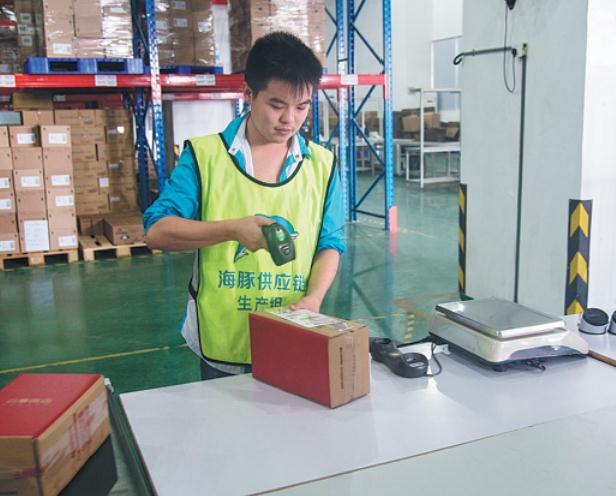
Professional logistics companies, including the Dolphin Supply Chain in Hangzhou, Zhejiang province, and courier STO Express in Shanghai, are investing heavily in warehouses, cargo planes and trucks.
For instance, Dolphin's IT system enables close tracking of collection times from retailers, and even slight delays are closely monitored and recorded. Once collection is complete, these products are deposited into Dolphin's temperature-controlled warehouses and sent to China
Challenges remain
Dolphin has warehouses in the United States, Japan, Hong Kong, Australia, the United Kingdom, Germany and Poland, which the company locates close to its core sector-food suppliers.
David Lee, CEO of Dolphin Supply Chain, said: "Our own contract fleet of truck drivers and cargo planes enables us to have complete control of the timing of delivery, and to monitor and ensure products are kept in optimal condition."
The rapidly growing scale of China's e-commerce may seem like a win-win situation for retailers, consumers and platforms, but the sector could also face the challenge of "delivery-clogging" if logistics streamlining efforts cannot keep up with demand, Alibaba's co-founder and executive chairman Jack Ma said earlier this year.
Ma predicts that courier companies will face overwhelming challenges in the next five to 10 years, when total daily package deliveries may reach 1 billion.
Despite the significant investments Alibaba, JD and other e-commerce platforms have made in warehouses, IT systems and automated sorting processes, it remains to be seen whether technological advancements in the logistics sector will keep pace with the expected increase in volume.
China still lags many other markets when it comes to logistics performance. In 2016, the country ranked No 27 on the World Bank's Logistics Performance Index, which measures each market on logistics environment, core logistics processes, delivery time and cost.
As its e-commerce sector integrates further into global systems, Chinese companies have been building their overseas logistics networks, client relationships and other service expertise, such as customs-clearing abilities across different markets.
For instance, customers from more than 200 countries and regions bought products on Alibaba's platforms on Singles Day last year, which boosted the festival's international transaction volume by 60 percent year-on-year.
But Zhou Zhiyong, a business operator at AliExpress, told Global Times some customers in countries with inadequate express delivery services faced great disappointment, as it took as long as six months for their orders to arrive.
Deloitte's Zhang said: "Chinese e-commerce companies' overseas expansion faces both challenges and opportunities. They can realize significant opportunities by investing in the e-commerce logistics infrastructure of countries that are still in the early stages of building their e-commerce sectors, such as those in Africa and the Middle East.
"Doing so would be a test for the all-round international capability and experience of Chinese e-commerce companies. It is a tough journey, but certainly the next breakthrough milestone for many of these firms."




















