



US soybean farmers store crops









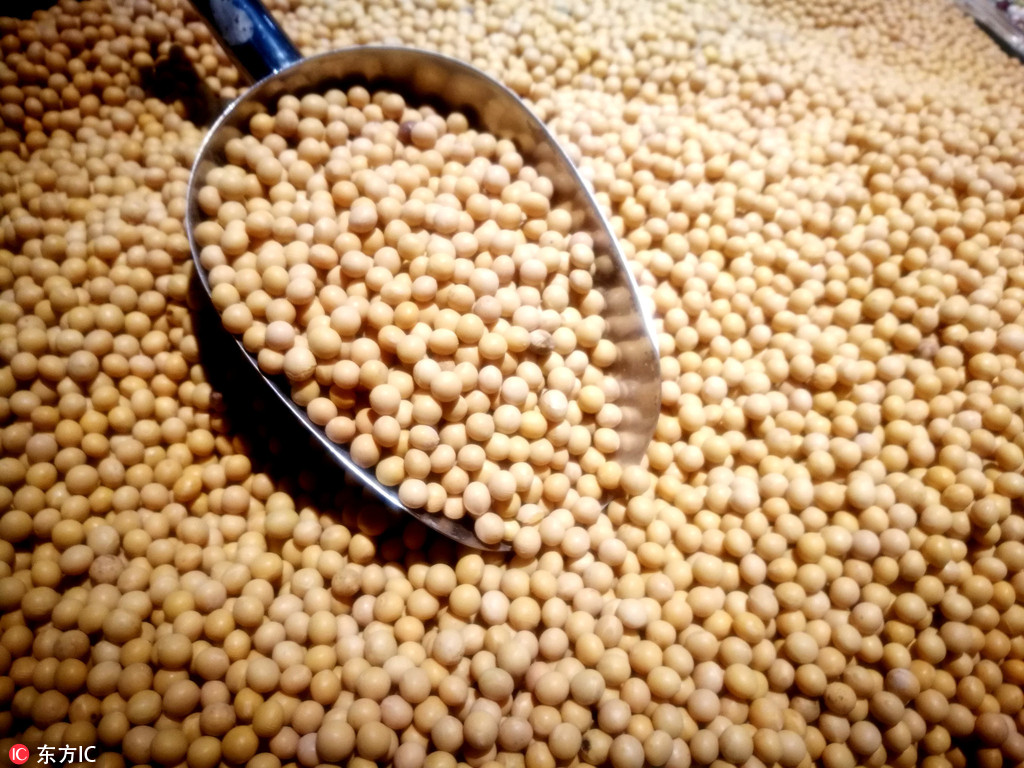
Rather than sell into a depressed market caused by tariffs, US soybean farmers are storing their crops hoping to eventually get a better price.
A bumper harvest and tariffs imposed by China on American exports in response to US tariffs on Chinese goods has hit price levels.
Austin Rincker, who grows corn and soybeans and raises cattle on a farm near Moweaqua, Illinois, said farmers like him are facing stiff headwinds.
"We are storing beans on the farm and at a co-op (cooperative) in town," he said in an interview on Monday.
Rincker said that there are a lot of farmers looking for markets to sell their crops, and "they want to see the US and China come to some sort of negotiation'' over the current trade dispute.
Illinois is the No 1 soybean producing state. In 2017, Illinois farmers produced 10.5 million acres of soybeans with an average yield of 58 bushels per acre and a total production of 611.9 million bushels of soybeans, according to the state soybean association.
Bloomberg reported that a bushel of US-grown soybeans was going for $8.87 last week. Before the Chinese tariffs were imposed, that same bushel was selling for about $2 more, according to Bloomberg.
Amid trade disputes with the US and rising tariffs, Chinese importers have switched to Brazil for soybean supplies, which led to sharp fall in Chicago Board of Trade (CBOT) soybean prices.
Soybeans futures recorded a 0.88 percent rally when China and the United States held their second diplomatic and security dialogue in Washington on Nov 9.
Before the talks, US Ambassador to China Terry Branstad met with Agriculture Secretary Sonny Perdue on trade issues. Branstad, a former governor of the key soybean growing state Iowa, expressed his hope to "develop a framework that can lead to an agreement" with China, the top buyer of US soybeans.
US farmers have constantly urged Washington to resolve trade issues with China as soon as possible, so as not to lose their biggest market.
Rincker in Illinois said that there are a lot of farmers looking for markets to sell their crops, and "they want to see the US and China come to some sort of negotiation'' over the current trade dispute.
Frayne Olson, North Dakota State University crop marketing economist, said most farmers and grain elevators in the US have permanent storage facilities for their corn, wheat and soybeans. "If properly managed, soybeans can be stored for several years in permanent facilities without any deterioration," he said in an email.
However, if soybeans are stored at a high moisture level in temporary facilities without the ability to manage temperature and moisture (such as large white silage bags seen on many farms), the soybeans can deteriorate quickly, added Olson.
Rincker's farm has aeration fans on the storage bins and "we can monitor conditions," he said.
Rincker said he will watch the market carefully and sell into any strengthening. "We can store beans into 2020 if we have to. We would like to have the storage freed up by the fall of 2019 so we can store the 2019 crop," he said.
Most soybean farmers in North Dakota store some of their soybeans after harvest, Olson said. During typical market conditions, there are market incentives for farmers to store soybeans into January and February, but these market incentives usually disappear during March.
Approximately 70 to 75 percent of North Dakota soybeans are sold to export terminals in the Pacific Northwest and approximately 98 percent of the soybeans purchased by these export terminals are sold to Chinese buyers, he said.
"It is very expensive to ship North Dakota soybeans to alternative markets, Olson said, adding that North Dakota farmers have seen futures market prices for soybeans decrease because of low export volumes and very high national yields.
Xinhua contributed to this story.
Contact the writer at paulwelitzkin@chinadailyusa.com










