



Largest collider to probe 'uncharted territory'









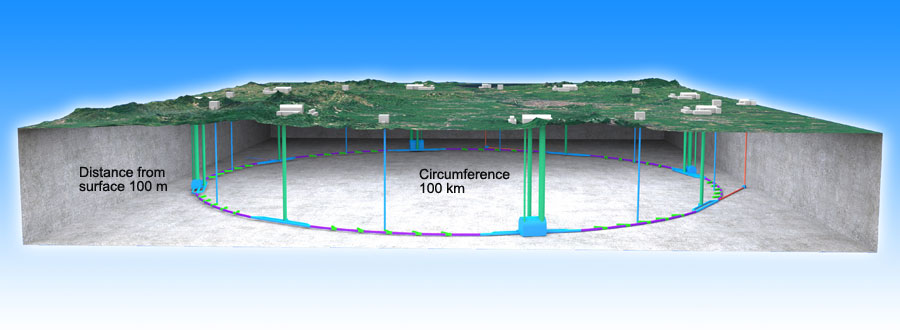
China plans to complete the world's largest and most powerful particle collider by 2030, allowing scientists to open a new chapter of fundamental physics and tackle some of the greatest scientific mysteries, ranging from dark matter to antimatter.
The Circular Electron-Positron Collider is a particle accelerator that will measure 100 kilometers in circumference. The collider, to be built with global collaborators, is to be over 100 meters underground, according to a conceptual design report published on Wednesday by the Institute of High Energy Physics of the Chinese Academy of Sciences, the project's initiator.
The accelerator's circumference will be almost four times greater than the Large Hadron Collider, the world's most powerful particle accelerator, a 27-kilometer ring of superconducting magnets located beneath the border of Switzerland and France.
The project's cost is estimated at more than 30 billion yuan ($4.3 billion). The location is still being evaluated, and possible candidates include Qinhuangdao and Xiongan New Area in Hebei province, Huzhou in Zhejiang province and Shenshan Special Cooperation Zone in Guangdong province.
"Radiation from the project will be negligible compared with a nuclear power plant, and its experiments will not harm the environment or people," said Gao Yuanning, chairman of the CEPC Council Committee.
Prototypes for its key components are expected to be built between 2018 and 2022, and construction is to begin by 2025 if financing and all preparations are in place.
Within its 10-year estimated operation time, CEPC will generate more than 1 million Higgs bosons-an elusive particle discovered in 2012 whose field of energy can interact and grant mass to some elementary particles, such as quarks. Such particles are the building blocks for the protons and neutrons in atomic nuclei.
Physicists think this energy field, called the Higgs field, exists in every region of the universe, including the vacuum of space. It is thought to be the reason matter exists as it is and not in some other form, according to the European Organization for Nuclear Research.
"Higgs is really new physics. We had never seen anything like it," said Nima Arkani-Hamed, a theoretical physicist from the Institute for Advanced Study, a research center in the United States. "It is the harbinger of profound new principles, and we must look at it closely."
The Large Hadron Collider can produce Higgs particles by smashing billions of accelerated protons together. But it is a "very dirty" machine because it "smashes particles like a sledgehammer and the valuable particles, the ones we are trying to closely examine, are often hidden in the scattered mess", Gao said.
Scientists estimated the European collider takes 10 billion collisions to produce a single Higgs boson. "It is like finding a needle in a mountain of hay," said Ruan Manqi, a researcher from the Institute of High Energy Physics.
However, the CEPC can generate one Higgs boson from every 1,000 collisions.
"This will result in many more opportunities to closely study the Higgs boson's properties, and collect data in a cleaner and more precise environment," Ruan said. "Understanding these properties might help solve some of the greatest scientific mysteries that cannot be explained by our current models of physics."
Developments in particle physics have yielded many world-changing inventions, such as cancer diagnosis and treatment, the World Wide Web and magnetic resonance imaging in medicine, said Franco Bedeschi, a researcher at the National Institute for Nuclear Physics in Pisa, Italy. "We are venturing into uncharted territory in science."


- Investigation uncovers mismanagement of donated artifacts
- Gold mine accident kills 7 in East China
- Defense minister greets foreign military envoys at Chinese New Year event
- Judicial efforts lead to decline in China's pollution cases
- SPP steps up food and drug safety oversight
- Visually impaired student's rail journey goes viral












