San Bao: Searching for soundless sound









China Reform and Opening – Forty Years in Perspective
San Bao: Searching for soundless sound
Editor's note: Laurence Brahm, first came to China as a fresh university exchange student from the US in 1981 and he has spent much of the past three and a half decades living and working in the country. He has been a lawyer, a writer, and now he is Founding Director of Himalayan Consensus and a Senior International Fellow at the Center for China and Globalization.
He has captured his own story and the nation's journey in China Reform and Opening – Forty Years in Perspective. China Daily is running a series of articles every Thursday starting from May 24 that reveal the changes that have taken place in the country in the past four decades. Starting this month, China Daily will run two articles from this series each week – on Tuesday and Thursday. Keep track of the story by following us.
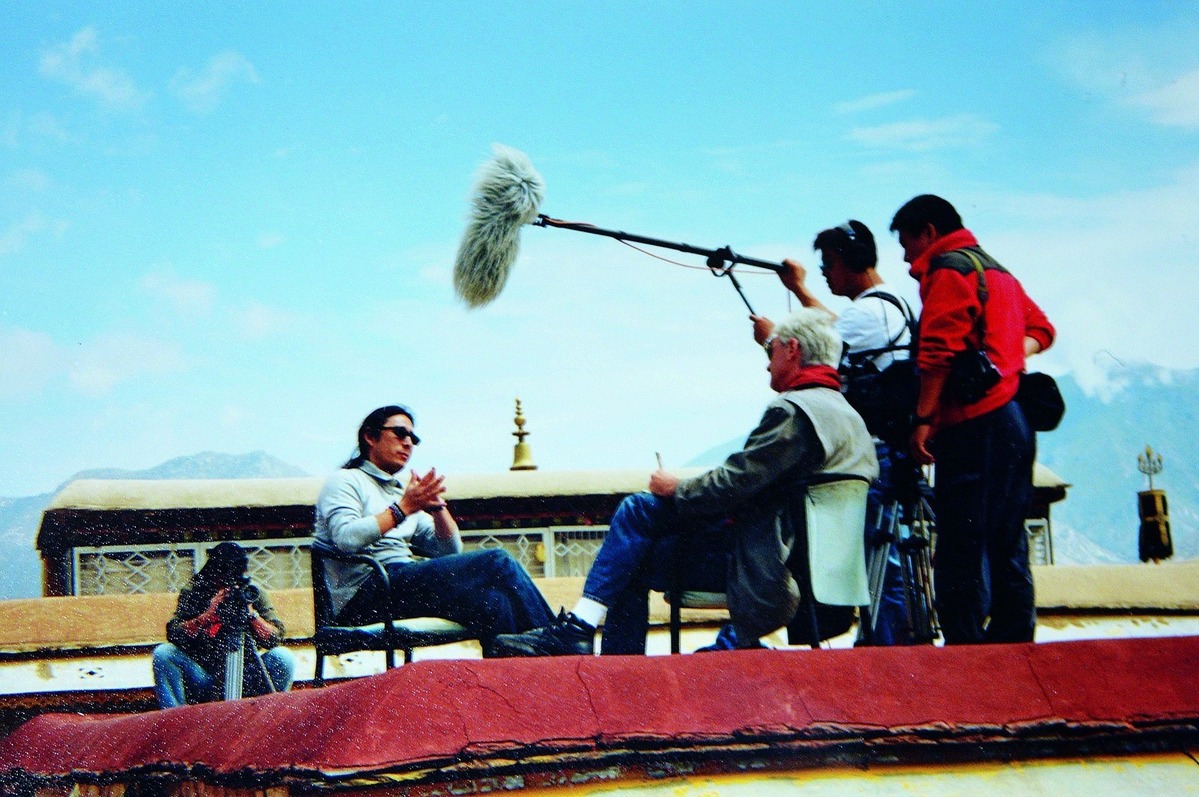
Author interviews music composer San Bao during filming of Searching for Shangrila-la in 2002. [Photo provided to chinadaily.com.cn]
On the first leg of Searching for Shangri-La expedition, I was joined by San Bao, one of China’s greatest music composers. From classical to pop, San Bao has created stars through his song writing and composition by writing hits for pop singers and movie directors like Zhang Yimou and Feng Xiaogang.
San Bao is actually ethnic Mongolian. The Mongolian people also practice Tibetan Buddhism. Lifestyle in the mountains and grasslands are similar to the Tibetans, so is their nomadic spirit. I will never forget one afternoon, we sat together on the rooftop of Jokhang Temple, drinking yak butter tea. Potala Palace was within the distance and the crystal blue sky created an illusion that one could actually reach out and touch it. I tried to touch it, only to realize it was just an illusion, a distortion of perceptions. I began questioning my own perception of distance, space, time and music. We talked about sound.
"Many people are backpacking to Tibet, searching for inspiration," I wondered. "But why are we really here? What do you make of it?"
"Every person has a Shangri-la in his mind," San Bao explained.
"So is this search for Shangri-la the driving force behind New Age music, like the band Enigma?"
"From the music perspective, in the early 1980s, so-called New Age or World music emerged. New Age music has now become a fashion. Suddenly, it appears that everyone is doing this and it is now becoming overdone. Every person thinks that as long as you get some primitive sounds and patch them together, you have the New Age sound."
The clouds shifted, exposing more blue.
"Many people search. " San Bao continued, "This is just idealistic. The real dream is inside our own minds if your heart can really find it. I like to go to really rural areas where life is simple. In fact, it is not the place that I go to that is important, it is the process of getting there. People in the city, however, often do not even have the time to consider this single question. Many workaholics probably do not even think that this is Shangri-la. But I am not a workaholic. So people often ask me as if I am strange, whether I feel bored going off to that kind of place, working alone for over a dozen hours at a time? I say, maybe it is boring for you, but every person is different and has different feelings. Some people feel that if they have a nice house, a stable job in the city, a nice family and well-behaved children, then that is enough. They feel that that is their Shangri-la, their dream. Is there anything wrong with that? In fact, they live a real life and that is really great."
"Mongolian and Tibetan nomad music is completely integrated with the landscape," he explained, pointing to a Mongolian yak hair standard propped on one rooftop of Jokhang. Integrated lifestyle of these two nomadic peoples had made this Mongolian symbol of power Tibetan as well. "In the vast grasslands, there are actually very few people. Their lifestyle is focused on raising sheep and yaks. Sometimes, there is only one person out there with the sheep and yaks. Imagine, alone all day on the grasslands with nobody to talk to. So the nomad will sing. The space is too vast. Anybody who comes to such a place will feel its expansiveness as they cannot see anyone on the horizon. So what do you feel, what do you really want to do? Just scream out. Here you have the feeling that you can let yourself go altogether. Here, one’s relationship with the forces of nature is the most basic. You can hear such a person sing from a very great distance. Completely alone, one will tend to sing to oneself just to make oneself happy. It is a pure relationship between an individual and the environment."
"Then has the search for Shangri-la become just a fashion," I asked, "like New Age music or fusion lifestyle living?"
"Many people will just do what is in fashion," San Bao shrugged, "instead of really finding Shangri-la. For instance, the other day, a whole bunch of fashion models had used Jokhang Temple as a background for their modeling. Why? This is very superficial. Things like this disgust me and I cannot accept it. In fact, it is quite frightening if you think about it. Real things must be found from within yourself, not just in a place. It can’t be found just because you have come to Lhasa. The spirit within you is the most important. In reality, Shangri-la represents a state of composure. Regardless of where Shangri-la might be, this is really not so important. It is a lifestyle, a state of composure, or the ideal in one’s imagination. "
"There is a Zen concept of a voiceless voice." I asked. "Can you tell me about this soundless sound?"
"I once discussed this in detail with a Zen," San Bao replied. "The sound within Zen is the most sensitive and the most basic element of all things. You see, I am a composer, so I am very sensitive to sound. This point of Zen is very difficult to understand. When I was young, my teacher taught me something that changed the way I would ever think. ‘You must remember,’ he explained, ‘within music, the point of silence is actually a part of the music.’ My realization suddenly had greater clarity. These words have influenced my own understanding of music ever since."
As San Bao explained the vision of his music, I noticed the Mongolian yak hair standard protruding from one of the rooftops of Jokhang Temple, sharp against the blue of the sky. Golden rooftops with guardian dragons and laughing lions framed Potala Palace in the distance, which seemed so close. We sat on the rooftop of Jokhang Temple all morning, discussing the search for a sound that could not be heard. The blue sky, which stretched behind San Bao, seemed so close that it could be touched at any moment. Just reach out and grab a cloud passing by. Such is an illusion perpetuated by the blue sky. Such was its clearness. Awareness undistorted. If the Tibetan sky were a sound, a chime would ring forever.
Please click here to read previous articles.