Botanist builds 'bank' for desert plants









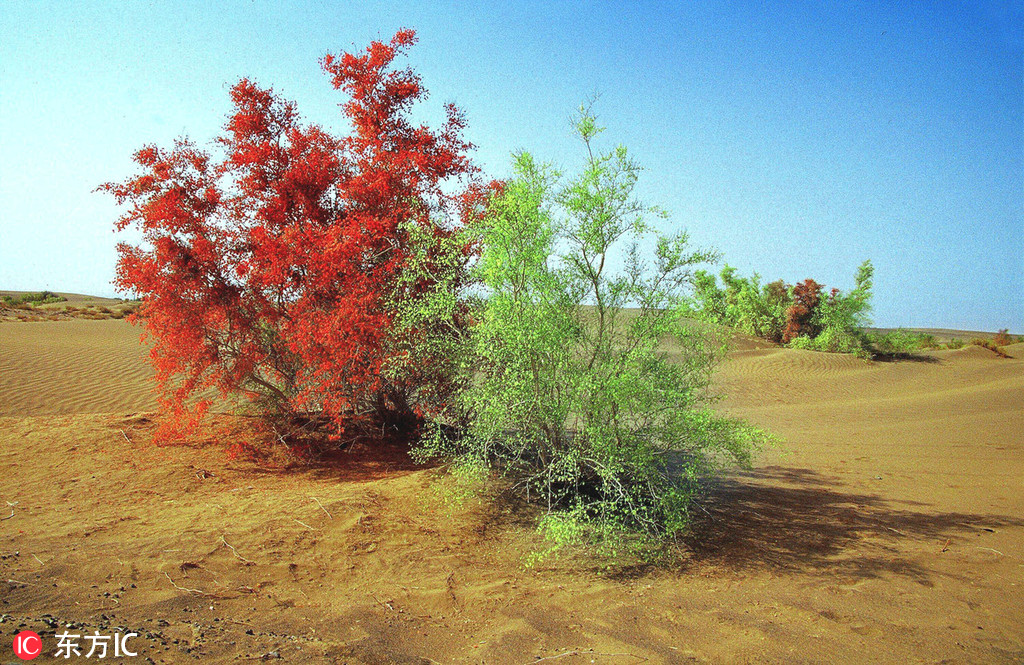
"The Turpan Eremophytes Botanic Garden is just like a 'bank' where we deposit abundant desert plants. We can take out the 'savings' when needed." — Pan Borong
Pan Borong, a researcher with the Xinjiang Institute of Ecology and Geography under the Chinese Academy of Sciences, has been dedicated to the research and cultivation of plants in arid regions for 46 years.
Pan recently received the 2018 China Botanical Garden Lifetime Achievement Award for his outstanding contributions to the cause of desert botanical garden in China.
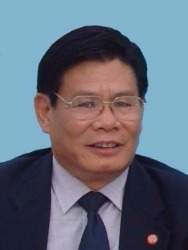
Pan is the founder of the Turpan Eremophytes Botanic Garden in Xinjiang, the country's first botanical garden for desert plants.
In 1972, Pan began researching and domesticating drought-resistant plants for desert control at a people's commune in Turpan, a city along the ancient Silk Road.
At that time, the commune was plagued by frequent gales blown from the sandy land to its west. Local residents hoped the researchers could help them shake off the fear of the sands.
Life in Turpan was harsh. Pan and other researchers lived in cave houses with windows made of plastic. In the winter, heavy winds would tear apart the windows, leaving dust and sand everywhere.
Food supplies were also scarce. Researchers' regular diet included steamed cakes of sorghum, green turnips and onions. They had to bicycle to the county seat to buy daily necessities such as meat, sugar and soap with ration coupons.
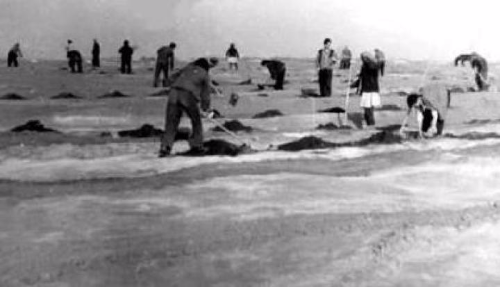
Despite the difficulties, the researchers worked hard and successfully introduced a dozen drought-resistant plants, including suosuo, tamarix ramosissma and desert poplar, which are adaptable to local climate and soil conditions. After sapling nursery and planting trials, several species were chosen to be promoted in Turpan.
After years of effort, the "land of no life" began to be covered with vegetation. And today, these sand-fixation plants have grown into tall shrubs which form a "green barrier" to prevent sands from moving.


- Tsinghua math talent rivals top US peers, Yau says
- China's sacred revolutionary sites Zunyi, Yan'an to be connected by high-speed rail
- Power of education shines in Xizang
- Ancient pressure cooker making a stir
- Ten photos from across China: Jan 16 – 22
- China moves to set national standards for pre-made dishes