


Ancient City of Pingyao









Category of site: Cultural site
Brief introduction
Founded in the 14th century, the Ancient City of Pingyao, located in China's Shanxi province, is an exceptionally well-preserved example of a traditional Han Chinese city. The property includes three parts: the entire area within the walls of Pingyao, Shuanglin Temple (six kilometers southwest of the county seat), and Zhenguo Temple (12 kilometers northeast of the county seat).
The Ancient City of Pingyao is an outstanding example of Han cities in the Ming and Qing dynasties (from the 14th to 20th century). It retains all the Han city features, provides a complete picture of the cultural, social, economic and religious development in Chinese history, and it is of great value for studying the social form, economic structure, military defense, religious beliefs, traditional thinking, traditional ethics and dwelling form.
It was listed as a World Cultural Heritage Site by UNESCO in 1997.
Cultural heritage
Pingyao was constructed during the reign of King Xuan of the Western Zhou Dynasty (C.827-782B.C.). King Xuan's original purpose for building Pingyao was to withstand the attacks of the nomads from the north. Afterwards, Pingyao was developed into a multi-functional city, the starting place of commercial business in Shanxi and the birthplace of China's first rudimentary form of a modern bank. Pingyao also retains most of its ancient charm in buildings like the Temple of Confucius, the Qingxu Temple and a great number of residential buildings.
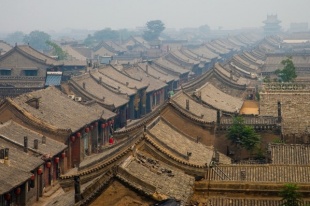
The Old Town of Pingyao was constructed according to traditional planning and building style of the Han ethnic group, and was designed according to the functions of its different parts. Four large streets, eight smaller ones, and 72 lanes form a neat grid. Symmetrically arranged along an an axis, the private houses were constructed either in the style of courtyard houses or in the style of manmade-cave houses, all with local features. Today, Pingyao still has 3,797 courtyard houses, 400 of which are especially well preserved. In addition, richly decorated temples and shops are scattered all over the town. These old buildings bring back a scene of the flourishing town of Pingyao as one of the most prosperous commercial centers during the Ming and Qing periods.
The Zhenguo Temple, located in the northeast part of the city, was built 1,000 years ago, and its Hall of Ten Thousand Buddha (Wan Fo Hall) is the third-oldest existing wooden building in China. The painted statues from the Five Dynasties period (907-960) inside the Wanfo Hall are recognized as precious sculptures.
The Shuanglin Temple, with its 10 halls, is located in the southwest part of the town. It was rebuilt in 571, during the Northern Qi Dynasty (550-577). Since the temple is home to more than 2,000 painted clay statues from the Yuan Dynasty (1271-1368) through the Ming Dynasty, it is known as the Treasure House of Painted Sculptures.
Other treasures in Pingyao include the Hall of Great Achievements (Da Cheng Dian) in the Temple of Confucius, reconstructed in 1163, and the Qingxu Temple, originally constructed in 657.
Pingyao city wall
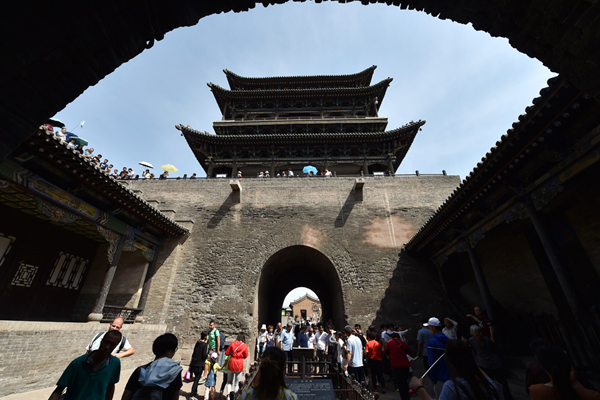
The wall of Pingyao Ancient City was built in the Ming Dynasty and it includes six gates, four turrents, 72 watch towers and 3,000 crenels. It is one of the most well-preserved ancient city walls in China and a core part of Pingyao Ancient City. The wall is 10 meters high, 6,163 meters around, and three to five meters wide at the top. The west and east sides of wall have two gates while the southern and northern walls have one gate. Each gate has a barbican entrance with an inner and an outer door with a tower above it. Seventy-two watch towers were built every 50 to 100 meters along the top and 3,000 crenels for shooting were distributed on the two-meter-high wall. These numbers represent the 72 disciples and 3,000 students of Confucius.
Legends and stories
The parapet, or the Maiden's Wall, is named after a little girl who saved a workman's life at the cost of her own. Legend has it that the girl used to sit on the city wall everyday watching her grandpa help build the wall. One day, when she saw a fatigued worker swaggering by the edge of the wall, she came up to push him back to a safe place but fell off herself. In grief, the workers built a smaller parapet on the wall to commemorate her.