
<tt id="6hsgl"><pre id="6hsgl"><pre id="6hsgl"></pre></pre></tt>
          <nav id="6hsgl"><th id="6hsgl"></th></nav>
          国产免费网站看v片元遮挡,一亚洲一区二区中文字幕,波多野结衣一区二区免费视频,天天色综网,久久综合给合久久狠狠狠,男人的天堂av一二三区,午夜福利看片在线观看,亚洲中文字幕在线无码一区二区
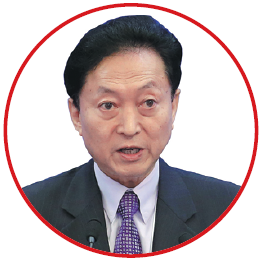
          Yukio Hatoyama
          Former Japanese prime minister
          BORN:

          Tokyo on Feb 11, 1947

          EDUCATION:

          1969: BA in engineering, University of Tokyo

          1976: PhD in industrial engineering, Stanford University

          CAREER:

          1981: Teaches management at Senshu University in Tokyo

          1986: Elected to Japanese House of Representatives

          1996: Forms Democratic Party of Japan

          Sept 1999-Dec 2002: DPJ leader

          May 2009-June 2010: DPJ leader

          Sept 2009: Becomes prime minister after commanding victory over Liberal Democratic Party, which had governed Japan almost continuously since 1955

          June 2010: Resigns as prime minister

          2012: Stands down as member of House of Representatives

          2013: Establishes East Asian Community Institute

          A family history of enhancing ties
          Former Japanese prime minister Yukio Hatoyama says country can learn a lot from China's development
          Pan Mengqi and Liu Yang
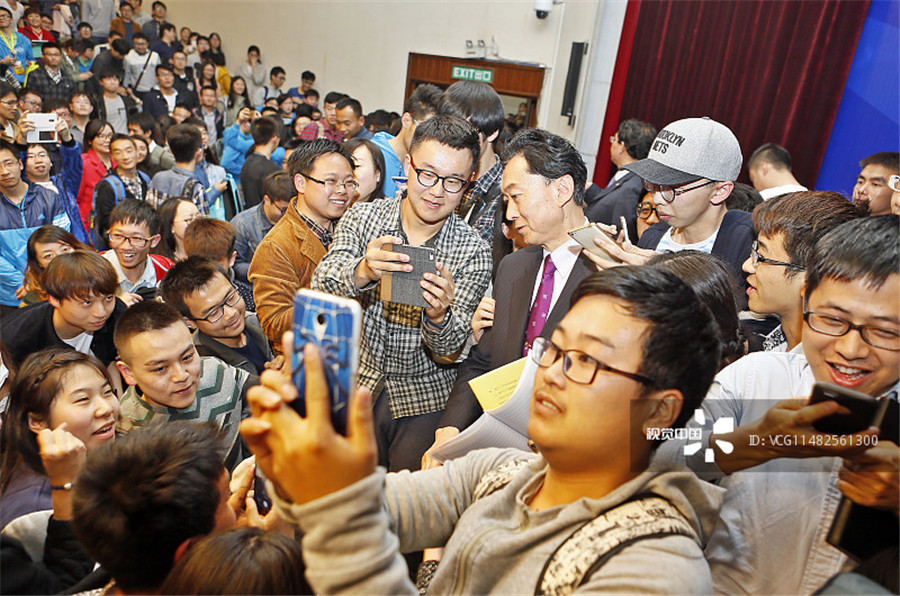
          Hatoyama meets students at Xi'an Jiaotong University in Xi'an, Shaanxi province, after delivering a speech there, on April 7, 2016. [ZHANG JIE/FOR CHINA DAILY]

          To help restore damaged ties, in 1974 Iichiro Hatoyama built up a cooperative project with the China-Japan Friendship Association, a Chinese organization formed in 1963 at the urging of Zhou to foster civil relations between the two countries.

          The project saw Iichiro Hatoyama send three batches of youths to China as "China-Japan Friendship envoys", and also receive Chinese youth representatives sent to visit Japan.

          More than a million Chinese and Japanese youths have taken part in such exchanges in the past four decades.

          In 1981, Iichiro Hatoyama also launched the first technical trainee exchange program with China. Hundreds of Chinese trainees arrived in Japan that year, to be placed with many well-known Japanese companies including Panasonic and Toyota.

          Sending trainees to Japan was an extremely important part of Sino-Japanese exchanges and brought benefits to both sides. It not only cultivated the technical talent much needed by China, which was then at the beginning of reform and opening-up, but also helped make up for a shortage of Japanese labor.

          In 1982, Iichiro Hatoyama was invited to Beijing to attend activities celebrating the 10th anniversary of the normalization of Sino-Japanese diplomatic relations.

          Fourteen years later, his son, Yukio Hatoyama, was elected leader of the Democratic Party of Japan.

          Just months after his election, he visited China for what he described to Chinese officials as an "icebreaking" trip. He said his party would have a correct view of Japan's past, and that resolving political mistrust was the first step toward improving China-Japan relations.

          In 2013, three years after stepping down as Japanese prime minister, Yukio Hatoyama paid his first visit to Nanjing, the capital of eastern China's Jiangsu province. At the end of a visit to the memorial hall dedicated to the 300,000 people killed in the city by the Japanese army from December 1937 to January 1938, he bowed deeply and said the conduct of the Japanese troops was not acceptable.

          "I apologize for the crimes that Japanese soldiers committed during wartime, and I sincerely hope this tragedy will not be repeated," he said, adding that Japan must keep apologizing until it receives forgiveness.

          On another visit to Nanjing, in September this year, Yukio Hatoyama and his wife, Miyuki, closed their eyes and put their palms together to send prayers in front of the memorial wall listing the names of those massacred in Nanjing.

          It was Yukio Hatoyama's 13th visit to China this year.

          His trips to China have incensed right-wing Japanese politicians, who have painted him as an "alien". But during decades of ups and down in China-Japan relations, Yukio Hatoyama's stance has provided a change of tone, winning praise from the Chinese public.

          He said he believed the China-Japan relationship ranks among each country's most important bilateral ties, and that reducing political mistrust is his first step in refueling the relationship.

          The second, he said, is to tackle the issues that both Japan and China are facing. By doing so, both countries could learn from the other's experience.

          In the past 10 years, most of Yukio Hatoyama's trips to China have centered around planting trees. In April, on his 29th tree-planting trip, Yukio Hatoyama and hundreds of students from Japan and China planted trees in Baoji, Shaanxi province, and Chaoyang, Liaoning province.

          He came up with the idea of planting trees in China in 2007. As president of the Yuai Association, a nonprofit organization encouraging fraternity, Yukio Hatoyama proposed the formation of a group of Japanese youths who would visit China and plant trees together.

          When he took part in a tree planting activity in Jinzhou, Liaoning, in 2014, he agreed with local officials to plant 10 trees. But he ran out of time and only planted seven. He promised the city government he would return to plant the three remaining the next year.

          Since then, he has made a habit keeping a few trees unplanted, "in order to have a reason to come back to China next time".

          "Trees represent hope; youth represents hope," he said, adding that the two governments could start their cooperation in the field of environmental protection, including preventing global warming, desertification and air pollution.

          "If China and Japan can work together to tackle difficulties that the two sides are both facing, the hearts of the two peoples will be naturally linked together," he said.

          Yukio Hatoyama said that idea first sprang to mind on a visit to China in the 1990s. He said China impressed him then, because it was undertaking a project - the reform and opening-up launched in 1978 - that was changing the lives of more than a billion people.

          "I felt at that time that a country with such a vast territory and rich natural resources must hold many promises," he said. "China had just started its reform and opening-up policy then and the Chinese people all had a strong drive to pursue a better life."

          During China's 40 years of reform and opening-up, Japan has played an important role as China's economic partner. But Yukio Hatoyama said he believed more frequent civil interactions between the two neighbors, separated by just a narrow strip of water, will be beneficial to the prosperity and stability of Asia and the world.

          He said "development for the people, by the people and to the benefit of the people" is the fundamental purpose of China's reform and opening-up and its modernization drive.

          Now China is the world's second-largest economy, and its stable development is continuing. As a frequent visitor to China, he said he hoped Japan can also learn from China's development experience.

          What has impressed Yukio Hatoyama most is the economic and social development in China's rural areas, including the steady increase in farmers' incomes, the modernization of agricultural production facilities, the continued development of agricultural technology, the remarkable improvement in the quality of agricultural products, the enhancement of educational facilities, and the urbanization of villages.

          Over 40 years of China's reform and opening-up, 700 million Chinese people have been lifted out of poverty, he said, adding that China has also become one of the first countries to reach the UN's millennium development goals.

          Meanwhile, China's stable development and its expanding overseas direct investment have been providing great trade opportunities to other countries.

          "Just as an old Japanese saying goes, 'The better yields the rice shoots have, the lower they bow their heads.' And that is how China, a country with a population of more than 1.3 billion, deals with things (by keeping its head down)," Yukio Hatoyama said.

          "Now Japan is facing various social challenges - including low economic growth, a low birthrate, and an aging population - I think Japan can learn and cooperate with China, because our neighbor has just had a huge success in development in the past decades."

          As a member of the international advisory panel of the China-initiated Asian Infrastructure Investment Bank, he said it is "unnatural" that Japan has not yet joined the AIIB, and urged the two countries to enhance cooperation for the sake of peace and development in Asia.

          "China is promoting co-development with neighboring countries with initiatives such as the Belt and Road Initiative," he said. "I hope Japan will not exclude itself from such programs but adopt cooperative policies in order to grab the chances to develop together."


          |<< Previous 1 2   
          Yukio Hatoyama
          Former Japanese prime minister
          BORN:

          Tokyo on Feb 11, 1947

          EDUCATION:

          1969: BA in engineering, University of Tokyo

          1976: PhD in industrial engineering, Stanford University

          CAREER:

          1981: Teaches management at Senshu University in Tokyo

          1986: Elected to Japanese House of Representatives

          1996: Forms Democratic Party of Japan

          Sept 1999-Dec 2002: DPJ leader

          May 2009-June 2010: DPJ leader

          Sept 2009: Becomes prime minister after commanding victory over Liberal Democratic Party, which had governed Japan almost continuously since 1955

          June 2010: Resigns as prime minister

          2012: Stands down as member of House of Representatives

          2013: Establishes East Asian Community Institute

          A family history of enhancing ties

          Former Japanese prime minister Yukio Hatoyama says country can learn a lot from China's development
          Pan Mengqi and Liu Yang
          Hatoyama meets students at Xi'an Jiaotong University in Xi'an, Shaanxi province, after delivering a speech there, on April 7, 2016. [ZHANG JIE/FOR CHINA DAILY]

          To help restore damaged ties, in 1974 Iichiro Hatoyama built up a cooperative project with the China-Japan Friendship Association, a Chinese organization formed in 1963 at the urging of Zhou to foster civil relations between the two countries.

          The project saw Iichiro Hatoyama send three batches of youths to China as "China-Japan Friendship envoys", and also receive Chinese youth representatives sent to visit Japan.

          More than a million Chinese and Japanese youths have taken part in such exchanges in the past four decades.

          In 1981, Iichiro Hatoyama also launched the first technical trainee exchange program with China. Hundreds of Chinese trainees arrived in Japan that year, to be placed with many well-known Japanese companies including Panasonic and Toyota.

          Sending trainees to Japan was an extremely important part of Sino-Japanese exchanges and brought benefits to both sides. It not only cultivated the technical talent much needed by China, which was then at the beginning of reform and opening-up, but also helped make up for a shortage of Japanese labor.

          In 1982, Iichiro Hatoyama was invited to Beijing to attend activities celebrating the 10th anniversary of the normalization of Sino-Japanese diplomatic relations.

          Fourteen years later, his son, Yukio Hatoyama, was elected leader of the Democratic Party of Japan.

          Just months after his election, he visited China for what he described to Chinese officials as an "icebreaking" trip. He said his party would have a correct view of Japan's past, and that resolving political mistrust was the first step toward improving China-Japan relations.

          In 2013, three years after stepping down as Japanese prime minister, Yukio Hatoyama paid his first visit to Nanjing, the capital of eastern China's Jiangsu province. At the end of a visit to the memorial hall dedicated to the 300,000 people killed in the city by the Japanese army from December 1937 to January 1938, he bowed deeply and said the conduct of the Japanese troops was not acceptable.

          "I apologize for the crimes that Japanese soldiers committed during wartime, and I sincerely hope this tragedy will not be repeated," he said, adding that Japan must keep apologizing until it receives forgiveness.

          On another visit to Nanjing, in September this year, Yukio Hatoyama and his wife, Miyuki, closed their eyes and put their palms together to send prayers in front of the memorial wall listing the names of those massacred in Nanjing.

          It was Yukio Hatoyama's 13th visit to China this year.

          His trips to China have incensed right-wing Japanese politicians, who have painted him as an "alien". But during decades of ups and down in China-Japan relations, Yukio Hatoyama's stance has provided a change of tone, winning praise from the Chinese public.

          He said he believed the China-Japan relationship ranks among each country's most important bilateral ties, and that reducing political mistrust is his first step in refueling the relationship.

          The second, he said, is to tackle the issues that both Japan and China are facing. By doing so, both countries could learn from the other's experience.

          In the past 10 years, most of Yukio Hatoyama's trips to China have centered around planting trees. In April, on his 29th tree-planting trip, Yukio Hatoyama and hundreds of students from Japan and China planted trees in Baoji, Shaanxi province, and Chaoyang, Liaoning province.

          He came up with the idea of planting trees in China in 2007. As president of the Yuai Association, a nonprofit organization encouraging fraternity, Yukio Hatoyama proposed the formation of a group of Japanese youths who would visit China and plant trees together.

          When he took part in a tree planting activity in Jinzhou, Liaoning, in 2014, he agreed with local officials to plant 10 trees. But he ran out of time and only planted seven. He promised the city government he would return to plant the three remaining the next year.

          Since then, he has made a habit keeping a few trees unplanted, "in order to have a reason to come back to China next time".

          "Trees represent hope; youth represents hope," he said, adding that the two governments could start their cooperation in the field of environmental protection, including preventing global warming, desertification and air pollution.

          "If China and Japan can work together to tackle difficulties that the two sides are both facing, the hearts of the two peoples will be naturally linked together," he said.

          Yukio Hatoyama said that idea first sprang to mind on a visit to China in the 1990s. He said China impressed him then, because it was undertaking a project - the reform and opening-up launched in 1978 - that was changing the lives of more than a billion people.

          "I felt at that time that a country with such a vast territory and rich natural resources must hold many promises," he said. "China had just started its reform and opening-up policy then and the Chinese people all had a strong drive to pursue a better life."

          During China's 40 years of reform and opening-up, Japan has played an important role as China's economic partner. But Yukio Hatoyama said he believed more frequent civil interactions between the two neighbors, separated by just a narrow strip of water, will be beneficial to the prosperity and stability of Asia and the world.

          He said "development for the people, by the people and to the benefit of the people" is the fundamental purpose of China's reform and opening-up and its modernization drive.

          Now China is the world's second-largest economy, and its stable development is continuing. As a frequent visitor to China, he said he hoped Japan can also learn from China's development experience.

          What has impressed Yukio Hatoyama most is the economic and social development in China's rural areas, including the steady increase in farmers' incomes, the modernization of agricultural production facilities, the continued development of agricultural technology, the remarkable improvement in the quality of agricultural products, the enhancement of educational facilities, and the urbanization of villages.

          Over 40 years of China's reform and opening-up, 700 million Chinese people have been lifted out of poverty, he said, adding that China has also become one of the first countries to reach the UN's millennium development goals.

          Meanwhile, China's stable development and its expanding overseas direct investment have been providing great trade opportunities to other countries.

          "Just as an old Japanese saying goes, 'The better yields the rice shoots have, the lower they bow their heads.' And that is how China, a country with a population of more than 1.3 billion, deals with things (by keeping its head down)," Yukio Hatoyama said.

          "Now Japan is facing various social challenges - including low economic growth, a low birthrate, and an aging population - I think Japan can learn and cooperate with China, because our neighbor has just had a huge success in development in the past decades."

          As a member of the international advisory panel of the China-initiated Asian Infrastructure Investment Bank, he said it is "unnatural" that Japan has not yet joined the AIIB, and urged the two countries to enhance cooperation for the sake of peace and development in Asia.

          "China is promoting co-development with neighboring countries with initiatives such as the Belt and Road Initiative," he said. "I hope Japan will not exclude itself from such programs but adopt cooperative policies in order to grab the chances to develop together."

          主站蜘蛛池模板: 国产精品亚洲色婷婷99久久精品| 久热伊人精品国产中文| 国产精品小仙女自拍视频| 久久久久亚洲AV无码专| 精品天堂色吊丝一区二区| 成人免费亚洲av在线| 91精品国产麻豆国产自产| 色窝窝免费播放视频在线| 高潮潮喷奶水飞溅视频无码| 国产91午夜福利精品| 黄色A级国产免费大片视频| 亚洲国产日韩一区三区| 露脸国产精品自产拍在线观看| 欧美乱码伦视频免费| 中文丰满岳乱妇在线观看| 国产精品中文字幕久久| 久久精品国产久精国产| 亚洲av综合av一区| 色综合天天综合| 天堂亚洲免费视频| 激情动态图亚洲区域激情| 亚洲高清激情一区二区三区 | 亚洲精品一区久久久久一品av| 婷婷色综合成人成人网小说| 国产成人无码免费网站| 毛片免费观看视频| 91久久国产热精品免费| 中文字幕精品乱码亚洲一区99| 大屁股国产白浆一二区| 成人区精品一区二区不卡| 最新AV中文字幕无码专区| 18av千部影片| 国产丝袜一区二区三区在线不卡| 亚洲高清WWW色好看美女| 国产内射XXXXX在线| 一个色综合亚洲热色综合| 亚洲精品国产一二三区| 少妇极品熟妇人妻| 亚洲av网站首页在线观看| 99久久精品午夜一区二区| 熟妇人妻引诱中文字幕|