



Two nations look to the stars with massive telescope project in Southern Hemisphere









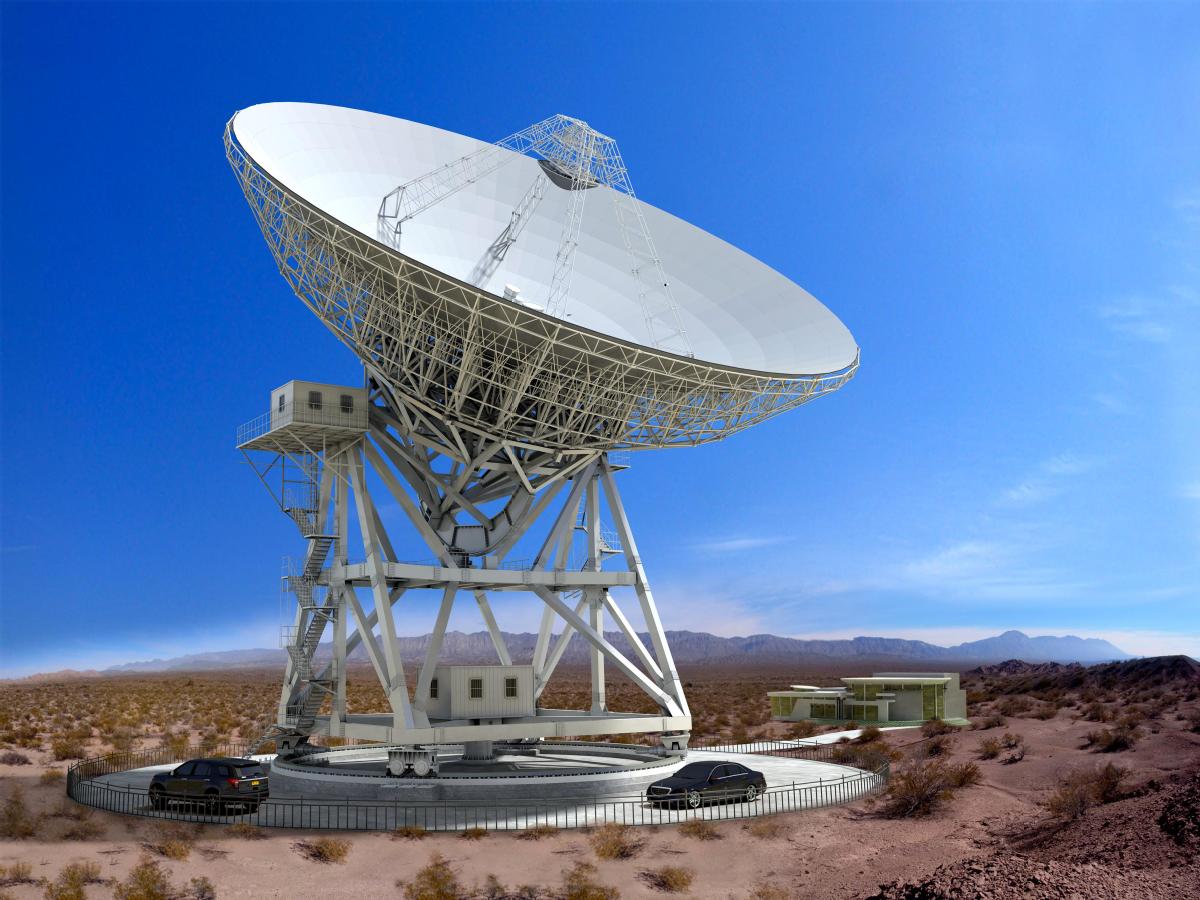
The largest single-dish radio telescope in Latin America, planned jointly by China and Argentina, will be completed by June 2020, according to the project's chief scientist, Li Jinzeng, who spoke with China Daily recently.
Called the China-Argentina Radio Telescope, or CART, it will serve as a platform for scientists to better observe celestial objects from the southern hemisphere. It can also be used to study chemical compounds in the cosmos, which might provide new insights on star formation and potential trace chemicals for the origin of life, Li said.
Weighing more than 1,200 metric tons and with a dish 40 meters in diameter, the estimated 150 million-yuan ($21.6 million) telescope will be situated west of Argentina's San Juan province near the Carlos Ulrrico Cesco Astronomical Station, one of Argentina's key astronomy complexes.
The telescope was designed for an operational life span of at least 30 years, but that can easily be prolonged through upgrades and maintenance, Li said.
CART was approved in December 2010 by the Ministry of Science and Technology as one of China's major international collaborative science projects.
"It will be China's first major astronomical facility built overseas," Li said, who is also a research professor for the National Astronomical Observatories of the Chinese Academy of Sciences.
It will be China's first large telescope in the Southern Hemisphere, which is crucial for astronomy research because the southern sky has many key research targets - for example, being able to see the center of the Milky Way and a wealth of regions where stars have been formed.
Data collected from telescopes south of the equator will be invaluable and complement those in the north, where most of the world's telescopes are located, Li said.
"China and Argentina already have a rich history of cooperation in astronomy, starting in the early 1990s," he said, noting that the two countries jointly built a satellite laser ranging system in 2006 and a fixed global positioning system station in 2011.
The CART telescope will serve as a key platform to further enhance mutual friendship, trust and science collaborations between the two countries, and help promote scientific outreach and education to residents and visitors, he added.
Because of the shortage of similar devices in Latin America, CART can be integrated with the global network of telescopes via a technique called Very Long Baseline Interferometry, and aid research in astronomy by collecting high-resolution data.
It can also be used to monitor pulsars, which are bright, superheavy remnants of massive stars that spin at a consistent rate, allowing scientists to track time with ultrahigh precision and use them as "lighthouses for future interstellar exploration," Li said.
In addition, CART can survey the night sky and find spectra - readings of light broken down into their constituent wavelengths - that can reveal the chemical makeup of matter in space.
Before the 1960s, scientists doubted complex molecules could exist in interstellar space because of intense radiation that tears chemical bonds apart. Since then, however, more than 200 chemical compounds, from ammonia to "Buckyball" - a conglomeration of 60 carbon atoms in the shape of a soccer ball - have been found in space.
"These discoveries are mind-boggling," Li said. "They might not lead to extraterrestrial life, but researching these compounds will help us have a better understanding of how interstellar matter evolves over time."
Discoveries "may not always yield immediate socioeconomic benefits, but they are crucial for mankind's journey beyond Earth and into deep space," he said.
With that in mind, Li said, both countries have been highly supportive of the project. In May last year, leaders from both countries vowed to enhance science cooperation, with CART specifically included in their joint communique issued during the Belt and Road Forum for International Cooperation.
In August, Argentina's San Juan province issued a decree promising to help build the foundation of CART, as well as to provide utilities supporting the project.
The local government committed $3 million to support the project, on top of the $1.5 million invested by the Ministry of Science, Technology and Productive Innovation of Argentina.
"CART will be a great addition to Argentina's telescope roster and beneficial to scientific research, education and even the local economy," Li said, adding that the new facility will be located within El Leoncito National Park, which will boost tourism and attract scientific talent to the region.
"Our experience in carrying out the joint project abroad and dealing with the people - from coordination with officials to securing funds - may serve as a reference for similar joint projects for China in the future," he said.










