Economic assumptions turn upside down









China Reform and Opening – Forty Years in Perspective
Economic assumptions turn upside down
Editor's note: Laurence Brahm, first came to China as a fresh university exchange student from the US in 1981 and he has spent much of the past three and a half decades living and working in the country. He has been a lawyer, a writer, and now he is Founding Director of Himalayan Consensus and a Senior International Fellow at the Center for China and Globalization.
He has captured his own story and the nation's journey in China Reform and Opening – Forty Years in Perspective. China Daily is running a series of articles every Thursday starting from May 24 that reveal the changes that have taken place in the country in the past four decades. Starting this month, China Daily will run two articles from this series each week – on Tuesday and Thursday. Keep track of the story by following us.
Lhasa, 2005: It was already 9:30 am. But the narrow whitewashed adobe alleyways of Lhasa’s old city were just beginning to awaken. That is because things start later in Lhasa.
At 3,600 meters above sea level, breathing becomes difficult. Having just arrived the night before, I still felt wheezy from the altitude, as if everything was in slow motion.
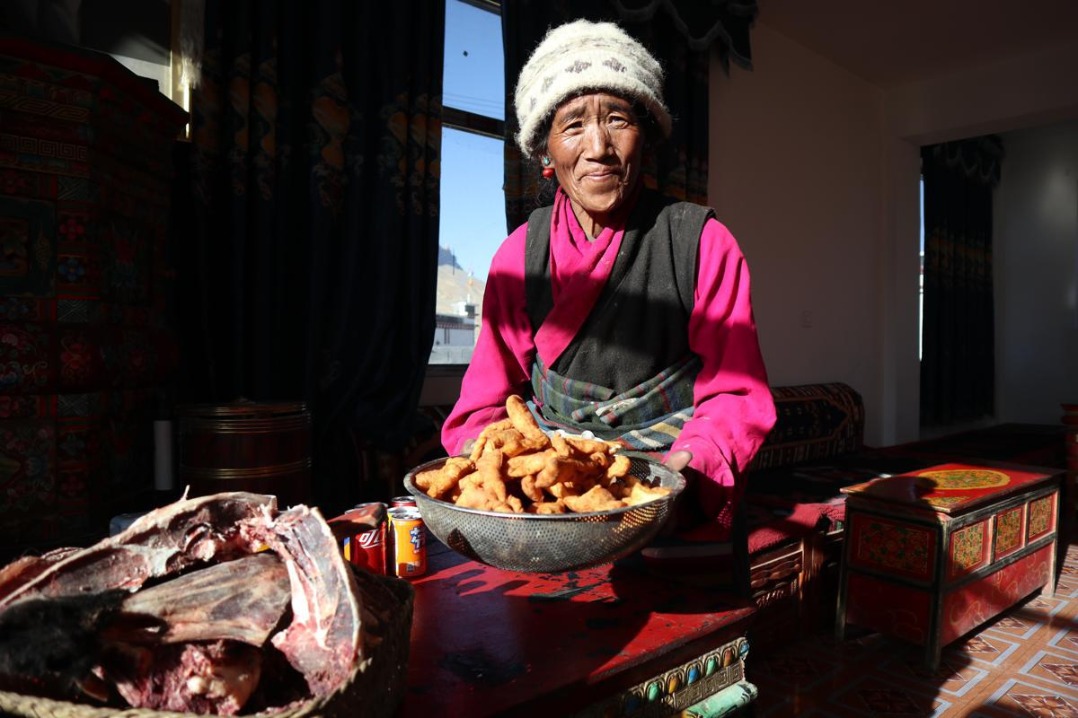
I stopped for breakfast at a food stall selling palip Tibetan flat bread. “How much for one flat bread?” I asked the woman.
“Five jiao (50 cents),” she said, smiling.
As I pulled five Chinese 10-cent coins from my pocket, three children rushed up. They tugged at my sleeves, hands held out, begging.
I handed the 50 cents to the stall lady. Smiling, she leaned over and gave each begging child one 10-cent piece. “Now go,” she told them. “Leave the foreigner alone.”
The kids ran off giggling.
I was stunned as I quickly ran the economics through my head. She had sold me Tibetan bread for 50 cents but gave most of it away to children. With only 20 cents in her hand, she was technically covering the cost of the dough and keeping the same amount she had given each child for herself.
I reflected on this simple situation. In most cities of the world, locals might easily cheat money from an unwitting newly arrived foreigner. But giving it to begging children leaving just a margin over break-even? This sudden glimpse into Tibetan thinking challenged my economic assumptions.
The year before, my second film, Shambhala Sutra, documented an expedition searching for the mythical kingdom. I had interviewed many lamas asking where Shambhala might be, or how to get there. Finally, I had been granted a rare audience with Nanqin Rinpoche, then the highest-ranking surviving tantric practitioner in Tibet. Elderly and frail, his long white beard gave him a noble look. He sat on a raised dais, wrapped in warm robes against the evening cold, in a room heaving with incense.
“Where is Shambhala?” I had asked. Knowing by then that Shambhala is more about a metaphysical state of mind than an actual place, I clumsily asked what meditation technique could zoom me there on a cloud, as if I was about to board an airplane.
With a mystic look in his eyes, he had nodded and then responded. “It is not anywhere. You cannot find it by searching. You cannot go there through meditation either. It is through compassionate action, giving to others, that we can create a better world. We can visualize the future through meditation. But without action it is useless. Only through each person’s individual action every day, bringing that vision to become reality can we arrive in Shambhala. There is no other way.”
This is when I stopped searching.
Inspired by the people I met during my three-year journey making documentaries in Tibet, I decided to create a social enterprise of my own. I gave up investment consulting altogether and closed the remaining parts of my business. I moved to Lhasa in 2005, and bought an old three-story Tibetan house.
The house was located in a narrow alleyway in the Tibetan quarter called the Barkor after the famous circumambulation route that wrapped around the central Jokhang Monastery. Every day the route was thronged with devotees from all over Tibet making it a pilgrimage route. Radiating from the market a labyrinth of alleyways connecting whitewashed stone and adobe buildings formed the old city. I found myself living in an all-Tibetan society where the rhythm of life and tradition remained more or less intact, as it may have centuries ago.
I awoke each day to the sound of prayers being chanted just outside my window. Nuns sat in groups collecting alms from passers-by. Every morning I would give change to them. “Begging” or “almsgiving” – depends how you look at it – represents another set of economic relationships. Everywhere throughout the Barkor, nuns and monks sit in groups along alleyways, chant mantra or read sutra. They receive alms from people passing by. Often it is just small change. But they need this to live on. Chanting begins early in the morning and lasts into the evening. An immediate western reaction might be to label this as “begging” which has a negative connotation. It is not begging.
The chanting represents a service, in the form of prayer. In a Tibetan context, this is a service no different than might be provided by a doctor, psychotherapist, or lawyer. Passing pedestrians are busy with their daily work. Maybe they do not have time, or they forget to say their daily mantra and prayers, which are an integral part of Tibetan life. However, by giving donations in the rush to get from one place to another, they gain the benefit of those chants and prayers being done for them along the way.
In the realm of Tibetan thought, these prayers can ward off negativity by spreading positive energy. I understood the deep religiosity of Tibetans. Living in the harsh environment of the Tibetan plateau, with its extreme weather changes, one intimately faces life and death on a daily basis. In a practical sense, protector prayers can remind one to take precautions and act in a caring and thoughtful way, thereby avoiding accidents. This is certainly more cost-effective than going to a doctor or lawyer afterwards.
Please click here to read previous articles.